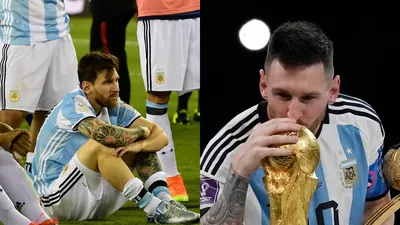
Lionel Messi retirement from international football on August 31, 2026, brings an extraordinary Argentina career to a close. For more than two decades, Messi carried the hopes of one of football’s most demanding nations, experiencing devastating defeats before eventually delivering the trophies that had once seemed impossible.
Messi’s international story is unusual because it contains two completely different endings. In 2016, a 29-year-old Messi walked away from Argentina after another painful final defeat. In 2026, he stepped away as a World Cup winner, a two-time Copa América champion, a Finalissima winner and Argentina’s most-capped player and leading scorer.
The most remarkable detail is that both retirement moments were connected to the same stadium. MetLife Stadium in New Jersey witnessed Messi’s first international goodbye in 2016 and later became the setting for the final chapter of his Argentina career.
Lionel Messi’s international career before the 2016 retirement
Messi made his Argentina senior debut in 2005 and appeared at his first World Cup in Germany in 2006. His talent was obvious from the beginning, but international success proved much harder to achieve than his club achievements with Barcelona.
By the middle of the 2010s, Messi had already established himself as one of the greatest players in football history at club level. He had won Ballon d’Or awards, domestic league titles and Champions League trophies with Barcelona.
Argentina, however, had become the unfinished part of his career.
His national team had reached the 2007 Copa América final, the 2014 World Cup final and the 2015 and 2016 Copa América finals without winning a senior major trophy during that period. The repeated failures created enormous pressure around Messi.
The 2014 World Cup defeat against Germany was followed by two consecutive Copa América final losses to Chile. The 2016 defeat was particularly difficult because Argentina lost on penalties after a goalless final, with Messi missing Argentina’s first penalty in the shootout.
Three consecutive major final defeats had turned international football into an emotional burden rather than a celebration for Messi.
Why Messi retired from Argentina in 2016
Messi announced his first international retirement in June 2016, shortly after Argentina’s Copa América defeat to Chile. At only 29, he believed he had reached the point where continuing with the national team was no longer worthwhile.
The decision shocked football supporters because Messi was still near the peak of his powers. Argentina fans and football figures strongly encouraged him to reconsider.
Within weeks, Messi changed his mind and returned to the national team.
That comeback ultimately became one of the most important moments of his career. Had Messi remained retired, the greatest chapter of his Argentina story would never have happened.
The 2018 World Cup showed that the problems were bigger than Messi
Messi’s return did not immediately transform Argentina.
At the 2018 FIFA World Cup in Russia, Argentina struggled during the group stage and eventually lost to France in the Round of 16. The tournament exposed weaknesses in the team’s structure and consistency.
Messi was still producing moments of brilliance, but Argentina lacked the balance required to compete with the strongest international teams.
This period also intensified the debate about Messi’s leadership. Critics compared his international performances with his extraordinary success at Barcelona and questioned whether he could inspire Argentina in the same way.
In hindsight, the criticism missed an important point: international football is fundamentally different from club football. A national team has limited preparation time, fewer opportunities to develop tactical relationships and much less squad depth than an elite club.
Messi did not simply need to play better. Argentina needed to become a better team.
Lionel Scaloni changed the equation
The appointment of Lionel Scaloni proved to be a major turning point.
Scaloni gradually developed an Argentina side that was not built entirely around Messi having to solve every problem. Instead, the team provided him with runners, defensive support, midfield control and attacking options.
This tactical and cultural change reduced the pressure on Messi.
He could still be Argentina’s creative leader, but he no longer had to be the team’s entire attacking system.
The emergence of players such as Ángel Di María, Rodrigo De Paul, Lautaro Martínez and other key members of the squad helped create a stronger collective identity.
The transformation was about more than tactics. Argentina became emotionally comfortable with Messi being its leader. The relationship between the player, teammates and supporters changed.
2021 Copa América ended Messi’s major-trophy wait
Argentina’s breakthrough finally arrived at the 2021 Copa América.
In the final at the Maracanã Stadium, Argentina defeated Brazil 1-0 through Ángel Di María’s goal. Messi finally had a senior international trophy with Argentina.
The significance went far beyond one medal.
For years, Messi had been judged primarily by the trophies he had not won for his country. Suddenly, that central criticism disappeared.
The victory also demonstrated how much Messi’s role had changed. He did not need to score in the final to define the tournament. His creativity, experience and influence were enough to help Argentina achieve the result.
The Copa América became the foundation for everything that followed.
The 2022 World Cup completed the story
If the 2021 Copa América removed one burden from Messi, the 2022 FIFA World Cup removed the biggest one.
Argentina entered the tournament in Qatar with high expectations, but the campaign began with a stunning 2-1 defeat against Saudi Arabia.
Instead of collapsing, Argentina responded.
The team progressed through the tournament and eventually reached the final against France. What followed became one of the most dramatic World Cup finals ever played.
Argentina and France drew 3-3 after extra time, with the match eventually decided by penalties. Argentina won the shootout and Messi finally lifted the World Cup.
Messi scored twice during the final and was central to Argentina’s attacking play throughout the tournament. He also received the Golden Ball as the tournament’s best player.
For Messi, the victory transformed the way his entire career was discussed.
The comparison with Diego Maradona had dominated conversations about Argentine football for years. After Qatar, Messi no longer needed to prove that he could win the World Cup.
Messi continued winning after the World Cup
Winning the World Cup could easily have been the natural endpoint of Messi’s international career, but he continued playing for Argentina.
In 2022, Argentina also won the Finalissima against Italy, adding another international trophy to Messi’s collection.
Then came the 2024 Copa América, where Argentina successfully defended its continental crown.
These achievements were important because they showed that Messi’s success in Qatar was not an isolated tournament. Argentina had developed into one of the strongest international teams of its era.
Messi remained influential even as he entered the later stages of his playing career. His role increasingly depended on intelligence, passing, positioning and decision-making rather than simply relying on explosive movement.
Messi’s 2026 World Cup and final international chapter
The 2026 World Cup represented a completely different challenge.
Messi entered the tournament at 39, an age when most elite footballers have already retired from international competition. Yet he remained part of Argentina’s campaign and helped the team reach the final.
Argentina ultimately lost the final 1-0 to Spain after extra time.
That defeat meant Messi did not finish his international career with another World Cup victory. However, judging his legacy through one final would miss the bigger picture.
His international career had already been transformed years earlier.
In 2016, losing a final convinced Messi that international football was no longer worth the emotional cost. In 2026, losing a World Cup final could not erase a decade of achievements.
Two retirements, one stadium and completely different emotions
The connection between Messi’s two retirements at MetLife Stadium is one of the most striking details of his career.
| Year | Moment | Messi’s position | Outcome |
|---|---|---|---|
| 2016 | Copa América final defeat | 29 years old | First international retirement |
| 2021 | Copa América victory | 34 years old | First major senior international trophy |
| 2022 | World Cup victory | 35 years old | World champion and Golden Ball winner |
| 2024 | Copa América victory | 37 years old | Second Copa América title |
| 2026 | World Cup final defeat | 39 years old | International retirement |
The contrast is extraordinary. The same venue that once symbolised disappointment became part of a career that ultimately contained almost every major international honour available to Messi.
Messi’s Argentina numbers tell only part of the story
By the end of his international career, Messi had accumulated 207 appearances, 125 goals and 65 assists for Argentina. He became the country’s most-capped player and all-time leading scorer.
His trophy collection included the 2008 Olympic gold medal, two Copa América titles, the 2022 World Cup and the Finalissima.
He also won two World Cup Golden Balls.
Those statistics establish the scale of his achievement, but numbers alone cannot explain the transformation.
The more important statistic may be the change between 2016 and 2026: Messi went from believing he had failed Argentina to becoming the central figure in one of the most successful periods in the country’s modern football history.
What made Messi’s second act so special?
The most important lesson from Messi’s Argentina career is that greatness does not always follow a straight line.
At 29, Messi appeared to have reached a dead end with his national team. At 35, he was a World Cup champion. At 39, he retired after having established a legacy that was no longer dependent on comparisons with previous Argentine legends.
His story also demonstrates the importance of environment.
Messi did not suddenly become a better footballer after 2016. Instead, Argentina became better equipped to use his abilities. Scaloni’s system gave Messi greater freedom while teammates accepted their responsibilities around him.
That distinction is often overlooked when individual players are judged in international football.
Messi vs Maradona: why the old debate has changed
For decades, the Messi-Maradona debate was inseparable from Argentina’s World Cup history. Maradona led Argentina to the 1986 World Cup title and became a national symbol.
Messi spent much of his career being asked whether he could reproduce that achievement.
After 2022, the comparison became less about who had won what and more about two different eras and styles of leadership.
Maradona remains an iconic figure in Argentine football, but Messi’s international résumé now stands on its own. His longevity, statistical output, number of major tournaments and sustained influence give his legacy a different dimension.
The debate may never disappear, but Messi no longer needs the comparison to validate his career.
The bigger impact of Lionel Messi’s retirement
Messi’s departure from international football marks the end of one of the defining individual stories of the modern game.
Argentina will eventually have to build its team without the player who has been its attacking reference point for more than 20 years. That transition will involve more than replacing goals and assists.
The next generation must also replace his experience, creativity and ability to control important moments.
For Argentina supporters, however, the biggest change is emotional. The national team no longer carries the burden of needing to win something for Messi. That chapter is finished.
The future can now belong entirely to the next generation.
Lionel Messi’s legacy goes beyond trophies
Messi’s international career cannot be reduced to his 125 goals or his collection of medals.
Its real significance lies in the transformation from disappointment to fulfillment.
He experienced four major final defeats before finally winning a senior international trophy. He retired at 29, returned, endured another difficult World Cup, helped Argentina rebuild and eventually lifted the World Cup at 35.
That journey makes his story particularly powerful because it contains something many sporting careers do not: genuine redemption.
The 2016 version of Messi could not imagine the player he would become in the next decade. The 2026 version leaves knowing that the biggest question surrounding his international career has finally been answered.
Conclusion: Messi leaves Argentina with the unfinished story completed
Lionel Messi’s retirement from international football closes a chapter that once looked destined to end in disappointment. His first goodbye came after a painful Copa América defeat, when he believed Argentina had failed him and he had failed Argentina.
His second goodbye arrives after years of success.
Between those two moments came the 2021 Copa América, the 2022 World Cup, the Finalissima, the 2024 Copa América and a collection of individual records that place Messi at the summit of Argentina’s football history.
His final World Cup ended in defeat, but that does little to alter the larger picture.
Messi did not simply finish his international career as a great player. He finished it as the player who turned his greatest weakness into one of his greatest strengths.
The boy who once left Argentina for Spain became the country’s record scorer, record appearance holder and World Cup-winning captain. And the player who once walked away from the national team with tears eventually walked away with nothing left to prove.
That is why Messi’s international story will be remembered not as a story about two retirements, but as a story about the extraordinary decade between them.
For breaking news and live news updates, like us on Facebook or follow us on Twitter and Instagram. Read more on Latest Football on thefoxdaily.com.





COMMENTS 0