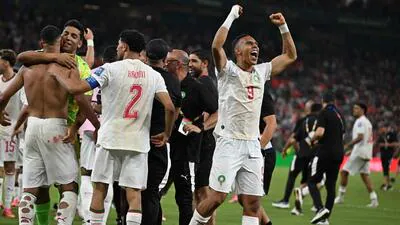
Morocco Football revolution has become one of the most fascinating stories in international football as the Atlas Lions continue proving that sustainable planning can transform a nation’s sporting identity.
Morocco’s recent World Cup success did not happen overnight. Behind the historic performances is a long-term project focused on developing young players, identifying talent across the world, improving coaching standards, and creating a system capable of competing with football’s biggest nations.
The team’s progress has changed how the football world views Morocco. Once considered an unpredictable African side, the Atlas Lions have developed into a serious global competitor with a clear pathway from youth football to the senior national team.
Morocco’s World Cup journey: From disappointment to dominance
Morocco’s transformation becomes clearer when looking at its past struggles. The national team experienced years of inconsistency, including difficulty qualifying for major tournaments.
After appearing in the 1998 FIFA World Cup, Morocco had to wait until 2018 for another appearance on football’s biggest stage. The team also missed several Africa Cup of Nations tournaments during difficult periods.
However, Moroccan football leaders recognised that short-term solutions would not be enough. A complete restructuring was needed to create a stronger football culture.
That vision eventually produced one of the biggest success stories in modern international football.
The 2009 project that changed Moroccan football forever
The foundation of Morocco’s rise was laid in 2009 with the creation of a national football academy project backed by King Mohammed VI.
The goal was simple: develop elite footballers inside a professional environment while creating a long-term pipeline for the national team.
| Area | Morocco’s Development Approach |
|---|---|
| Youth Development | Professional academy system focused on technical and physical growth |
| Scouting | Global search for Moroccan-origin talent |
| Coaching | Investment in local coaches and national teams |
| Infrastructure | Modern training and sports science facilities |
The academy model combined football training with education, allowing young players to develop both as athletes and individuals.
The facility included classrooms, study areas, medical departments and modern training resources designed to prepare players for professional football.
Why Morocco’s academy model became different from others
Many countries invest in youth academies, but Morocco’s approach focused on building an entire football ecosystem rather than simply producing individual talents.
The system was designed to connect different levels of football:
- Grassroots development
- Youth national teams
- Professional clubs
- Senior national team
This created continuity. Players moving from youth teams to senior football already understood the country’s football philosophy and expectations.
The success of this model became visible when players developed through the system started contributing on the biggest stages.
The global scouting strategy: Finding Moroccan talent worldwide
One of Morocco’s smartest moves was recognising that national talent was not limited by geography.
Millions of people with Moroccan heritage live across Europe, especially in countries with strong football systems such as France, Netherlands, Belgium, Spain and Germany.
Instead of waiting for these players to become stars elsewhere, Morocco created a scouting structure to identify and build relationships with eligible players from a young age.
The strategy focused on monitoring players with Moroccan roots before they became international options for other countries.
This approach helped Morocco attract players who had experience in some of Europe’s strongest football environments.
Foreign-born players became a strength, not a weakness
One of the biggest reasons behind Morocco’s rise has been the ability to combine local development with international experience.
| World Cup Period | Foreign-born Players in Squad |
|---|---|
| 2018 | Several players with European backgrounds |
| 2022 | Majority of squad included foreign-born talent |
| 2026 | Large percentage of squad developed outside Morocco |
The important factor was not where players were born, but whether they connected with Morocco’s football identity.
Players such as these brought European-level training, tactical knowledge and competitive experience while representing Moroccan ambition.
Morocco’s youth teams prove the system is working
The biggest evidence of Morocco’s football planning has come through youth competitions.
- The men’s team reached the semi-finals of the 2022 FIFA World Cup.
- The women’s team reached the Round of 16 at the 2023 FIFA Women’s World Cup.
- The U-17 team reached the quarter-finals of the 2023 FIFA U-17 World Cup.
- Morocco won its first FIFA U-20 World Cup title in 2025.
These results show that the success is not limited to one golden generation. Multiple age groups are producing competitive teams.
The importance of Moroccan coaches in the football structure
Another major change has been Morocco’s investment in domestic coaching talent.
Instead of depending completely on foreign managers, Morocco focused on educating and developing its own coaches.
This approach created better understanding between youth teams and the senior national side.
When Walid Regragui became head coach of the men’s national team, the move represented the success of that philosophy.
Moroccan coaches had already been involved across different age groups, creating a connected football environment.
What other football nations can learn from Morocco
Morocco’s rise offers an important lesson: success in international football requires patience.
Many teams search for immediate results by changing coaches or relying on one talented generation. Morocco instead invested over a decade into building a structure.
| Short-Term Approach | Morocco’s Long-Term Approach |
|---|---|
| Focus on immediate results | Build sustainable talent pipeline |
| Depend on individual stars | Create complete football system |
| Limited scouting | Global talent identification |
The difference is that Morocco built a machine capable of producing future teams, not just one successful squad.
Hosting the 2030 World Cup: The next major opportunity
Morocco’s future looks even more ambitious after securing the right to host the 2030 FIFA World Cup alongside Spain and Portugal.
Hosting the tournament will bring investment, infrastructure development and global attention to Moroccan football.
By 2030, the country hopes its football system will be even stronger, with better facilities, more developed players and greater international influence.
Future prediction: Can Morocco become a permanent football power?
The biggest question is whether Morocco can maintain this level of success.
The challenge for any emerging football nation is consistency. Reaching one World Cup semi-final is difficult; staying competitive for decades is even harder.
However, Morocco’s advantage is that its success is built on systems rather than luck.
With continued investment in youth development, coaching and scouting, the Atlas Lions have the foundation to remain one of football’s strongest national teams.
Conclusion: The Atlas Lions’ roar is the result of planning, not chance
Morocco’s football story proves that major sporting transformations require vision, patience and commitment.
The journey from struggling World Cup appearances to becoming global contenders was created through years of preparation, not a sudden breakthrough.
The Atlas Lions have shown that with the right structure, investment and belief, a nation can completely change its place in world football.
For breaking news and live news updates, like us on Facebook or follow us on Twitter and Instagram. Read more on Latest Sports on thefoxdaily.com.





COMMENTS 0