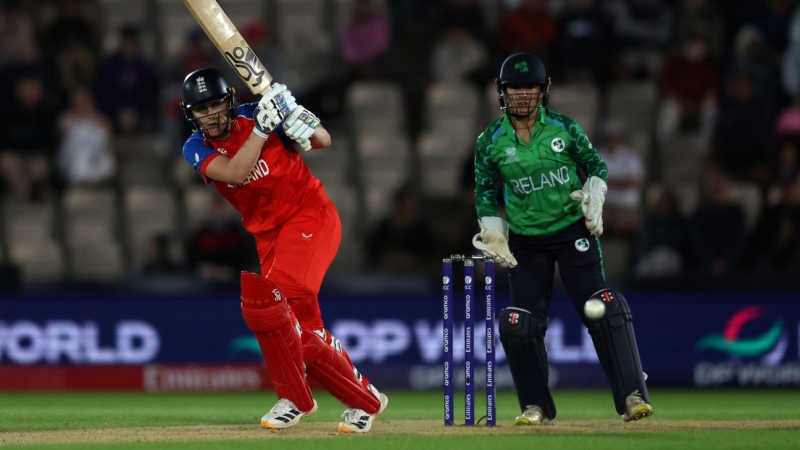
England’s hopes of maintaining momentum in the Women’s T20 World Cup 2026 have suffered a major setback after captain and star all-rounder Nat Sciver-Brunt was ruled out of the team’s next two group-stage matches due to a recurring calf injury.
Scans conducted after England’s four-wicket victory over Ireland confirmed that Sciver-Brunt had aggravated the same left calf muscle she injured earlier this summer during county cricket.
The 33-year-old retired hurt on 48 during England’s successful run chase in Southampton after experiencing discomfort while batting. Although she had returned to action before the World Cup as a specialist batter following her initial injury, the recurrence raises fresh concerns about her fitness for the remainder of the tournament.
England’s medical staff will continue to monitor her rehabilitation closely, with the team hopeful she can return for their final group-stage fixture against New Zealand at The Oval on June 27.
How Nat Sciver-Brunt’s Injury Happened
Sciver-Brunt appeared in good touch against Ireland, anchoring England’s chase with a composed and fluent innings before pulling up with tightness in her left calf.
The injury immediately raised alarm bells because it affected the same muscle that had sidelined her earlier in the season.
Recurring soft-tissue injuries are particularly challenging for elite athletes, as returning too soon can increase the risk of further setbacks.
England had carefully managed Sciver-Brunt’s workload ahead of the tournament, limiting her bowling responsibilities during warm-up matches against Australia and India.
However, the physical demands of international cricket have once again taken their toll.
Why Sciver-Brunt Is Irreplaceable for England
Few players in world cricket influence matches across all departments quite like Nat Sciver-Brunt.
As a top-order batter, reliable medium pacer and inspirational leader, she forms the backbone of England’s T20 setup.
Her ability to absorb pressure, accelerate innings and deliver crucial breakthroughs with the ball makes her one of the most complete all-rounders in the women’s game.
Beyond statistics, Sciver-Brunt provides tactical clarity and calmness during high-pressure moments—qualities that become even more valuable during major tournaments.
Her absence creates a leadership vacuum and forces England to rethink their team balance.
| Nat Sciver-Brunt’s Role | Impact on England |
|---|---|
| Top-order batter | Provides stability and acceleration |
| Medium-pace option | Adds flexibility to bowling plans |
| Captain | Leads tactics and decision-making |
| Senior player | Offers experience in pressure situations |
Charlie Dean Steps Up as Stand-In Captain
In Sciver-Brunt’s absence, spin-bowling all-rounder Charlie Dean will take over leadership duties.
Dean is not new to the role, having captained England during bilateral series against New Zealand and India earlier this year.
Her calm temperament and tactical awareness earned praise during those assignments, making her a natural choice to guide the team through this crucial phase of the tournament.
However, leading a side at a World Cup presents a different challenge altogether.
Dean must balance her responsibilities as a key spinner while ensuring England maintain their momentum in a competitive group.
England’s Group Stage Schedule Gets More Complicated
England had entered the Women’s T20 World Cup among the tournament favourites, but Sciver-Brunt’s injury adds an unexpected layer of complexity to their campaign.
The immediate concern will be navigating matches against Scotland and West Indies without their captain and premier all-rounder.
While England will likely remain favourites against Scotland, the clash with West Indies could prove significantly more demanding.
The possibility of welcoming Sciver-Brunt back for the New Zealand match offers some optimism, but England cannot afford to rush her recovery.
Securing qualification for the knockout stage without jeopardising her long-term fitness will be the team’s priority.
How England Can Adjust Without Their Captain
England possess one of the deepest squads in world cricket, but replacing a player of Sciver-Brunt’s calibre requires a collective effort rather than a like-for-like substitution.
The batting unit will need greater contributions from senior players, while England’s bowling attack may have to adapt without her overs.
Potential changes could include:
- Expanding Charlie Dean’s role as both a tactical leader and key wicket-taking option.
- Increasing responsibility on senior batters to anchor innings.
- Using specialist bowlers more strategically to compensate for the loss of Sciver-Brunt’s medium pace.
- Rotating all-rounders effectively to maintain squad balance.
England’s depth will now face its biggest test of the tournament.
The Growing Challenge of Injury Management in Women’s Cricket
Sciver-Brunt’s setback highlights an increasingly important issue in modern women’s cricket: player workload management.
The women’s calendar has expanded rapidly over the past decade, with players balancing international commitments, domestic competitions and franchise leagues.
While the growth of the sport has created new opportunities, it has also increased physical demands on players.
Soft-tissue injuries, including calf strains, hamstring issues and stress-related conditions, are becoming more common as schedules intensify.
Teams are investing more heavily in sports science, recovery programmes and workload monitoring, but finding the right balance remains a challenge.
For England, protecting Sciver-Brunt’s long-term fitness is essential—not only for this World Cup but for the future of the team.
Players Who Must Step Up for England
- Charlie Dean: The stand-in captain will be central to England’s plans with both leadership and bowling responsibilities.
- Sophia Dunkley: Her ability to provide quick starts becomes increasingly important.
- Danni Wyatt-Hodge: England will need experience at the top of the order.
- Alice Capsey: The young all-rounder may take on a larger role.
- Sophie Ecclestone: England’s premier spinner will be expected to lead the bowling attack.
What Happens Next for Nat Sciver-Brunt?
The England medical team will continue to assess Sciver-Brunt throughout her rehabilitation programme while keeping her involved with the squad.
The key objective is ensuring she returns only when fully fit, reducing the risk of further aggravation.
Calf injuries can be unpredictable, particularly when they recur within a short period.
England will likely adopt a cautious approach, recognising that a fully fit Sciver-Brunt could be the difference-maker during the knockout stages.
The coming days will determine whether she can return for the final group game against New Zealand or whether her recovery timeline needs to be extended.
Conclusion
Nat Sciver-Brunt’s injury is a significant blow to England’s Women’s T20 World Cup ambitions.
As captain, premier all-rounder and one of the world’s most influential cricketers, her absence will be felt across every aspect of the team.
However, England’s squad depth and Charlie Dean’s leadership experience offer reasons for optimism.
The next two matches will test England’s resilience and adaptability, while the medical team’s priority remains ensuring Sciver-Brunt returns only when fully recovered.
For now, England must find a way to keep their World Cup campaign on track without the player who so often holds it together.
For breaking news and live news updates, like us on Facebook or follow us on Twitter and Instagram. Read more on Latest Sports on thefoxdaily.com.






COMMENTS 0