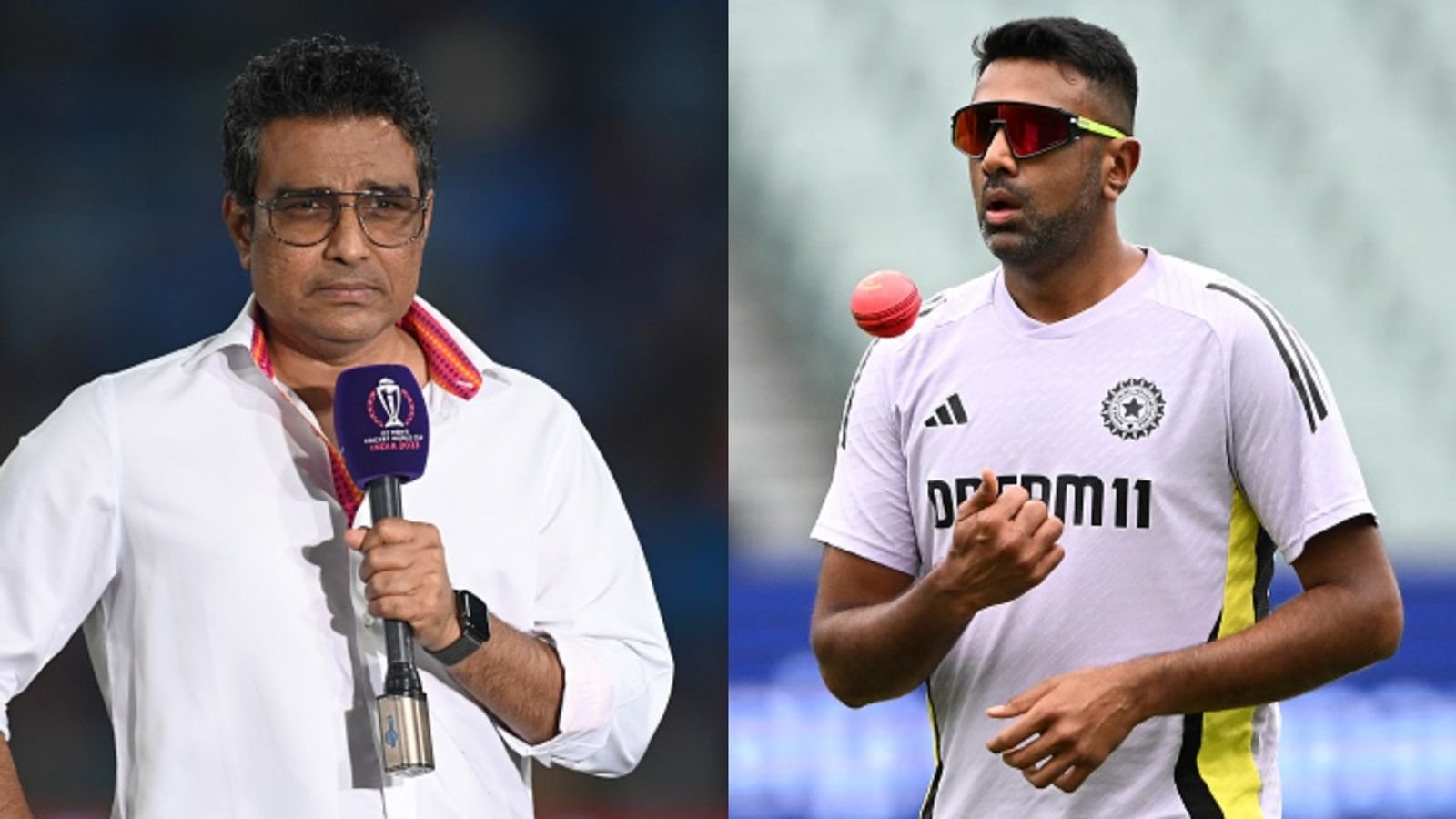
Ravichandran Ashwin has opened up about the unusual story behind his relationship with Sanjay Manjrekar, revealing that harsh criticism following his first tour of Australia left him angry and hurt enough to stop speaking to the former India batter for several years.
The incident, however, eventually became an important turning point in Ashwin’s career. What initially felt like an unfair assessment became a source of motivation as the off-spinner worked extensively on his fitness and other areas of his game before returning to Australia in 2015.
Speaking in an interaction with JioHotstar, Ashwin recalled reading a lengthy article written by Manjrekar after his maiden Australia tour. The criticism focused heavily on his fitness and suggested that it was affecting both his bowling and fielding.
Ashwin admitted that he reacted emotionally at the time. But years later, after seeing Manjrekar praise his bowling, Ashwin reached out to him and explained that the original criticism had ultimately changed his life.
What did Sanjay Manjrekar say about R Ashwin?
After Ashwin’s first Australia tour, Manjrekar wrote an article that questioned the spinner’s physical condition and its influence on his cricket.
For Ashwin, the timing and nature of the criticism made it particularly difficult to process. He was still establishing himself at international level and had just experienced the demanding conditions of an overseas Test tour.
Rather than dismissing the criticism immediately, Ashwin read the article in full while returning from Australia. He admitted that his first reaction was anger.
“After reading I got angry, getting angry is one thing, but I felt very bad.”
The criticism clearly stayed with him. Ashwin said that he did not speak much to Manjrekar anyway, but after the article he avoided interacting with him for a long period.
What makes the story remarkable is that Ashwin did not allow the criticism to remain simply a source of resentment. Instead, he eventually turned it into motivation.
Why Ashwin stopped talking to Manjrekar
Ashwin’s decision to distance himself from Manjrekar was rooted in how personally he took the criticism.
Professional athletes routinely face scrutiny, particularly at international level. However, criticism can feel different when it focuses on an area that a player already believes is a weakness.
Ashwin described himself as someone who was not naturally gifted athletically. That admission is important because it explains why fitness became such a significant part of his development.
Instead of relying purely on natural athletic ability, Ashwin recognised that physical preparation was something he could actively improve.
Over the next several years, he worked extensively on his fitness.
“The next four years, I worked a lot, as I was not a gifted athlete.”
The transformation did not happen overnight. It was a long-term process that required discipline away from the spotlight.
The criticism became a source of motivation
The most important part of Ashwin’s story is not that he was offended by the criticism. It is what he did afterward.
Rather than allowing Manjrekar’s assessment to define him, Ashwin used it as a reference point for improvement.
This is particularly significant because fitness in modern cricket affects much more than a player’s appearance or ability to run between wickets.
For a spinner, physical conditioning can influence workload, recovery, fielding ability and the capacity to maintain intensity through long spells. In Test cricket, where a bowler can be required to operate for extended periods, those factors can become decisive.
Ashwin’s development therefore illustrates a broader principle of elite sport: criticism can be useful when an athlete converts it into a measurable development goal.
Ashwin’s return to Australia changed the story
The next major chapter came in 2015.
After spending several years working on his fitness and cricket, Ashwin returned to Australia. By then, his reputation had grown considerably, and his performances had established him as one of India’s leading spin options.
Manjrekar subsequently wrote another article, this time praising Ashwin’s bowling.
The change in tone caught Ashwin’s attention.
Instead of simply enjoying the praise, Ashwin used the opportunity to contact Manjrekar directly. He asked for his number and sent him a message explaining how much the original article had influenced his development.
“Your article back then changed my life.”
That message effectively closed a chapter that had begun with anger and disappointment.
Why Ashwin’s story is bigger than one criticism
It would be easy to view the incident simply as a disagreement between a cricketer and a commentator. But Ashwin’s account reveals something more valuable about professional development.
Criticism can have two possible outcomes. It can damage confidence, or it can expose an area that an athlete needs to address.
In Ashwin’s case, the initial reaction was emotional. He felt hurt and stopped talking to Manjrekar. But with time, the criticism became actionable.
That distinction is crucial.
Ashwin did not merely attempt to prove Manjrekar wrong by continuing to bowl well. He addressed the specific area that had been questioned: his physical preparation.
The result was a more complete cricketer.
Fitness became an important part of Ashwin’s evolution
Ashwin is primarily remembered for his extraordinary achievements as a spinner, but his longevity at international level was also supported by his willingness to evolve.
Modern cricket places increasingly demanding physical requirements on players. Test bowlers, in particular, need to handle long spells, recover quickly and remain effective across multiple days.
For Ashwin, improving fitness helped remove one potential limitation from his game.
That allowed him to focus more heavily on his greatest strengths: variations, control, tactical awareness and his ability to understand batters.
The transformation also reflected Ashwin’s wider approach to cricket. Throughout his career, he has been known for constantly experimenting and searching for ways to improve.
His willingness to examine criticism rather than simply reject it fits into that broader pattern.
From being questioned to becoming one of India’s greatest spinners
The long-term outcome makes the original incident even more interesting.
Ashwin went on to establish himself as one of India’s greatest spin bowlers. His career became defined by remarkable consistency, tactical intelligence and an extraordinary ability to adapt.
He developed a large range of deliveries and became particularly effective at reading conditions and anticipating how batters would respond.
His career also demonstrated that his value extended beyond conventional expectations of an off-spinner. Ashwin contributed with the bat, improved his fielding and became an important tactical figure within India’s Test setup.
That makes the fitness criticism from his early career an interesting historical footnote. The player being questioned about his physical limitations eventually became a highly durable and influential international cricketer.
Ashwin and Manjrekar eventually repaired their relationship
The relationship between the two changed significantly by 2015.
Manjrekar’s later praise gave Ashwin an opportunity to revisit the earlier disagreement from a different perspective.
Instead of holding on to the resentment, Ashwin acknowledged the positive effect the criticism had on his career.
That is perhaps the most mature part of the story.
Ashwin did not claim that the original criticism felt good. It did not. He openly admitted that he was angry and hurt.
But he was able to separate the emotional reaction from the eventual value of the message.
That allowed the two cricketers to move beyond the incident.
R Ashwin’s transformation: Then vs. later career
| Stage | Ashwin’s situation | Impact |
|---|---|---|
| First Australia tour | Ashwin faced criticism over his fitness and its influence on his cricket. | The comments left him angry and hurt. |
| Following years | He focused heavily on physical preparation and improving his overall game. | Fitness became an important part of his development. |
| 2015 Australia return | Ashwin returned after several years of development. | Manjrekar later praised his bowling. |
| After the second article | Ashwin contacted Manjrekar directly. | The two moved beyond their earlier tension. |
| Later career | Ashwin became one of India’s leading spinners. | His long-term development validated the importance of continuous improvement. |
The lesson for athletes: criticism can become a development tool
Ashwin’s story offers a useful lesson that extends beyond cricket.
Not every criticism is correct, constructive or worth following. Athletes should not automatically accept every opinion they hear from commentators, fans or analysts.
But criticism can sometimes identify a weakness that an athlete has overlooked.
The important step is separating the delivery from the substance.
Ashwin clearly disliked how the criticism affected him emotionally. Yet instead of allowing that emotion to end the story, he eventually asked himself whether there was something useful inside the assessment.
His answer was yes.
He then worked on it for years.
That process is considerably more difficult than simply responding to criticism on social media or dismissing it as uninformed. It requires turning an uncomfortable observation into a long-term training objective.
Why the 2015 moment was a turning point
The 2015 exchange between Ashwin and Manjrekar represents more than reconciliation.
It showed that Ashwin had developed enough perspective to recognise the difference between criticism that hurts and criticism that helps.
When Manjrekar praised his bowling, Ashwin could have ignored the earlier article completely. Instead, he contacted him and explained its impact.
That decision transformed the relationship from one shaped by resentment into one based on mutual understanding.
It also gave Ashwin the opportunity to acknowledge that his response to criticism had helped him become a better cricketer.
A unique perspective on Ashwin’s career
When great players are remembered, attention usually goes to statistics, records and trophies.
Ashwin’s revelation provides a different way of looking at his career.
His development was not simply the result of natural talent. It involved identifying weaknesses, accepting uncomfortable truths and putting in years of work to address them.
The fact that he openly describes himself as not being a gifted athlete makes the story even more revealing.
It suggests that Ashwin’s success was built partly on his willingness to compensate for perceived limitations through preparation and continuous learning.
That mindset may have been one of the reasons he was able to remain effective for such a long period.
Conclusion
R Ashwin has revealed that Sanjay Manjrekar’s criticism following his first Australia tour once left him so angry and hurt that he stopped speaking to the former India batter for several years. Manjrekar’s concerns about Ashwin’s fitness, however, eventually became a powerful source of motivation.
Ashwin spent the following years working extensively on his fitness and overall game before returning to Australia in 2015. When Manjrekar later praised his bowling, Ashwin reached out and told him that the original criticism had changed his life.
The story provides a revealing insight into Ashwin’s mentality. He did not enjoy the criticism, but he ultimately extracted value from it.
That may be one of the most important lessons from his career: criticism does not have to define an athlete, but the right response to it can help transform one.
For breaking news and live news updates, like us on Facebook or follow us on Twitter and Instagram. Read more on Latest Cricket on thefoxdaily.com.





COMMENTS 0