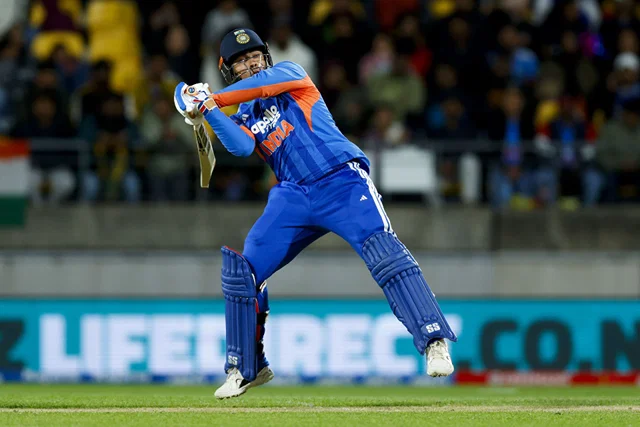
Former India batter Sanjay Manjrekar has questioned the direction of modern white-ball cricket following Vaibhav Suryavanshi’s extraordinary 53-ball double century against the United Arab Emirates (UAE) in the ACC Men’s Asia Cup Rising Stars 2026. While acknowledging the 15-year-old’s special talent, Manjrekar argued that the innings highlighted what he considers an excessive emphasis on batting at the expense of the contest between bat and ball.
Suryavanshi produced a remarkable performance in Doha on Tuesday, scoring 204 runs from just 53 deliveries during India A’s Group B encounter against the UAE. His innings included 28 sixes and seven fours, making it one of the most extraordinary individual performances in List A cricket.
The teenager reached his century in only 28 balls before continuing his aggressive approach to complete a double hundred in 52 deliveries. His performance helped India A chase down a target of 250 runs in just 14.2 overs and secure qualification for the Rising Stars Asia Cup semifinal.
However, Manjrekar believes that such extreme batting performances also raise questions about the balance of modern limited-overs cricket. In a post on X, he described the current stage of white-ball cricket as ridiculous and rejected the idea that fans necessarily want a contest dominated almost entirely by batters.
Sanjay Manjrekar questions the direction of white-ball cricket
Reacting to Suryavanshi’s record-breaking innings on his X account, Manjrekar recognised the youngster’s exceptional ability but expressed concern about what the performance represented for the sport.
“There is something special about Vaibhav, no doubt about that. But what he did is another reminder of the ridiculous stage white-ball cricket has reached. It’s a fallacy to think that this is what fans want. It’s a game of bat & ball. Not just bat.”
Manjrekar’s comments focused on the importance of maintaining a competitive relationship between batting and bowling. His argument was not that Suryavanshi lacked talent, but that the increasing dominance of batters in white-ball cricket could make the overall contest less balanced.
The former India batter’s use of the word “fallacy” challenged the assumption that spectators always prefer high-scoring matches and enormous individual totals. According to his perspective, cricket’s appeal comes from the interaction between batters and bowlers, rather than from batting entertainment alone.
Suryavanshi’s innings provided a striking example of the extraordinary scoring rates now possible in limited-overs cricket. With 28 sixes in just 53 deliveries, the teenager repeatedly cleared the boundary and put the UAE bowling attack under enormous pressure.
His performance has therefore created two different conversations: one about the achievement of a young player producing an exceptional innings and another about the broader balance of white-ball cricket.
Vaibhav Suryavanshi creates multiple List A records
Suryavanshi’s 204-run innings was not simply a high-scoring performance. It also established several significant milestones in List A cricket, particularly because of his age and the speed at which he reached the major batting landmarks.
At 15 years and 242 days, Suryavanshi became the youngest player to score a double century in List A cricket. He surpassed the previous record held by Yashasvi Jaiswal, adding another achievement to a career that has already attracted considerable attention.
His century arrived in just 28 deliveries, one ball quicker than Jake Fraser-McGurk’s List A record. The milestone demonstrated the extraordinary speed of his scoring and set the foundation for an even bigger innings.
The teenager then completed his double century in 52 balls, less than half the 103 deliveries previously required by Chad Bowes to reach the same landmark. The difference between the two records highlights the exceptional nature of Suryavanshi’s performance.
His six-hitting also produced another major milestone. Suryavanshi struck 28 sixes, surpassing D’Arcy Short’s previous List A record of 23. He also went beyond Tanmay Agarwal’s record of 26 sixes in an innings across senior professional cricket.
These achievements made the knock significant across several statistical categories. Suryavanshi combined an exceptionally fast century, a record-breaking double hundred and a new benchmark for sixes in a senior professional innings.
India A complete a remarkable chase against the UAE
Suryavanshi’s extraordinary innings helped India A secure a convincing victory in their Group B match against the UAE. Chasing a target of 250, India reached 254 for three in only 14.2 overs.
The required target was completed with considerable time remaining, largely because of the teenager’s aggressive approach. His 204 runs formed the central part of the chase and gave India A the momentum needed to finish the match comfortably.
India’s batting performance was particularly notable because the team crossed the 250-run target after losing only three wickets. The UAE bowlers struggled to contain Suryavanshi, who maintained a remarkable scoring rate throughout his stay at the crease.
His innings eventually ended when Basil Hameed dismissed him. By that stage, however, Suryavanshi had already produced a performance that transformed the match and placed several records within reach.
The victory also secured India A’s place in the semifinal of the Rising Stars Asia Cup 2026. The result gave the team an opportunity to continue its campaign after a dominant performance in the final group-stage encounter.
Suryavanshi records the highest List A strike rate in a century innings
Another remarkable feature of Suryavanshi’s innings was his strike rate of 384.90. It became the highest strike rate recorded in a List A innings featuring a century, moving ahead of AB de Villiers’ previous mark of 338.63.
The comparison highlights the extraordinary pace at which Suryavanshi scored his runs. De Villiers was widely recognised for his ability to accelerate and produce explosive innings, but the young Indian batter’s performance established a new statistical benchmark in this category.
Scoring 204 runs from 53 balls requires an exceptional combination of timing, power and consistency. Suryavanshi managed to maintain that level of aggression for long enough to reach a double century, rather than producing only a brief burst of boundaries.
His 28 sixes were particularly important to the final total. The number of maximums showed how frequently he cleared the boundary and how difficult it became for the UAE bowlers to restrict the scoring rate.
While the statistics underline the scale of his achievement, Manjrekar’s reaction suggests that the broader implications of such innings will remain a subject of discussion among cricket observers.
From two modest scores to a record-breaking double century
Suryavanshi’s performance against the UAE came after a relatively quiet beginning to his Rising Stars Asia Cup campaign. He had scored 26 against Nepal and 11 against Pakistan A in his first two matches.
Those performances meant that he had not yet produced a major innings in the tournament before the UAE encounter. His response was emphatic, as he moved from two modest scores to a double century that helped India A qualify for the semifinal.
The contrast between his earlier outings and the record-breaking knock also demonstrated how quickly a young batter can change the course of a tournament. Against the UAE, Suryavanshi found his rhythm and converted it into one of the most memorable innings of the competition.
His ability to score at such a high rate will naturally attract attention as India A progresses through the knockout stage. The challenge now will be to maintain consistency while adapting to different opponents and match situations.
Rinku Singh supports Suryavanshi with an unbeaten contribution
Although Suryavanshi dominated the scoreboard, Rinku Singh also played an important role in completing the chase. Rinku remained unbeaten on 27 and shared a 137-run partnership for the third wicket with the teenager.
The partnership helped India A maintain control of the chase and ensured that the team continued moving towards the target after the fall of wickets. Rinku’s contribution provided support at the other end while Suryavanshi continued his aggressive scoring.
The 137-run stand was an important part of India’s overall performance, even though most of the attention naturally centred on Suryavanshi’s double century. Rinku’s unbeaten finish also meant that India A reached the target with seven wickets remaining.
The combination of Suryavanshi’s extraordinary hitting and Rinku’s support helped India complete the chase in only 14.2 overs, turning the match into a dominant victory.
Youngest player to make senior India debut earlier in 2026
Suryavanshi’s latest achievement adds to an already notable year in his young career. Earlier in 2026, he became the youngest player to make his debut for the senior Indian team during the T20I series in England.
His progress from age-group and domestic cricket to international representation has made him one of the most closely watched young talents in Indian Cricket. The double century against the UAE has further strengthened that attention by demonstrating his ability to produce a major performance in a competitive tournament.
At just 15 years old, Suryavanshi has already reached milestones that many established players spend years pursuing. However, his continued development will depend on how he handles different conditions, bowling attacks and the expectations that naturally follow high-profile performances.
The attention surrounding his innings also places his achievement within a wider conversation about the changing nature of white-ball cricket. While supporters may celebrate the records and entertainment, Manjrekar’s comments raise questions about whether the balance between bat and ball is being maintained.
India A prepare for Rising Stars Asia Cup semifinal
Following their thumping victory over the UAE, India A will return to action in the semifinal of the Rising Stars Asia Cup 2026. The team is scheduled to face Sri Lanka A on Thursday, November 26.
The upcoming knockout match will provide Suryavanshi with another opportunity to continue his impressive campaign. After scoring 204 from 53 balls, expectations around his next appearance will naturally be high.
India A will also look to carry the momentum from its dominant group-stage victory into the semifinal. The team will need contributions from its wider batting and bowling units as it attempts to progress further in the tournament.
For Suryavanshi, the immediate challenge will be to approach the next match with the same confidence while responding to the different demands of knockout cricket. His performance against the UAE has already established him as one of the major talking points of the competition.
Conclusion
Vaibhav Suryavanshi’s 53-ball 204 against the UAE was a historic performance that delivered multiple List A records and helped India A qualify for the Rising Stars Asia Cup 2026 semifinal. At 15 years and 242 days, he became the youngest player to score a List A double century, while his 28 sixes and strike rate of 384.90 added further significance to the innings.
However, Sanjay Manjrekar’s reaction has brought attention to a different aspect of the performance. While he acknowledged Suryavanshi’s special talent, he argued that the increasing dominance of batters could affect the balance that makes cricket a contest between bat and ball.
As India A prepares to face Sri Lanka A on November 26, Suryavanshi will have another opportunity to make an impact. His double century has already become a major moment in the tournament, while the debate over the direction of white-ball cricket is likely to continue.
For breaking news and live news updates, like us on Facebook or follow us on Twitter and Instagram. Read more on Latest Cricket on thefoxdaily.com.






COMMENTS 0