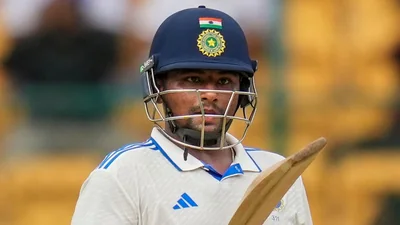
Sarfaraz Khan vs Dhruv Jurel has emerged as one of the most interesting selection battles ahead of India’s Test series in Sri Lanka. With the tour expected to feature spin-friendly conditions, former India batter Mohammad Kaif believes Sarfaraz’s ability to attack and manipulate spin gives him a strong case for a place in the middle order.
Sarfaraz has returned to India’s Test squad after a lengthy wait for another opportunity, while Jurel remains part of the team’s plans after previously receiving backing from the management. The competition between the two is therefore not simply about recent scores. It involves a larger question about what type of batter India need when conditions increasingly favour spin as a Test progresses.
Kaif’s preferred XI includes Sarfaraz at No. 5 or No. 6, although he acknowledged that India could still choose Jurel because of the trust already invested in the wicketkeeper-batter.
That distinction is crucial. The selection debate is not necessarily about whether Jurel is a better or worse cricketer than Sarfaraz. It is about which player gives India the most suitable combination for Sri Lankan conditions.
Why Sarfaraz Khan Has Entered the Selection Debate
Sarfaraz’s strongest argument is his ability to score against spin without relying exclusively on conventional defensive batting.
His Test career has already provided evidence that he can be aggressive against turning bowling. His century against New Zealand stood out during a difficult series for India’s batting unit, where opposition spinners created sustained problems for several of India’s established batters.
That performance has become particularly relevant because Sri Lanka could offer another environment in which reading the ball early, using the crease and rotating the strike become essential.
In such conditions, a middle-order batter who can score quickly against spin can change the shape of an innings.
Instead of allowing a spinner to bowl long, economical spells, an aggressive batter can force changes in field placements and bowling plans. That can create scoring opportunities for the batters at the other end as well.
Mohammad Kaif’s Best XI Includes Sarfaraz
Kaif has made his preference clear.
He believes Sarfaraz deserves a place in India’s best XI because of his ability to handle spin at No. 5 or No. 6.
However, Kaif also recognised the selection logic that could favour Jurel. India have previously backed Jurel, and team management may prefer continuity rather than immediately changing a player who has already been integrated into the Test setup.
This creates two different selection philosophies.
- Continuity: Continue backing Jurel because he has already been part of the Test setup.
- Conditions-based selection: Pick Sarfaraz because his skill set appears particularly suited to spin-heavy conditions.
The choice could ultimately depend on how the selectors assess the pitch and the balance of the XI.
Why Sri Lankan Conditions Could Favour Sarfaraz
Test cricket in Sri Lanka can become increasingly demanding for batters as matches progress.
As the surface wears, spinners can extract more turn and variation. Footwork becomes increasingly important, and batters who can use different scoring options have an advantage.
This is where Sarfaraz’s style becomes particularly interesting.
He is comfortable using sweeps and reverse sweeps, can attack from the back foot and is capable of hitting into areas that traditional defensive batters may struggle to access.
For a team trying to maintain scoring momentum against spin, those skills can be extremely valuable.
The challenge, however, is that attacking spin in Test cricket always involves risk. Sarfaraz’s aggressive approach can create scoring opportunities, but it can also expose him to mistakes if the bowler consistently changes pace, flight and line.
India will therefore need to decide whether the potential reward outweighs the risk.
Sarfaraz’s Spin Game Could Be a Tactical Weapon
The biggest advantage of Sarfaraz’s inclusion would not necessarily be his ability to hit boundaries.
It would be his capacity to change the way spinners operate.
A batter who repeatedly uses the sweep can force a captain to move fielders from conventional catching positions. A batter who attacks the off-side can prevent a spinner from bowling comfortably outside off stump. A player willing to move around the crease can also make it harder for the bowler to settle into a predictable rhythm.
That can benefit the entire batting unit.
If Sarfaraz can keep the scoreboard moving, India’s top-order batters may face fewer periods of sustained pressure when the ball is turning sharply.
Dhruv Jurel Has a Different Value
While Kaif has backed Sarfaraz, Jurel’s case cannot be dismissed simply because his recent batting numbers have not been overwhelming.
Jurel offers India wicketkeeping depth as well as middle-order batting. That dual role can influence team balance significantly.
If the management considers Jurel the primary wicketkeeper for the series, selecting him can allow India to maintain a more established combination behind the stumps while still having a batter capable of contributing runs.
His previous opportunities have also created a degree of trust.
That is an important factor in international selection. Teams do not always select players purely according to the most recent scorecard. They also consider technical development, role clarity, fielding, wicketkeeping, temperament and how a player fits into the wider squad.
Kaif Questions Jurel’s Recent Form
Kaif’s argument for Sarfaraz becomes stronger because he believes Jurel’s recent Test form has not been convincing enough to make his selection automatic.
Jurel has scored 478 runs in 10 Tests, but Kaif pointed to a lack of substantial contributions in recent outings.
That is where the selection debate becomes more complicated.
A player can have the confidence of the management while simultaneously being vulnerable to competition from another player with a more specialised skill set.
Jurel therefore has an opportunity to change the conversation with his performances, particularly if he can demonstrate that he has developed greater consistency in the middle order.
Sarfaraz Khan vs Dhruv Jurel: Skill Comparison
| Factor | Sarfaraz Khan | Dhruv Jurel |
|---|---|---|
| Primary strength | Aggressive middle-order batting against spin | Wicketkeeping plus middle-order batting |
| Spin game | Strong range of attacking options | Capable of playing spin but under selection pressure |
| Role | No. 5 or No. 6 option | Wicketkeeper-batter option |
| Selection argument | Conditions and attacking ability | Continuity and previous backing |
| Main question | Can aggressive batting be controlled in Tests? | Can he produce more consistent runs? |
India’s Selection Problem Is Bigger Than One Player
The Sarfaraz-Jurel debate highlights a broader issue facing India’s Test team: balancing specialist skills with overall team structure.
Modern Test cricket increasingly demands players who can contribute in multiple ways, but that does not mean specialist skills have become less valuable.
In Sri Lanka, India’s selectors could prioritise players who are particularly comfortable against spin. If the pitch turns significantly, that could influence the balance of the middle order.
But if the surface remains relatively good for batting, the value of selecting a player purely for spin expertise may decrease.
This is why the toss and pitch assessment could become important to the final XI.
Why No. 5 or No. 6 Is So Important
The position where Kaif wants Sarfaraz is also significant.
No. 5 and No. 6 are often the positions where a Test team’s strategy changes depending on match situation.
If the top order has performed well, the middle order may be expected to accelerate the scoring rate. If India lose early wickets, the same batter may need to rebuild the innings patiently.
Sarfaraz’s adaptability against spin could therefore be tested in very different circumstances.
He may have to attack a tired bowling attack late in the day, or he could be asked to survive when India are three or four wickets down.
That versatility will ultimately determine whether his spin-playing strength translates into consistent Test success.
The Fourth and Fifth Day Could Be Sarfaraz’s Opportunity
Kaif specifically highlighted the later stages of a Test match.
As the pitch deteriorates, scoring against spin can become more difficult. The ball can grip, bounce unpredictably and turn sharply.
A batter who has several scoring options can potentially prevent the bowling side from dictating every passage of play.
Sweeps and reverse sweeps are particularly useful because they allow the batter to challenge conventional spin fields.
However, the key is execution. Shot selection must be precise because a mistimed attacking shot on a turning surface can quickly become a match-changing dismissal.
Unique Insight: India May Need a Batter Who Can Attack the Problem, Not Just Survive It
The most interesting argument for Sarfaraz is not simply that he plays spin well.
It is that he may offer India a different solution to a familiar Test problem.
When teams face high-quality spin, the instinct is often to survive long periods and wait for scoring opportunities. But modern Test cricket has shown that passive survival can allow bowlers to build pressure.
A batter capable of disrupting that rhythm can sometimes be more valuable than one who simply accumulates defensive deliveries.
Sarfaraz’s style potentially gives India that alternative.
The risk is obvious, but so is the upside.
What Could Decide the Sarfaraz vs Jurel Battle?
Several factors could ultimately determine the selection.
- Pitch conditions: A turning surface would strengthen Sarfaraz’s case.
- Wicketkeeping plans: If Jurel is preferred behind the stumps, his overall value increases.
- Recent form: The management may weigh performances from training and warm-up matches.
- Team balance: India must decide whether they need another specialist batter or a wicketkeeper-batter.
- Opposition bowling: The quality and style of Sri Lanka’s spin attack could influence the final decision.
Why Continuity Could Still Keep Jurel Ahead
Despite Kaif’s preference, Jurel should not be considered out of the race.
International teams often value continuity because players become familiar with tactical plans, combinations and expectations.
Jurel has already experienced the demands of Test cricket with India, and that experience can matter when conditions become difficult.
Selectors could also believe that his recent struggles are temporary and that continued backing will eventually produce consistency.
That is a perfectly reasonable selection strategy, particularly if the management sees Jurel as an important long-term option.
Why Sarfaraz’s Return Is Significant
For Sarfaraz, simply returning to the Test squad is an important development.
His selection means the management still sees a role for his particular batting profile.
But being included in the squad and being selected in the XI are two different achievements.
He now needs to turn his opportunity into a compelling selection case.
If he gets the chance and produces a substantial innings against Sri Lanka’s spinners, the debate could quickly shift in his favour.
What India Should Prioritise in Sri Lanka
India’s selection should ultimately be based on the combination that gives them the best chance of winning the Test, rather than simply rewarding reputation or recent history.
If the conditions are expected to be heavily spin-friendly, Sarfaraz’s skill set deserves serious consideration.
If India require a wicketkeeper-batter combination and believe Jurel can deliver greater stability, the balance could move in his direction.
The ideal decision may not be the one that produces the most impressive-looking batting order on paper. It will be the combination that solves the specific problems presented by the opposition and surface.
Conclusion
Sarfaraz Khan vs Dhruv Jurel is shaping up as a fascinating selection battle ahead of India’s Tests in Sri Lanka.
Mohammad Kaif has made his preference clear: if he were selecting India’s best XI, Sarfaraz would make the team because of his strong ability against spin and his wide range of scoring options.
Jurel, however, still has a strong case because of his previous backing, wicketkeeping value and experience within the current setup.
The final decision could depend heavily on the conditions in Sri Lanka. A sharply turning pitch would make Sarfaraz’s ability to sweep, attack and manipulate the field particularly valuable. A more balanced surface could make continuity and team combination more important.
Ultimately, the selection battle represents a bigger question for India: should the team choose the player who has already earned the management’s trust, or the player whose specific skill set appears best suited to the challenge ahead?
For Kaif, the answer is Sarfaraz. For India’s selectors, the final call will come down to team balance, conditions and the belief that one player can turn a difficult spin challenge into an advantage.
For breaking news and live news updates, like us on Facebook or follow us on Twitter and Instagram. Read more on Latest Cricket on thefoxdaily.com.






COMMENTS 0