The Return Nobody Was Quite Expecting
When Serena Williams walked off the court at Flushing Meadows in 2022 following a third-round loss to Ajla Tomljanovic, the occasion was understood, by Williams herself and by everyone watching, as the end. A career that had begun in 1995 when she was 14 years old, that had accumulated 23 women’s singles Grand Slam titles and 16 doubles Grand Slams, that had redefined the possibilities of women’s tennis across three decades, was over. The tears, the tributes, and the outpouring of affection from the tennis world all suggested permanence.
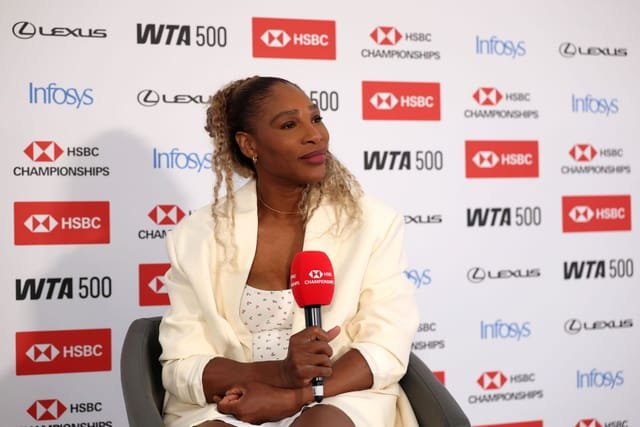
Four years later, Serena Williams is back. Not in the way that her 2022 farewell implied was impossible, but back nevertheless: competing in the women’s doubles event at the Queen’s Club Championships in London, partnered with Victoria Mboko, and standing at a press conference at the HSBC Championships answering questions about whether the singles game might follow the doubles return.
Her answer was careful, honest, and characteristic of the woman who has consistently refused to be confined by other people’s narratives of her career: “For singles, I can’t say yes, I can’t say no. Right now, no.” It is not a door slammed shut. It is not a door propped open as an invitation. It is the response of a 44-year-old woman who has nothing to prove and is taking this journey one step at a time, on her own terms, for her own reasons.
Who is returning? Serena Williams, 44, one of the greatest athletes in the history of professional sport. What format? Women’s doubles at the Queen’s Club Championships. When does she play? Tuesday, June 9, in the opening round. Where? Queen’s Club, London. Why is the singles question relevant? Because Serena’s career was built on singles, and any discussion of what this return means inevitably circles back to whether the format that defined her legacy will be part of it.
A Career That Defies Easy Summary
Placing Serena Williams’s return in proper context requires acknowledging what came before it, and the challenge in that acknowledgment is that the scale of her career resists the kind of quick summary that sports journalism typically employs.
Her first professional appearance came in 1995, when she was 14 years old and the professional women’s tour was occupied by players who were about to be systematically overtaken by herself and her sister Venus Williams. Over the following three decades, she won 23 women’s singles Grand Slam titles, a record in the Open Era at the time of her 2022 retirement, achieved across Australian Opens, French Opens, Wimbledons, and US Opens spanning from 1999 to 2017. Her 16 doubles Grand Slams, won primarily with Venus, add a further dimension to a career that combined individual brilliance with one of professional sport’s most compelling sibling partnerships.
She reached a world number one ranking that she held for a total of 319 weeks across her career. She won Olympic gold medals. She came back from childbirth complications that were life-threatening, returned to tennis, and competed at the highest levels of the sport while being a mother. She conducted all of this while being one of the most scrutinized, criticized, and celebrated figures in professional sport’s modern history.
The 2022 US Open farewell seemed to close this chapter permanently. The fact that she is now opening a new one, in doubles, in London, at 44 years old, is not the predictable next act of a career that had followed a conventional arc. It is something more interesting and more personal than that.
The Singles Question: What Williams Actually Said
The question of whether this comeback extends to singles competition was inevitable, and Williams addressed it directly at her press conference at the HSBC Championships:
“For singles, I can’t say yes, I can’t say no. Right now, no. I feel like I probably need to train a little bit more if I want to play singles. We’ll see if I get there, and if not, that’s not my journey right now.”
— Serena Williams
The answer contains several distinct elements worth unpacking.
First, the honest acknowledgment of current fitness: “I probably need to train a little bit more if I want to play singles.” This is a pragmatic assessment of the difference between the physical demands of doubles and singles at professional level. In doubles, the court coverage requirements are shared, the rallies are often shorter, and the serve-and-volley patterns that grass-court doubles particularly favor allow a player to function effectively at a level of fitness and mobility that might not sustain a full singles match against current tour players ranked in the top hundred. Singles requires full court coverage, sustained baseline rallying, and the physical endurance to compete through best-of-three sets against an opponent who has been training specifically for that format. Williams is acknowledging that she is not there yet and might not get there.
Second, the conditional language: “We’ll see if I get there.” This is not the closed door that a straightforward “no” would represent. Williams is leaving the possibility open while being clear about what it would require. If the training comes together, if the physical preparation reaches the necessary level, the option exists. She is not promising anything. She is also not ruling anything out.
Third, and perhaps most importantly: “If not, that’s not my journey right now.” This phrase locates the return within a specific personal narrative rather than a competitive agenda. Williams is not returning to prove something, to reclaim a ranking, or to chase a record. She is returning because the opportunity is there, because her children will see her play, and because the experience itself has value that is not measured in results.
The Last Singles Match: Looking Back to 2022
The most recent data point on Williams’s singles ability is now four years old, but it is worth reviewing what she showed at the 2022 US Open before the eventual farewell.
In her opening match, she defeated Danka Kovinic. In the second round, she overcame Anett Kontaveit, who was ranked world number two at the time. The Kontaveit victory was a genuine statement of competitive intent from a player who had suggested the career was winding down: beating a top-five player in a Grand Slam requires real quality, regardless of age or circumstances. Williams then fell to Ajla Tomljanovic in the third round, and that loss marked the end of her singles career.
Two wins, including one against a top-five player, in her final tournament, at a point when she had been making noise about retirement for some time. The performance level was not the Serena of peak dominance. But it demonstrated that at 40, on the back of a long competitive layoff and in the context of a deliberate farewell, she could still function at a level that tested quality players across multiple sets.
What that 2022 performance translates to at 44, after a further four years away from singles competition, is genuinely unknown. The gap between 40 and 44 in terms of athletic performance is significant in any sport, and Williams herself has implicitly acknowledged this by noting the additional training singles would require.
The Philosophy Behind the Return: Nothing to Prove, Everything to Gain
Williams’s most illuminating comments about this comeback were not about the singles question but about the deeper philosophy that is driving the return:
“I don’t need to win. I’ve won more than most people have in their whole lives. For me, that is not important to me. And it’s important that I keep reminding myself of that because I don’t have anything to prove. I don’t have anything to lose. Everything here is just to gain. It’s really about my kids getting to see me play. I mean, Olympia is a little bit older, Adira is very young, but it’s also having an opportunity to still be able to possibly do that one last time is kind of cool and exciting.”
— Serena Williams
This statement is one of the more honest and grounded things a great champion has said about a late-career return in recent sporting history. The acknowledgment that she “doesn’t need to win” is not false modesty from someone who has spent her career wanting to win more than almost anything else. It is a genuine recalibration of what success means at 44, with the competitive career effectively concluded, with two children who are at ages where their mother’s sporting life will form part of their early memories.
Olympia, Williams’s elder daughter, was born in 2017 and is old enough to understand and appreciate what her mother’s return to professional tennis represents. Adira, the younger daughter, will experience the return primarily through the energy and presence of it rather than the analytical understanding of what she is watching. Williams is doing this partly for them, to give them the experience of seeing their mother compete, and the warmth of that motivation runs through the press conference comments in a way that is immediately affecting.
“Everything here is just to gain” is a remarkable statement from someone who has accumulated as much as Williams has. It reflects the perspective shift that comes with having won what she has won: the pressure of expectation and the fear of failure, which have been central to competitive motivation for most of her career, have been replaced by something lighter and more present-tense. She is here because it is wonderful to still be here, doing this, rather than because the results require it.
The Doubles Match: Williams and Mboko vs Routliffe and Melichar-Martinez
The immediate practicalities of the comeback begin on Tuesday, June 9, when Williams and her partner Victoria Mboko face the team of Erin Routliffe and Nicole Melichar-Martinez in the opening round of the women’s doubles at the Queen’s Club Championships.
The pairing of Williams with Mboko is an interesting combination: a 44-year-old legend of the sport partnered with a player whose career is building rather than concluding. The dynamic of experience and youth in a doubles partnership, when it functions well, can produce complementary strengths that neither player could generate alone. Williams brings court presence, serve quality, and the psychological weight of her reputation. Mboko brings the mobility and energy of an active professional career.
Whether the partnership translates into results at professional level is the question that Tuesday will begin to answer. Routliffe and Melichar-Martinez are an established doubles pairing with competitive records that make the first-round match a genuine test rather than a routine opening. The draw will tell Williams quickly whether this return is competitive by the standards of current professional doubles or whether it is primarily experiential.
Conclusion: The Greatest on Her Own Terms
Serena Williams at 44, returning to professional tennis for women’s doubles at Queen’s Club, speaking honestly about singles possibilities without committing to them, and grounding the entire project in the experience of her children seeing her compete: this is a sporting return of a kind that resists easy categorization.
It is not a competitive comeback in the classic sense, not a return aimed at reclaiming rankings or titles or records. It is something more personal and more honest: a woman who gave decades to a sport, who achieved more in it than almost any athlete in any sport, choosing to spend a little more time in an environment that shaped her life and that her family has not yet had the chance to share with her fully.
“That’s not my journey right now” is Williams’s answer to the singles question, and it applies equally to the entire frame of competitive pressure and external expectation that her career has carried for thirty years. The journey right now is different. It is about the kids seeing her play. It is about the experience of still being able to do it. It is about the joy of the game, detached from the obligation to win it.
Twenty-three Grand Slam singles titles. Sixteen doubles titles. A career that started in 1995 and is, apparently, not quite done yet. Whatever happens at Queen’s Club on Tuesday, and whatever happens with the singles question over the weeks and months that follow, Serena Williams remains one of the most compelling figures professional sport has ever produced.
Right now, no to singles. Right now, yes to doubles. Right now, everything here is just to gain. That is a philosophy most athletes would do well to find, and Williams has found it at the age of 44, on her own terms, in the way she has always done everything.
For breaking news and live news updates, like us on Facebook or follow us on Twitter and Instagram. Read more on Latest Sports on thefoxdaily.com.






COMMENTS 0