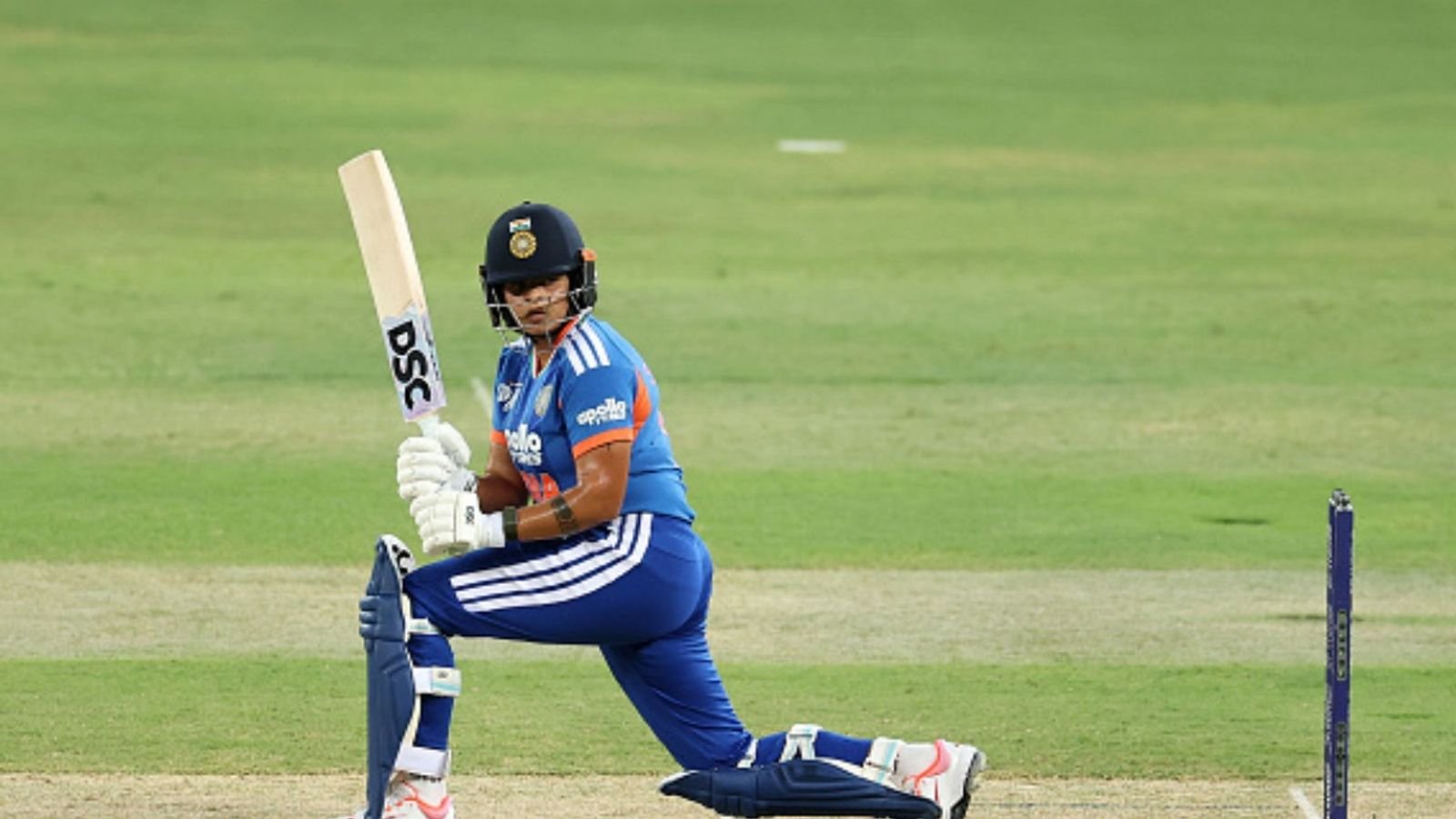
Shafali Verma 3,000 T20I runs marks another major milestone in the Indian opener’s rapidly developing international career. The 22-year-old reached the landmark during India’s Womenâs Asia Cup 2026 Group A match against Pakistan at the Dubai International Cricket Stadium.
Verma needed only seven runs when she walked out to bat, and she completed the milestone with the aggressive strokeplay that has become a defining feature of her game. The achievement made her the youngest woman to reach 3,000 runs in Women’s T20I cricket.
The record is significant because reaching 3,000 runs requires not just natural attacking ability but also sustained international longevity. Verma made her T20I debut as a 15-year-old in 2019, meaning she has reached the landmark after several years of playing at the highest level.
Shafali Verma creates history at 22
Verma reached 3,000 Women’s T20I runs at exactly 22 years and 220 days old. That age puts her ahead of Ireland’s Gaby Lewis, who previously held the record for being the youngest woman to reach the milestone.
Lewis had achieved the feat at 24 years and 347 days. Verma therefore lowered the age benchmark by more than two years, underlining just how quickly her international career has progressed.
The record is particularly impressive considering that T20 cricket demands regular high-impact performances. Batters often have limited time to settle before they are expected to score quickly, making consistency across hundreds of international appearances and innings difficult.
Verma is also the fastest to the 3,000-run mark
The Indian opener did not stop with the age record. She also became the fastest woman to score 3,000 runs in Women’s T20Is in terms of balls faced.
Verma reached the milestone after facing 2,182 deliveries. That figure reflects her aggressive approach and ability to score at a high rate throughout her T20I career.
Her batting style has always been built around attacking the bowling early. Rather than spending a long period simply accumulating runs, Verma has developed a reputation for putting pressure on bowlers from the beginning of an innings.
That approach carries risk, but when executed successfully it can dramatically change the momentum of a T20 match.
Only the 16th woman to enter the 3,000-run club
Verma has now joined an exclusive group of women’s international cricketers. She is the 16th woman overall to reach 3,000 T20I runs.
The milestone also makes her only the third Indian woman to enter the club. She follows two established stars of Indian cricket, Smriti Mandhana and Harmanpreet Kaur.
That places Verma alongside some of the most important batting figures in the history of India’s women’s T20I team.
For Indian cricket, the achievement also demonstrates the depth of batting talent that has developed over the past decade. Mandhana and Harmanpreet helped establish India as a major force in the women’s game, while Verma represents another generation continuing that progress.
How Verma’s career developed from a teenage debut
Verma’s journey to 3,000 T20I runs began when she made her international debut in 2019 at just 15 years old.
Entering senior international cricket at such a young age meant facing experienced bowlers and high-pressure situations almost immediately. Yet her attacking instincts allowed her to make an impact and establish herself as an important opening option for India.
Over time, the challenge was no longer simply about showing that she could hit the ball hard. She had to develop consistency, understand different match situations and adapt to opponents who had studied her strengths.
Reaching 3,000 runs shows that her development has extended beyond early promise. She has converted that promise into sustained international production.
Why the 3,000-run milestone matters in T20 cricket
Three thousand runs is an important benchmark in T20I cricket because the format provides relatively few deliveries for batters to influence a match.
Unlike longer formats, T20 innings are built around urgency. Players need to score quickly while managing the risk of dismissal. An international batter must therefore combine attacking ability with enough consistency to contribute across multiple seasons.
Verma’s milestone reflects both sides of that equation. Her aggressive batting has made her a dangerous powerplay option, while her accumulated runs demonstrate that she has been able to sustain that approach at international level.
The balls-faced record adds another layer to the achievement because it highlights the speed at which she has accumulated those runs.
India’s dominant win over Pakistan adds to the occasion
The record came during a one-sided Women’s Asia Cup contest between India and Pakistan.
India’s bowlers restricted Pakistan to just 55 runs, creating a straightforward chase for the Women in Blue. Verma entered the innings knowing that only seven runs separated her from the historic milestone.
She reached the landmark early in the chase, giving the match an additional individual highlight before India completed a seven-wicket victory.
The result also strengthened India’s campaign in the tournament and demonstrated the difference between the two sides on the day.
Verma’s aggressive style makes the record even more notable
One reason Verma’s record attracts attention is the contrast between the speed of the achievement and the traditional demands of consistency.
Her natural game is aggressive. She looks to attack bowlers rather than allowing them to dictate the tempo. In T20 cricket, that approach can create rapid scoring opportunities, especially during the powerplay.
However, aggressive batting can also produce periods of inconsistency. The ability to continue scoring international runs while maintaining an attacking mindset is therefore an important part of Verma’s development.
The 3,000-run milestone suggests that her impact has extended well beyond isolated explosive innings.
Verma’s record changes the conversation around India’s opening options
India’s women’s team has increasingly benefited from a strong group of top-order batters. Verma’s record provides another indication of the quality available at the top of the order.
Her role is particularly valuable because opening batters can influence the game before the middle order has even arrived at the crease.
A successful powerplay can provide the foundation for a large total, while an aggressive chase can remove pressure from the rest of the batting lineup.
Verma’s ability to attack early therefore has strategic value beyond her personal statistics.
Shafali Verma’s record compared with the previous benchmark
| Record | Shafali Verma | Previous Benchmark |
|---|---|---|
| Age at 3,000 T20I runs | 22 years, 220 days | Gaby Lewis – 24 years, 347 days |
| Balls faced to 3,000 runs | 2,182 balls | Previous record held by Alyssa Healy |
| Overall position | 16th woman to reach 3,000 T20I runs | Elite T20I run-scorers |
| India’s position | Third Indian woman to reach the mark | After Smriti Mandhana and Harmanpreet Kaur |
| International debut | 2019, aged 15 | — |
What the record says about Verma’s future
At 22, Verma has already reached a statistical milestone that many international players never achieve. That naturally raises the possibility of her becoming one of the defining run-scorers of women’s T20I cricket over the coming years.
However, the next challenge is maintaining the same level of performance. Reaching 3,000 runs is a milestone, but the period that follows will determine how high Verma can ultimately climb on the all-time run-scoring charts.
Her age gives her considerable time to add to the tally, provided she remains fit, consistent and an important part of India’s plans.
Her experience also means that opponents will continue developing strategies specifically designed to limit her attacking impact. Responding to those tactical changes will be an important part of her evolution as an international batter.
Why her early start matters
Verma’s record cannot be separated from the unusual beginning of her international career. She entered the Indian team as a teenager and had to learn the demands of international cricket while still developing as a young player.
That early exposure provided valuable experience against high-quality opposition. It also meant that the expectations around her grew quickly.
Reaching 3,000 runs at 22 shows how effectively she has converted those years of exposure into measurable results.
Her journey also illustrates how the growth of Womenâs Cricket has created opportunities for talented young players to enter international competition much earlier than previous generations.
The bigger picture for Indian women’s cricket
Verma’s achievement is another positive milestone for Indian women’s cricket, which has developed a growing group of internationally recognised players.
Mandhana and Harmanpreet have already established themselves as major figures, and Verma’s entry into the same statistical club adds another prominent name to India’s T20I batting history.
These individual milestones can also strengthen the broader profile of the women’s game. Records provide measurable evidence of long-term development and give younger players visible examples of what is possible at international level.
Can Verma become one of India’s greatest T20I run-scorers?
The answer will depend on what comes next. At 22, Verma has already reached 3,000 runs, leaving her with a substantial portion of her career still ahead of her.
If she continues to occupy an important position at the top of India’s batting order, her tally could rise significantly over time.
The most important factor will be consistency. T20 cricket rewards aggression, but the best long-term players learn how to combine attacking intent with match awareness.
Verma’s continued development in that area could determine whether this record becomes simply one remarkable achievement or the beginning of a much larger statistical legacy.
Conclusion: Shafali Verma enters the record books again
Shafali Verma 3,000 T20I runs is a milestone that captures the extraordinary speed of her international rise. At 22 years and 220 days, she has become the youngest woman to reach the mark and has also set a new benchmark for reaching 3,000 runs in the fewest balls faced.
Her achievement came during India’s dominant seven-wicket victory over Pakistan at the Women’s Asia Cup 2026, making an already significant team performance even more memorable.
As the third Indian woman to enter the 3,000-run club after Smriti Mandhana and Harmanpreet Kaur, Verma has now added her name to an exclusive part of India’s cricket history.
The most intriguing part of the story, however, is that she has reached this stage at only 22. Her record-breaking journey is still developing, and the next phase of her career could determine just how high she eventually climbs among the great run-scorers of women’s T20I cricket.
For breaking news and live news updates, like us on Facebook or follow us on Twitter and Instagram. Read more on Latest Cricket on thefoxdaily.com.






COMMENTS 0