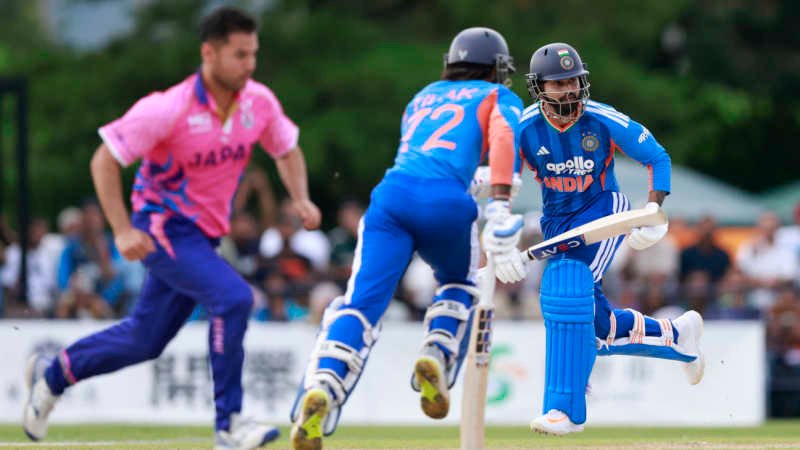
India captain Shreyas Iyer praised Japan’s outstanding performance after a difficult five-over contest ended with India escaping by just two runs in Sano.
India captain Shreyas Iyer had plenty of praise for Japan after India survived a dramatic two-run victory in the rain-shortened T20I at Sano International Cricket Ground on September 22, 2026. What was expected to be a straightforward contest turned into a tense five-over shootout after the wet outfield reduced the match.
India managed only 32 for 4 from their five overs, with Iyer’s 16 off 12 balls emerging as the innings’ most important contribution. Japan then pushed India all the way during the chase before finishing on 30 for 3.
The unusual conditions played a major role. The pitch offered significant turn almost immediately, making stroke-making difficult for both teams. All 10 overs of the match were bowled by spinners, while both sides managed only two fours each.
Despite India’s narrow escape, Iyer focused heavily on Japan’s performance. The Indian captain said the hosts showed an excellent attitude and approach and suggested their upcoming Asian Games fixtures could provide further opportunities to build on the display.
Shreyas Iyer Calls Japan’s Performance Outstanding
Speaking after the match, Iyer credited Japan for the way they competed against India in such challenging conditions. The Indian captain highlighted their approach rather than simply focusing on India’s narrow win.
Japan restricted a strong Indian batting lineup to just 32 runs, despite having only five overs available. They then came within three runs of successfully chasing the target.
For Iyer, the performance showed that Japan are developing in the right direction. He also pointed toward their upcoming matches against Afghanistan and Nepal at the Asian Games as important opportunities for the team.
The result therefore offered Japan something positive despite the defeat. They were able to test themselves against India in an extremely compressed format and remained in contention until the final over.
Why India Struggled to Score on the Sano Pitch
The biggest challenge for India was the playing surface. Iyer described it as a very difficult wicket to bat on, with the ball turning sharply from the beginning.
The conditions were particularly difficult for India’s top order, which normally includes batters capable of scoring quickly. Instead, India’s batters struggled to judge the pace and amount of spin.
Abhishek Sharma was dismissed from the first delivery he faced. Sanju Samson followed with nine runs, while Ishan Kishan made three. Tilak Varma remained unbeaten on one.
With India’s top order unable to establish itself, Iyer became the only Indian batter to reach double figures. His 16 runs eventually proved decisive because India finished with just enough runs to defend.
| India batter | Runs | Key outcome |
|---|---|---|
| Shreyas Iyer | 16 off 12 | Top scorer |
| Sanju Samson | 9 | Dismissed |
| Ishan Kishan | 3 | Dismissed |
| Abhishek Sharma | 0 | First-ball dismissal |
| Tilak Varma | 1* | Not out |
India’s total included only two fours and no sixes. That statistic reflected how different the match was from a conventional T20 contest, where teams normally have considerably more opportunities to attack.
Iyer’s Batting Plan Was About Strike Rotation
Once Iyer arrived at the crease, he recognised that conventional attacking batting was not necessarily the best option. Instead, he focused on collecting singles and twos while trying to keep the scoreboard moving.
On a surface where the ball was turning and occasionally behaving unpredictably, Iyer explained that he tried to play each delivery on its merit. He also attempted to use the bowler’s pace rather than forcing aggressive shots.
That approach allowed him to score 16 runs from 12 deliveries, making him India’s leading run-scorer in the shortened contest. His innings may have looked modest by normal T20 standards, but the conditions made every run particularly valuable.
The captain’s contribution became even more important when Japan came out to chase. With the target only 33, every additional run could influence the final result.
Japan Came Within Two Runs of India
Japan’s chase showed why Iyer was so impressed with their performance. Despite having only five overs, they did not allow the target to become an easy defence for India.
Japan eventually finished on 30 for 3, only two runs short of India’s score. The narrow margin meant India had to remain disciplined throughout the second innings.
The Japanese batters also faced the same difficult conditions, with India’s spinners able to exploit the turning surface. Yet Japan kept themselves within reach until the final stages.
Only two fours were scored during Japan’s innings, reinforcing the difficulty of the pitch. Instead of relying on boundary hitting, the chase became a contest of strike rotation, running and the ability to deal with spin.
All Ten Overs Were Bowled by Spinners
One of the most unusual features of the match was that spin dominated every over. Across India’s innings and Japan’s chase, all 10 overs were bowled by spinners.
The decision reflected how strongly the pitch was turning. Fast bowling was not necessary when the surface was already creating difficulties for the batters.
For India, the conditions offered a useful experience ahead of the Asian Games. The team will need to adapt to different surfaces and match situations when their campaign begins in Nisshin on September 28.
For Japan, competing effectively against India’s spin attack was another indication of how challenging their cricketing environment can be while still producing competitive performances against stronger opposition.
Iyer Warns About the Nature of Five-Over Cricket
Iyer also emphasised that a five-over match can change rapidly. With so few deliveries available, the difference between the two sides can be extremely small.
India’s narrow victory illustrated that point perfectly. A total of 32 would normally appear extremely low in a T20 match, but the difficult pitch transformed the game into a low-scoring contest.
Japan needed only 33 runs, but India’s bowlers were able to defend the total. At the same time, Japan’s bowlers had already shown that even India’s established batters could be restricted when conditions became difficult.
The match therefore offered a reminder that shortened cricket does not automatically mean high-scoring cricket. When weather and pitch conditions intervene, even five overs can produce a tactical contest.
Shreyas Iyer’s Captaincy Journey Continues
The Sano match was another chapter in Iyer’s relatively short career as India’s T20I captain. His leadership period has included both successful and difficult series.
India lost T20I series on tours of Ireland and England before recording wins against Zimbabwe and Afghanistan. The Japan match added another victory to that record, although it came in unusual circumstances and by the narrowest of margins.
The upcoming Asian Games will provide a larger assignment for Iyer and the Indian team. India’s campaign is scheduled to begin on September 28 in Nisshin.
Iyer has already acknowledged that India will be aiming for another gold medal. However, he stressed the importance of taking the competition one stage at a time rather than looking too far ahead.
Iyer Embraces the Pressure of Leadership
For Iyer, leading India is both an honour and a significant responsibility. He acknowledged the pressure associated with captaining a team with a strong record and a history of winning major tournaments.
At the same time, he views pressure as something that can bring out his best qualities as a leader. The captaincy role gives him an opportunity to develop further while managing different situations on the field.
The Japan match was certainly an unusual leadership test. India had to defend a tiny total on a turning pitch after their own batters had struggled. The margin for error was minimal, making decision-making particularly important.
Although India ultimately held on, Japan’s performance ensured that Iyer and his players had to remain engaged throughout the contest.
The Long Journey to Sano
The match also came after a lengthy journey for the Indian team. Iyer revealed that the trip to Sano took approximately three hours.
Despite the travel, he said the team remained focused on playing the match and giving the crowd an opportunity to watch India compete. The supporters who came to the ground were ultimately rewarded with an unusually close game.
The five-over format was not the original plan, but the weather and wet outfield forced the contest to be significantly shortened. Rather than cancelling the match, both teams were able to participate in a condensed version.
For Japan, the opportunity became particularly valuable because they pushed India to the final stages of the chase.
What the Result Means Ahead of the Asian Games
India will now turn its attention toward the Asian Games, where its matches begin on September 28 in Nisshin. The narrow win over Japan provides the team with a reminder that adaptability can be as important as batting strength.
The conditions in Sano were unusual, but the lessons from the match can still be relevant. India’s batters had to adjust their expectations, while the bowlers were required to defend a very small total.
Japan, meanwhile, can take confidence from the way they competed. Iyer’s public praise also underlines that the performance was noticed by the Indian camp.
The upcoming fixtures against Afghanistan and Nepal will give Japan further opportunities to build on their Sano showing during the Asian Games.
India vs Japan: Match Summary
| Team | Score | Overs | Result |
|---|---|---|---|
| India | 32/4 | 5 | Won by 2 runs |
| Japan | 30/3 | 5 | Lost by 2 runs |
Shreyas Iyer’s 16 from 12 balls was the top individual score in the match, while both teams managed only two fours. No sixes were hit, and every over was delivered by a spinner.
Final Verdict
India’s two-run victory over Japan was far closer than the pre-match expectations might have suggested. The five-over contest became a genuine thriller because of the turning Sano surface, which made batting difficult from the opening delivery.
Shreyas Iyer’s 16-run contribution proved valuable, but his biggest takeaway from the match was Japan’s performance. Rather than dismissing the narrow contest as an upset scare, Iyer highlighted the Japanese team’s approach and progress.
For India, the game provided valuable preparation for the Asian Games and another experience in adapting to unusual conditions. For Japan, pushing India to a two-run margin offers a significant competitive moment ahead of their upcoming matches against Afghanistan and Nepal.
For breaking news and live news updates, like us on Facebook or follow us on Twitter and Instagram. Read more on Latest Cricket on thefoxdaily.com.






COMMENTS 0