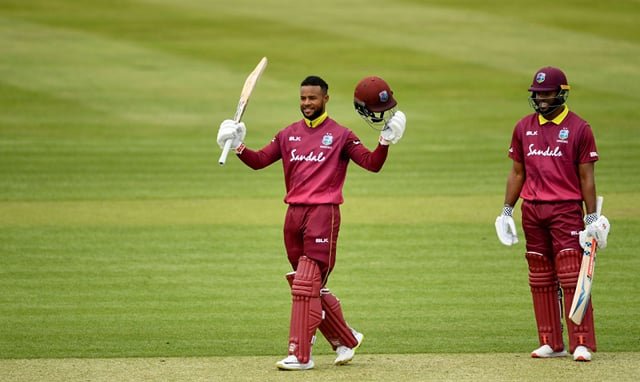
The IND vs WI 2026 2nd ODI produced a remarkable batting record on Wednesday, September 30, as three West Indies batters scored centuries in the same innings against India.
John Campbell, Shai Hope and Amir Jangoo powered the visitors to a huge total at the Barsapara Cricket Stadium in Guwahati. Their performances placed West Indies among a very small group of teams to have three centurions in one ODI innings.
The achievement also revived an unusual statistic involving Indian cricket. India has now been on the receiving end of the feat twice, with the previous occurrence coming during South Africa’s historic batting performance in 2015.
When Was the Last Time Three Batters Scored Hundreds Against India?
The previous occasion when three batters scored centuries against India in an ODI came during the fifth match of the 2015 India-South Africa series at the Wankhede Stadium in Mumbai.
South Africa’s Faf du Plessis, Quinton de Kock and AB de Villiers all reached three figures in that match. Their combined effort helped the Proteas post a mammoth 438/4 in 50 overs.
The innings was one of the most dominant batting displays witnessed against India in ODI cricket at the time. Each of the three South African batters played a major role in pushing the visitors beyond the 400-run barrier.
More than a decade later, West Indies matched the rare achievement in Guwahati, with Campbell, Hope and Jangoo becoming the latest trio to score centuries against India in the same ODI innings.
John Campbell Sets the Tone With a Fast Century
West Indies’ innings received an aggressive start from John Campbell after India opted to bowl first.
The left-handed opener attacked the Indian bowling during the first half of the innings and reached his century from just 65 deliveries. His innings gave West Indies the platform required for a very large total.
Campbell eventually departed after making 101 from 68 deliveries, with Gurnoor Brar claiming the wicket in the 19th over. Even though the opener did not remain until the end of the innings, his fast hundred had already changed the momentum of the contest.
His approach also allowed the middle order to bat with greater freedom. Instead of having to rebuild after the opening partnership, West Indies were able to continue attacking India’s bowlers.
Shai Hope Continues His Strong Run Against India
Shai Hope then continued the assault after Campbell’s departure. The West Indies captain has been one of the side’s most dependable ODI batters, and he once again delivered when his team needed a major contribution.
Hope combined with Amir Jangoo to produce a massive 182-run partnership for the third wicket. The stand kept India’s bowlers under pressure and provided the foundation for West Indies to target a score approaching 400.
Hope eventually reached his century before being dismissed by Kuldeep Yadav. It was the second consecutive match in the series in which Kuldeep had managed to dismiss the West Indies batter.
Despite Hope’s departure, the damage had already been done. West Indies had established complete control of the scoring rate and continued attacking through the final phase of the innings.
Amir Jangoo Completes West Indies’ Historic Trio
Amir Jangoo became the third West Indies batter to reach three figures, completing one of the rarest batting achievements in ODI cricket.
Jangoo was particularly effective during the middle and latter stages of the innings. His partnership with Hope ensured that West Indies did not lose momentum after Campbell’s dismissal.
The wicketkeeper-batter eventually finished with 114 runs from 77 deliveries, making him the highest scorer among the three West Indies centurions.
Jangoo’s dismissal also came during an important stage of the innings, with Ravindra Jadeja claiming the wicket. It was Jadeja’s first wicket in five matches.
The three hundreds meant that West Indies had three different batters scoring centuries in the same ODI innings against India for only the second time in India’s history as the defending side.
South Africa Were the Previous Team to Achieve the Feat Against India
The 2015 South Africa tour of India provides the previous example of three centuries being scored against India in an ODI innings.
During the fifth ODI at Wankhede Stadium, Faf du Plessis, Quinton de Kock and AB de Villiers produced an extraordinary batting display.
South Africa finished their 50 overs on 438/4, placing enormous pressure on the Indian batting lineup. The three centurions were able to attack throughout the innings, combining power hitting with calculated stroke play.
The performance remains one of the most memorable examples of a team dominating India’s bowling attack in an ODI.
How Rare Is Three Centuries in One ODI Innings?
Three batters scoring centuries in the same ODI innings is an extremely uncommon event. Even in modern one-day cricket, where aggressive batting has become increasingly common, reaching three individual hundreds in one innings requires an exceptional combination of partnerships, scoring rate and wickets in hand.
According to the match context, West Indies became only the fourth team in ODI history to achieve the feat. South Africa have also recorded the achievement on multiple occasions.
The Proteas have previously produced three-centurion innings against West Indies in 2015 and Sri Lanka in 2023. Their record highlights how unusual the accomplishment remains even among teams that have regularly produced powerful ODI batting lineups.
Australia’s 2025 Performance Was the Most Recent Before This Match
Before the IND vs WI 2026 2nd ODI, the most recent instance of three batters scoring centuries in one ODI innings came from Australia in 2025.
Travis Head, Mitchell Marsh and Cameron Green all reached hundreds in Australia’s third ODI against the opposition at Mackay. Australia used the three major individual scores to produce an enormous total of 431/2.
That innings demonstrated how quickly an ODI total can become enormous when multiple batters convert their starts into centuries. Australia’s three-century performance remained the latest example until West Indies produced a similar feat against India in Guwahati.
West Indies Push Towards a 400-Run Total
The three centuries also gave West Indies an opportunity to enter another exclusive statistical category: scoring 400 or more runs in an ODI innings.
With Campbell, Hope and Jangoo providing the major individual contributions, the visitors continued scoring heavily during the final overs.
At the stage covered by the match report, West Indies had moved to 360/5 with six overs remaining. That left the visitors within striking distance of the 400-run mark.
Reaching 400 would have added another major milestone to an already historic innings. West Indies had not only produced three individual centuries but had also maintained a scoring rate capable of challenging India’s bowlers throughout the 50-over contest.
What the Record Means for India’s Bowling Attack
From India’s perspective, the innings was a difficult outing for the bowling unit. Allowing three opposition batters to score centuries in a single ODI is rare and indicates how effectively the West Indies batters controlled the match.
Gurnoor Brar did manage the important dismissal of Campbell, while Kuldeep Yadav removed Hope for the second consecutive match. Jadeja later accounted for Jangoo, but the wickets came after the West Indies had already built a commanding platform.
The performance also underlined the importance of controlling partnerships. The 182-run stand between Hope and Jangoo allowed West Indies to recover quickly from Campbell’s dismissal and continue targeting boundaries.
IND vs WI 2nd ODI: A Record-Breaking West Indies Innings
The second ODI between India and West Indies was already an important contest, but the visitors’ batting performance gave the match an additional statistical dimension.
Campbell’s aggressive century provided the initial acceleration. Hope then anchored the middle phase before Jangoo produced the biggest individual score of the innings. Together, the three centuries transformed the West Indies innings into one of their most memorable ODI batting displays.
For India, the immediate challenge was to chase down a huge target after conceding such a substantial first-innings score. The Indian batting lineup had to produce a major performance of its own to keep the contest under control.
The match also demonstrated why ODI cricket continues to provide unusual statistical milestones. While individual centuries are relatively common in modern cricket, three hundreds from the same team in one innings remain exceptionally rare.
Three-Century ODI Feat: Key Facts
- West Indies centurions: John Campbell, Shai Hope and Amir Jangoo.
- Campbell’s score: 101 off 68 balls.
- Jangoo’s score: 114 off 77 balls.
- Major partnership: Hope and Jangoo added 182 runs for the third wicket.
- Previous instance against India: South Africa in the 2015 fifth ODI at Wankhede Stadium.
- South Africa’s total in 2015: 438/4.
- Most recent three-century ODI before this match: Australia in 2025.
- Australia’s total in that match: 431/2.
Why the Record Is Significant
The significance of West Indies’ performance goes beyond the three individual hundreds. It reflects how the visitors built their innings in different phases rather than relying on one batter to carry the scoring.
Campbell supplied the early momentum, while Hope and Jangoo converted the strong start into a huge total. Their combined effort meant India were forced to deal with sustained pressure rather than a single dangerous batter.
It also places West Indies in an exclusive group of ODI teams capable of producing three centuries in the same innings. For Indian cricket, meanwhile, it becomes another entry in an unusual record that had previously been associated with South Africa’s Wankhede masterclass in 2015.
Final Verdict
The last time three batters scored centuries against India in an ODI before the IND vs WI 2026 2nd ODI was in 2015, when South Africa’s Faf du Plessis, Quinton de Kock and AB de Villiers all reached three figures at Wankhede Stadium.
More than a decade later, West Indies repeated the rare feat through John Campbell, Shai Hope and Amir Jangoo in Guwahati. Campbell’s 101, Hope’s century and Jangoo’s 114 powered the visitors towards a massive total and created one of the most notable statistical moments of the 2026 ODI series.
For breaking news and live news updates, like us on Facebook or follow us on Twitter and Instagram. Read more on Latest Cricket on thefoxdaily.com.






COMMENTS 0