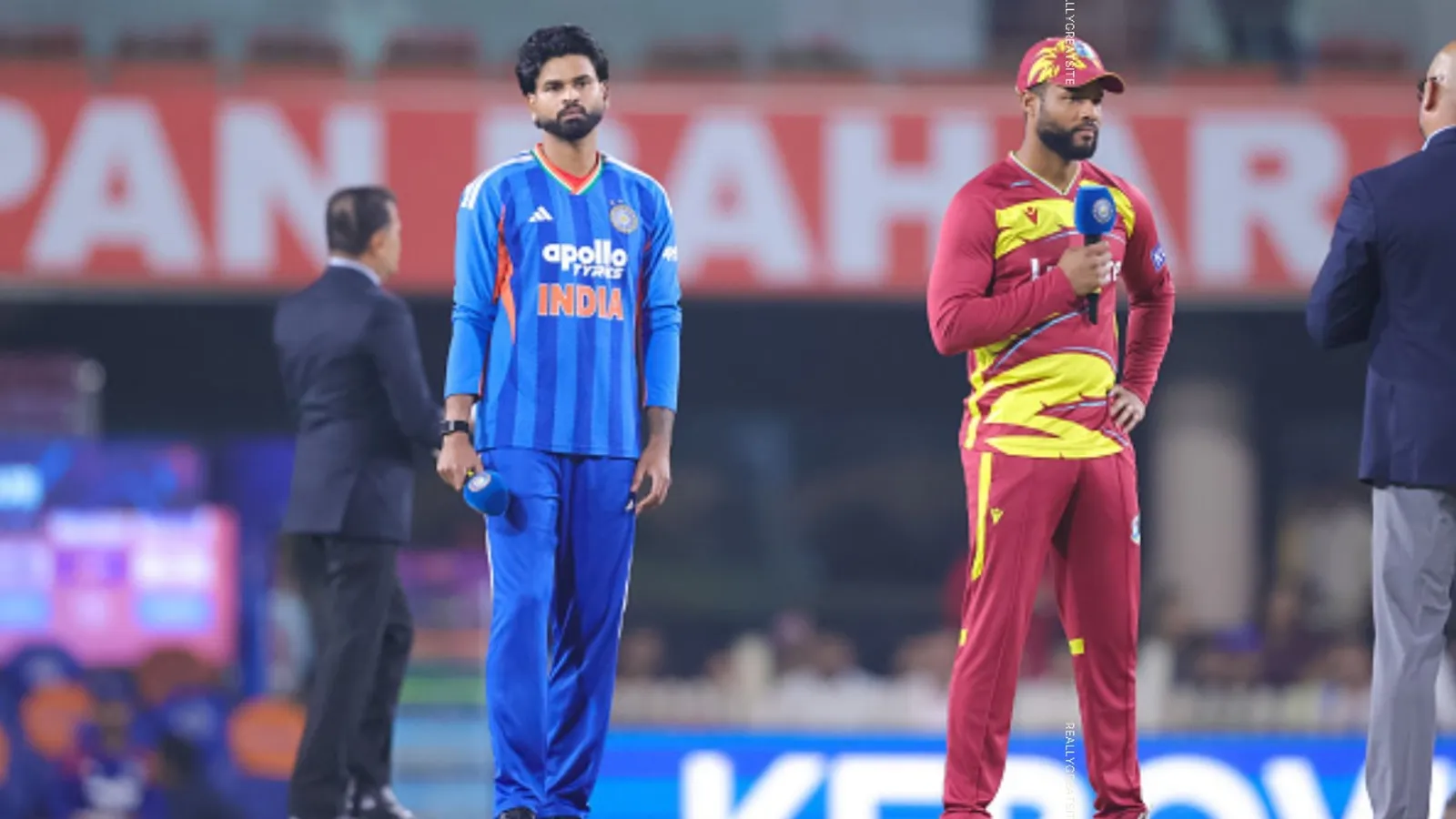
Former India captain Sunil Gavaskar has strongly defended the pitch at the Rajiv Gandhi International Stadium following India’s 24-run defeat against the West Indies in the fourth T20I. With the loss levelling the five-match series at 2-2, debate over batting-friendly surfaces has intensified, but Gavaskar believes the bowlers’ execution, rather than the pitch, was the primary reason for India’s struggles.
Speaking on JioHotstar, Gavaskar pointed out that bowlers from both teams made mistakes during the high-scoring contest, particularly by delivering too many full tosses. He argued that blaming the surface for a team’s inability to restrict the opposition overlooks the importance of bowling discipline, accurate lengths, and effective yorkers.
The fourth T20I saw the West Indies post an imposing 247 for three before restricting India to 223 for nine in 19.3 overs. Despite an explosive start from Sanju Samson and useful contributions from India’s middle order, Keemo Paul’s five-wicket haul proved decisive. The result has set up a series decider in Bengaluru, where India’s bowling execution will once again come under scrutiny.
Sunil Gavaskar Responds to Criticism of the Hyderabad Pitch
Following India’s defeat, criticism focused on the Hyderabad pitch, with some fans and observers arguing that surfaces in the series had become excessively favourable to batters. Multiple totals exceeding 200 runs have fuelled discussions about whether bowlers are receiving enough assistance in Indian T20 cricket.
Gavaskar, however, rejected the idea that the pitch should automatically be blamed whenever bowlers concede a large total. He argued that the quality of the deliveries matters just as much as the playing surface, particularly in a format where even a small execution error can result in a boundary.
Speaking on JioHotstar, the former India captain highlighted the mistakes made by West Indies bowlers during India’s middle-order partnership.
“Even the West Indies bowlers made quite a few errors while the partnership between Tilak Varma and Nitish was developing; they bowled too many full tosses,” Gavaskar said.
He followed up with a broader point about the tendency to blame pitches when bowling performances fall short of expectations.
“We often talk about pitches and blame them, claiming they offer no assistance to the bowlers. But if you bowl full tosses, the pitch isn’t to blame.”
Gavaskar’s argument was straightforward: bowlers cannot expect the surface to compensate for inaccurate deliveries. A full toss gives a batter an opportunity to attack, regardless of whether the pitch offers movement, bounce, or grip elsewhere in the innings.
He also noted that the West Indies found greater success when their bowlers delivered the correct lengths or executed yorkers. Those deliveries made it more difficult for India’s batters to score freely, demonstrating that discipline and variation remained important even on a high-scoring surface.
West Indies Post 247 as Shai Hope Leads the Charge
The West Indies produced a powerful batting performance after India elected to field first in Hyderabad. Captain Shai Hope led from the front with an unbeaten 102 off just 50 balls, giving his side the platform to post a formidable total of 247 for three.
Hope’s innings featured nine sixes and demonstrated his ability to combine aggressive stroke play with sustained scoring. His performance was supported by Sherfane Rutherford, who remained unbeaten on 49 from 26 deliveries, and Shimron Hetmyer, who contributed a rapid 33 off 12 balls.
The combined effort kept the scoring rate high throughout the innings and placed India under considerable pressure before their chase began.
For India’s bowlers, the challenge was not simply to contain one batter. Hope’s contribution, along with the late acceleration provided by Rutherford and Hetmyer, meant the hosts had to find a way to interrupt partnerships and prevent the West Indies from building momentum.
The innings also illustrated why bowling execution becomes especially important in T20 cricket. When batters are already scoring quickly, full tosses and deliveries that miss their intended lengths can provide additional opportunities to clear the boundary.
Sanju Samson’s Explosive Start Fails to Take India Home
India responded to the target with an aggressive approach, led by Sanju Samson at the top of the order. Samson scored 56 off just 23 balls, giving the hosts a strong start and keeping the required scoring rate within reach during the early stages of the chase.
Tilak Varma and Nitish Kumar Reddy also made useful contributions, scoring 43 and 41 respectively. Their partnership offered India another opportunity to build momentum after the opening phase of the innings.
However, India could not maintain the acceleration needed to complete the chase. Despite reaching 223 for nine, the hosts fell 24 runs short of the West Indies total.
Keemo Paul was the standout bowler for the visitors, taking five wickets for 41 runs. His five-wicket haul proved crucial in breaking India’s batting rhythm and preventing the middle and lower order from sustaining the challenge.
India’s innings demonstrated that a high-scoring pitch does not guarantee a successful chase. Even when batters produce quick starts and several players make useful contributions, a team must maintain its scoring rate while managing the loss of wickets.
The West Indies’ ability to take wickets at important moments ultimately proved decisive, allowing them to defend their total and level the series.
Gautam Gambhir’s View on Batting-Friendly Pitches
India head coach Gautam Gambhir has previously called for more sporting surfaces that provide bowlers with a fair opportunity to influence matches. His comments have highlighted concerns about pitches that consistently favour batters and make it difficult for bowlers to compete effectively.
Gambhir has emphasised that “bowlers’ careers are at stake” when matches are repeatedly played on flat tracks. His remarks following earlier games in the series, including the high-scoring second T20I in Ranchi, reflected his preference for contests in which both batters and bowlers have meaningful opportunities to contribute.
The debate is not limited to whether a pitch produces a large total. Instead, it concerns the balance between bat and ball and whether the conditions allow bowlers to use their skills effectively.
High-scoring matches can be entertaining, but consistently difficult conditions for bowlers may create questions about how much influence they can have over the result. On the other hand, a large total can also be the product of excellent batting combined with bowling mistakes rather than an inherently unfair pitch.
Gavaskar’s comments offer a different perspective within that discussion. While Gambhir has stressed the importance of sporting surfaces, Gavaskar has argued that bowlers must also take responsibility for their performance and avoid giving batters easy scoring opportunities.
The two viewpoints underline different aspects of the same debate: pitches should allow competitive cricket, but bowlers must still execute their plans to take advantage of the conditions.
Was the Hyderabad Pitch Really Too Easy for Batters?
The Hyderabad surface was reportedly a relaid pitch that offered some hold and bounce at different stages of the match. That detail complicates the argument that the conditions were entirely in favour of batters.
Despite the potential assistance available, India’s pace attack struggled to control the scoring. Mayank Yadav and Arshdeep Singh both conceded 52 runs in their four overs, while Prince Yadav was India’s standout bowler with figures of one for 36.
Those figures suggest that India’s bowlers found it difficult to contain the West Indies’ powerful batting lineup. However, the available information does not establish that the pitch alone was responsible for the expensive spells.
In T20 cricket, bowlers must constantly balance the need to prevent boundaries with the need to take wickets. A missed yorker, an inaccurate length, or a delivery that sits up for a batter can quickly change the momentum of an over.
Gavaskar’s criticism of full tosses reflects this challenge. When a bowler misses the intended length, the batter may receive a delivery that is easier to attack, making the pitch a less convincing explanation for the resulting runs.
The most useful assessment of the Hyderabad surface therefore requires consideration of both the conditions and the execution of the bowlers. The fact that the match produced 471 runs does not, by itself, prove that the pitch was unsuitable for competitive cricket.
Shreyas Iyer Admits India’s Bowling Execution Was a Problem
India captain Shreyas Iyer acknowledged after the match that the team’s problems began with its bowling performance. He admitted that the side failed to execute its lines and lengths consistently while attempting to defend a substantial total.
His assessment broadly aligns with Gavaskar’s argument that bowlers must take responsibility for their deliveries. Against a batting lineup capable of scoring quickly, even a handful of inaccurate overs can make a significant difference to the final total.
India’s challenge was made more difficult by the West Indies’ strong batting performances. Hope’s century provided stability and aggression, while Rutherford and Hetmyer ensured that the visitors continued scoring rapidly towards the end of their innings.
During the chase, India showed promising signs through Samson’s attacking start and contributions from Varma and Reddy. However, the batting lineup could not sustain the required acceleration against the West Indies’ improved bowling effort.
The defeat therefore highlighted issues in both innings. India’s bowlers struggled to contain the visitors, while the batters were unable to complete the chase despite scoring more than 220 runs.
India’s Bowling and Selection Questions Ahead of the Bengaluru Decider
With the series level at 2-2, attention now turns to the fifth and final T20I at the M. Chinnaswamy Stadium in Bengaluru on Saturday. India must address their bowling execution if they are to prevent the West Indies from producing another high-scoring performance.
The team may also face selection questions ahead of the decider, including whether specialist wrist-spinner Kuldeep Yadav could offer greater control on a surface that provides some grip. Kuldeep was left out of the Hyderabad match, and his potential inclusion could be considered as India evaluate their options.
However, the available information does not confirm that Kuldeep will return to the playing XI. Any selection decision will depend on the team’s assessment of the conditions, the opposition, and the balance required for the final match.
India will also need to consider the fitness situation following the fourth T20I. Arshdeep Singh retired hurt after being struck on the shoulder during the closing stages, adding another concern as the team prepares for the decider.
The final match offers India an opportunity to respond to the defeat and demonstrate greater control under pressure. Accurate lengths, effective yorkers, and better management of the opposition’s key batters could be central to their plans.
What India Must Improve Before the Fifth T20I
India’s defeat in Hyderabad provides several lessons ahead of the series decider. Although the pitch has become a major talking point, the team must focus on the areas it can directly control.
- Improve line and length: India’s bowlers need to avoid unnecessary full tosses and consistently deliver the lengths required to restrict aggressive batters.
- Execute yorkers more effectively: Gavaskar noted that the West Indies found success when they bowled yorkers and the right lengths. India could benefit from applying similar discipline.
- Control partnerships: Hope’s century and the contributions from Rutherford and Hetmyer allowed the West Indies to maintain momentum. India need to break partnerships before they become too damaging.
- Maintain pressure during the chase: Samson’s rapid innings gave India a strong start, but the middle order could not sustain the required scoring rate throughout the chase.
- Assess bowling options: The team must consider the balance of its attack and whether a specialist wrist-spinner could provide additional control in the decider.
These adjustments will be important regardless of the conditions in Bengaluru. While pitches influence how matches unfold, disciplined bowling and effective batting remain essential to winning T20 contests.
Frequently Asked Questions
Why did Sunil Gavaskar defend the Hyderabad pitch?
Gavaskar argued that India’s bowling execution, rather than the pitch alone, was responsible for the expensive performance. He pointed out that bowlers from both teams delivered too many full tosses and stressed that inaccurate deliveries should not automatically be blamed on the surface.
What did Sunil Gavaskar say about full tosses?
Speaking on JioHotstar, Gavaskar said that if bowlers deliver full tosses, the pitch should not be blamed for the resulting runs. He also noted that the West Indies achieved greater success when their bowlers delivered the correct lengths or executed yorkers.
What was the result of the fourth India vs West Indies T20I?
The West Indies defeated India by 24 runs in Hyderabad. The visitors scored 247 for three, while India managed 223 for nine in 19.3 overs. The result levelled the five-match series at 2-2.
Who was the top scorer for the West Indies in Hyderabad?
West Indies captain Shai Hope was the leading scorer, making an unbeaten 102 off 50 balls, including nine sixes. Sherfane Rutherford contributed 49 not out from 26 deliveries, while Shimron Hetmyer scored 33 off 12 balls.
Who was India’s top scorer in the fourth T20I?
Sanju Samson led India’s batting effort with 56 runs off 23 balls. Tilak Varma scored 43, while Nitish Kumar Reddy contributed 41, but India ultimately fell short of the target.
Who was the standout bowler for the West Indies?
Keemo Paul was the decisive bowler, taking five wickets for 41 runs. His performance helped the West Indies restrict India to 223 for nine and secure the victory.
What did Gautam Gambhir say about cricket pitches?
Gambhir has called for more sporting surfaces that offer bowlers a fair chance, warning that “bowlers’ careers are at stake” on consistently flat tracks. His comments reflect concerns about maintaining a competitive balance between bat and ball.
When and where is the fifth India vs West Indies T20I?
According to the supplied report, the series decider is scheduled for Saturday at the M. Chinnaswamy Stadium in Bengaluru, with India and the West Indies level at 2-2.
Conclusion
Sunil Gavaskar’s response to the criticism of the Hyderabad pitch has shifted attention towards India’s bowling execution. While the fourth T20I produced a high-scoring contest, the former India captain believes that full tosses and inaccurate deliveries were a more immediate problem than the playing surface itself.
The West Indies capitalised on their opportunities through Shai Hope’s century, Rutherford’s aggressive finishing, and Keemo Paul’s five-wicket haul. India, meanwhile, struggled to contain the opposition before falling short in their chase despite contributions from Samson, Varma, and Reddy.
With the series level at 2-2, India must improve their bowling discipline and make effective use of the conditions in Bengaluru. The pitch debate is likely to continue, but Gavaskar’s message remains clear: bowlers cannot rely on the surface alone. Accurate lengths, well-executed yorkers, and better decision-making will be crucial if India are to win the series decider.
For breaking news and live news updates, like us on Facebook or follow us on Twitter and Instagram. Read more on Latest Cricket on thefoxdaily.com.






COMMENTS 0