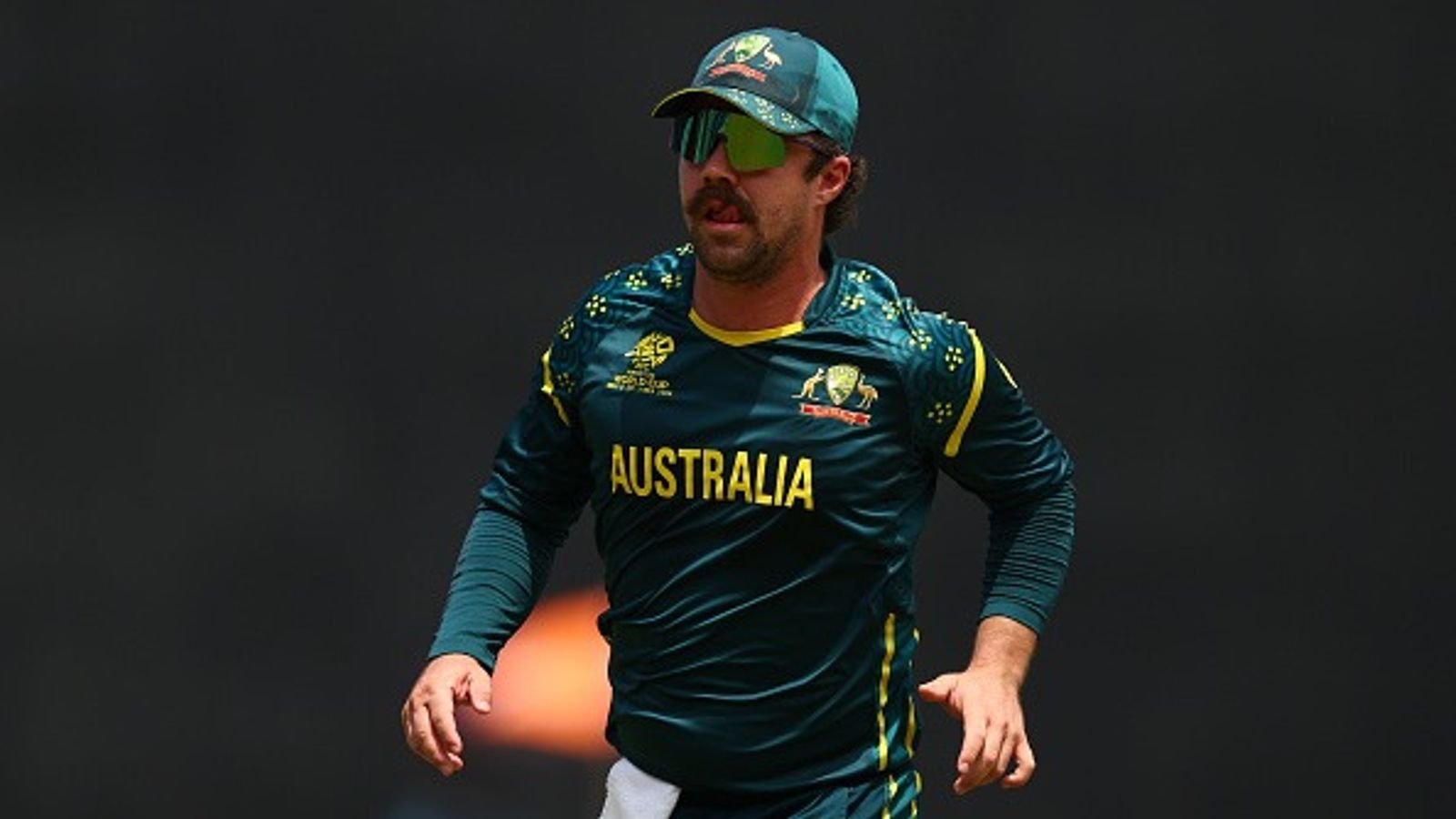
Travis Head has retained the Allan Border Medal after edging Alex Carey by just one vote at Cricket Australia’s delayed awards event in Brisbane, producing one of the closest finishes in the history of the prestigious individual honour.
Head finished with 153 votes to Carey’s 152, while Mitchell Starc completed a remarkably tight top three with 150 votes. The result confirmed Head as the standout men’s cricketer of the awards period and placed him among an exclusive group of Australian players to win the Allan Border Medal in consecutive years.
The night also highlighted the depth of Australian Cricket across formats. Starc was recognised as the Shane Warne Men’s Test Player of the Year, Mitchell Marsh collected the ODI Player of the Year award, and Tim David was named T20I Player of the Year after an outstanding campaign in the shortest format.
Travis Head Wins Allan Border Medal by the Smallest Margin
The headline result came down to an extraordinary one-vote difference.
Head’s 153 votes were enough to keep Carey behind him, but the margin demonstrates just how competitive the award race was. Starc was only three votes behind Head, meaning the leading three players were separated by just three votes in total.
| Player | Votes | Result |
|---|---|---|
| Travis Head | 153 | Allan Border Medal winner |
| Alex Carey | 152 | Runner-up |
| Mitchell Starc | 150 | Third |
The result is particularly significant because the Allan Border Medal is designed to recognise the leading Australian men’s cricketer across the voting period. It therefore rewards consistency and influence across different conditions and formats rather than simply one spectacular series.
Head’s ability to remain at the top despite intense competition from a teammate and one of Australia’s leading Test bowlers underlines how influential his performances were throughout the assessment period.
Head Joins an Exclusive Back-to-Back Winners’ Club
Retaining the Allan Border Medal is not a routine achievement. Head now joins a select group of Australian greats who have won the award in consecutive seasons.
His name now sits alongside Ricky Ponting, Shane Watson, Michael Clarke and David Warner, all of whom previously managed the difficult feat of defending the honour.
The achievement also strengthens Head’s standing among multiple Allan Border Medal winners. He joins teammates including Steve Smith and Nathan Lyon in the group of players who have claimed the award more than once.
That context makes Head’s latest victory more significant than the narrow voting margin alone suggests. A single vote separated him from Carey, but the broader achievement reflects sustained excellence rather than one decisive performance.
The Sydney Test That Helped Head’s Case
One of the defining moments of Head’s campaign came during the concluding Ashes Test at the Sydney Cricket Ground.
Head was promoted to open the batting and responded with a decisive 163. The innings arrived in a high-pressure contest in which Australia also received important contributions from Steve Smith, Beau Webster, Mitchell Starc and Michael Neser.
For an awards race decided by votes, performances in major matches can have an outsized influence. Head’s Sydney hundred gave voters another compelling example of his ability to change the course of a Test match when Australia needed it most.
It also reinforced one of the defining characteristics of Head’s batting: his willingness to attack rather than simply survive difficult periods.
Why Head’s Win Matters Beyond the Award
Head’s second Allan Border Medal adds another layer to his growing reputation as one of the central figures in Australian cricket.
His value is not restricted to traditional statistics. Head has repeatedly been used in situations where Australia need momentum, whether that means taking on a new-ball attack, changing the tempo of a Test innings or providing aggression in limited-overs cricket.
That versatility makes him particularly valuable in modern international cricket. The Allan Border Medal is an individual award, but Head’s success also reflects the importance of players who can influence matches in multiple ways.
There is also an interesting contrast in the final voting result. Carey, a wicketkeeper-batter, came within one vote of taking the medal, while Starc was only three votes away. That suggests the award was not dominated by one obvious candidate and instead reflected a highly competitive Australian team environment.
Mitchell Starc Dominates the Test Player of the Year Race
While Head claimed the overall prize, Mitchell Starc had an equally compelling case in Test cricket.
The left-arm fast bowler was named Shane Warne Men’s Test Player of the Year after an exceptional 11-match run that produced 57 wickets at an average of 18.12.
Those figures put Starc comfortably ahead of his nearest Australian teammate in the wicket-taking standings. Nathan Lyon finished with 28 wickets during the same period, meaning Starc collected more than twice as many wickets.
| Player | Test Player of the Year Votes | Key Statistic |
|---|---|---|
| Mitchell Starc | 25 | 57 wickets at 18.12 |
| Travis Head | 21 | Major batting contributions |
| Alex Carey | 20 | Strong all-round wicketkeeping-batting impact |
Starc received 25 votes, ahead of Head on 21 and Carey on 20. The narrow overall Allan Border Medal race therefore contrasted with a clearer result in the Test category.
For Starc, the award represents his second Test Player of the Year honour, coming almost a decade after his first.
Starc’s Numbers Explain Why He Was So Difficult to Overlook
A bowling average of 18.12 across 57 wickets tells only part of the story.
Starc’s left-arm angle, pace and ability to attack both edges of the bat continue to make him a unique weapon in Australia’s Test attack. His effectiveness becomes even more important when Australia need early wickets or are attempting to break partnerships with the second new ball.
The volume of wickets also matters. Taking 57 wickets over 11 matches means Starc was not simply producing one extraordinary performance; he was repeatedly contributing across a substantial stretch of Test cricket.
That consistency explains why his Test award was one of the strongest individual recognitions of the evening.
Mitchell Marsh Wins ODI Player of the Year Despite Limited Appearances
Mitchell Marsh took home the ODI Player of the Year award despite playing only six of Australia’s 10 eligible matches during the voting period.
His success is particularly notable because he returned to the team following a back injury and then took on additional responsibility as Australia’s captain during home ODI series against South Africa and India.
Marsh also maintained a batting average above 60, underlining the impact he made whenever he was available.
His award demonstrates that availability is not the only factor considered when assessing an individual season. A player who makes a major contribution in a smaller number of matches can still emerge as the leading performer if the quality and importance of those performances are high enough.
Marsh’s All-Round Value Adds Another Dimension
Marsh’s importance to Australia’s ODI setup extends beyond his batting numbers.
As an all-rounder and captain, he occupies a role that requires balancing individual performance with team leadership. His ability to contribute with the bat while carrying leadership responsibilities makes his award especially meaningful.
The fact that he won despite appearing in only six eligible matches suggests that his performances had a strong impact on the voting period.
For Australia, that is an encouraging sign because the team’s limited-overs success often depends on having players capable of performing multiple roles rather than relying exclusively on specialists.
Tim David Takes T20I Player of the Year Award
The shortest-format award went to Tim David, whose destructive batting made him one of the most influential performers in Australia’s T20I campaign.
David finished the period with a remarkable strike rate of 197.50 and an average of 49.37, numbers that underline the combination of power and consistency he brought to Australia’s middle order.
His promotion into a more prominent middle-order role proved particularly effective. Rather than being used solely as a late-innings hitter, David was given greater responsibility, allowing him more opportunities to influence matches.
The result was an attacking campaign highlighted by a 37-ball international century against the West Indies in St Kitts.
David’s Century Shows Why His Role Has Changed
A 37-ball century is the kind of performance that immediately changes expectations around a player.
For David, it demonstrated that his value in T20 cricket is not limited to producing quick runs in the final overs. He can also take control of an innings when given enough time and responsibility.
His 197.50 strike rate is particularly striking because it came alongside an average of 49.37. In T20 cricket, maintaining that combination is difficult: extreme aggression can often reduce consistency, while excessive caution can reduce scoring speed.
David’s campaign suggests he found a productive balance between the two.
Awards Night Highlights Australia’s Multi-Format Strength
One of the most interesting aspects of the Cricket Australia awards was the distribution of honours.
- Travis Head: Allan Border Medal winner.
- Mitchell Starc: Shane Warne Men’s Test Player of the Year.
- Mitchell Marsh: ODI Player of the Year.
- Tim David: T20I Player of the Year.
The spread of awards across different players demonstrates the depth of Australia’s international setup. Rather than one cricketer dominating every category, different specialists and all-round contributors stood out in different formats.
That could prove important for Australia as the international calendar continues to demand players capable of switching between Test, ODI and T20 cricket.
Why Alex Carey’s Near Miss Is Also Significant
Although Carey did not win the Allan Border Medal, finishing only one vote behind Head represents a major recognition of his contribution.
His 152 votes put him ahead of Starc and demonstrated that wicketkeeper-batters can have a substantial influence on the overall award race.
Carey’s position also makes the final result more intriguing. Had a single vote gone in the opposite direction, Australia would have been celebrating a different Allan Border Medal winner.
That razor-thin margin is likely to become one of the defining talking points from this year’s awards.
What the Results Say About Australia’s Cricket Priorities
The awards provide an interesting snapshot of what Australia values across formats.
Head’s overall victory reflects match-winning batting and versatility. Starc’s Test award highlights sustained excellence in the longest format. Marsh’s ODI recognition rewards both performance and leadership, while David’s T20I honour celebrates modern power hitting.
Together, the results reveal that Australia’s strength is not based on one style of cricket. The country continues to produce players who can dominate in very different match environments.
That depth will be particularly valuable as Australia balance a demanding Test schedule with major white-ball commitments.
Final Verdict: Head Keeps the Crown, But Australia Had Many Winners
Travis Head remains the Allan Border Medal winner after surviving an extraordinary three-way contest decided by just three votes between the top three players. His 153 votes were enough to beat Alex Carey by a solitary vote, while Mitchell Starc finished only two votes behind Carey.
The back-to-back success places Head among an elite group of Australian cricketers and confirms his status as one of the country’s most influential modern players.
But the wider awards story is just as impressive. Starc’s 57 Test wickets earned him the Shane Warne Men’s Test Player of the Year honour, Marsh’s outstanding ODI campaign brought him the 50-over award, and David’s explosive T20I numbers secured recognition in the shortest format.
Head may have taken the biggest individual prize, but the awards night ultimately showcased the breadth of Australia’s cricketing talent across all three international formats.
For breaking news and live news updates, like us on Facebook or follow us on Twitter and Instagram. Read more on Latest Cricket on thefoxdaily.com.






COMMENTS 0