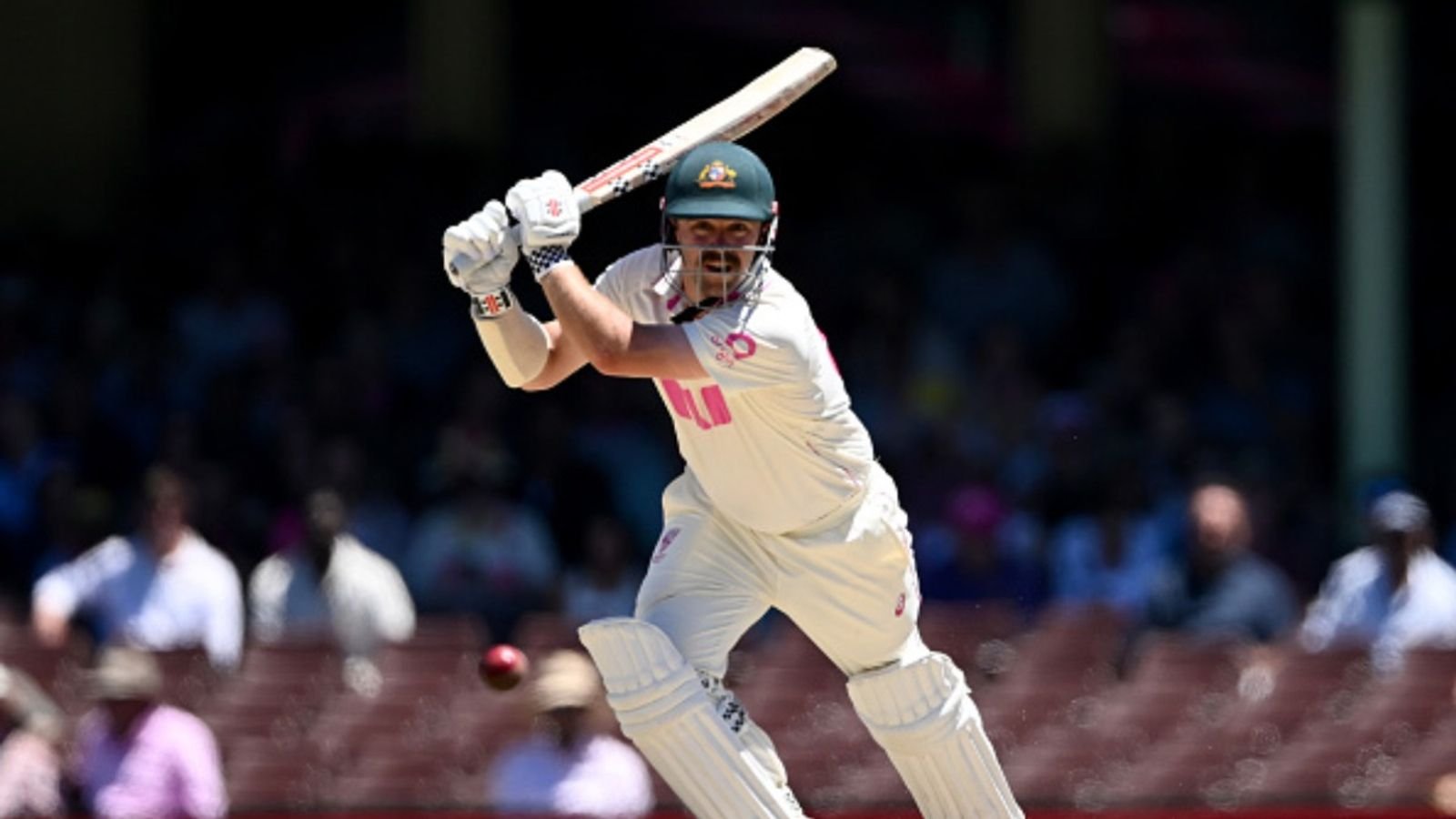
Travis Head has retained the Allan Border Medal after one of the closest finishes in the award’s history, beating Australia teammate Alex Carey by just a single vote to claim the country’s premier individual men’s cricket honour for a second consecutive year.
The victory, announced at Australia’s annual cricket awards ceremony, puts Head in an exclusive group of Australian players who have successfully defended the prestigious award. More importantly, the narrow margin highlights just how competitive the voting period was, with Carey finishing immediately behind him and Mitchell Starc only three votes away from the top spot.
Head’s triumph was based on performances recorded between January 29, 2025, and January 8, 2026. During that period, the left-hander produced a collection of high-impact innings across Test and limited-overs cricket, with his performances during the Ashes playing a particularly important role in his successful title defence.
Travis Head wins Allan Border Medal by just one vote
The final voting result could hardly have been tighter.
Head finished at the top, while Alex Carey missed out by only one vote. Mitchell Starc was also firmly in contention, ending just three votes behind Head.
Such a margin illustrates how little separated Australia’s leading performers during the voting period. Rather than being a comfortable victory for the defending champion, Head’s second medal was secured in a contest that remained extremely close until the final count.
| Player | Result | Key significance |
|---|---|---|
| Travis Head | Winner | Retained the Allan Border Medal for a second consecutive year |
| Alex Carey | Runner-up | Finished only one vote behind Head |
| Mitchell Starc | Third | Finished three votes behind Head |
The result also demonstrates the breadth of Australia’s recent cricketing strength. The leading candidates represented different roles within the team, with Head’s batting, Carey’s contributions behind the stumps and with the bat, and Starc’s pace bowling all making strong cases.
Why Travis Head was so difficult to overlook
Head’s biggest advantage was his ability to produce decisive performances in major matches.
His numbers were not built solely on accumulation. Instead, several of his most memorable contributions came when Australia needed a batter capable of changing the momentum of a contest.
The Ashes provided the clearest example.
Head scored three Test centuries during the series, producing scores of 123 in Perth, 170 in Adelaide and 163 in Sydney. Those innings showcased the combination that has increasingly defined his international batting: aggression without completely sacrificing control.
His ability to put pressure back on opposition bowlers is particularly valuable in Test cricket. A batter who can score rapidly can change field settings, disrupt bowling plans and force captains to make defensive decisions earlier than they would prefer.
That impact is difficult to capture through a single statistic, which makes Head’s match-winning contributions especially important when assessing why voters selected him.
The Ashes may have been the decisive factor
Head’s three centuries during the Ashes were arguably the strongest foundation of his medal campaign.
His 123 in Perth gave Australia a major batting contribution at the beginning of the series. The 170 in Adelaide was even more significant because it demonstrated his ability to dominate for a prolonged period, while the 163 at the Sydney Cricket Ground reinforced the consistency of his performances across the contest.
There is a wider pattern behind those innings.
Head has developed a reputation for playing his best cricket when the stakes are high. For an award decided by votes from his peers and members of the cricket community, performances in major series can carry considerable weight because they remain prominent in the memory long after individual matches have ended.
His Ashes output therefore gave voters more than statistics to consider. It provided a series of defining moments.
Head’s impact extended beyond Test cricket
Although the Ashes played an important role in Head’s campaign, his case was not built exclusively on red-ball cricket.
He also produced a spectacular performance in Australia’s ODI cricket, smashing 142 against South Africa in Mackay.
That innings reinforced another important part of Head’s value: his ability to transfer an aggressive batting approach across formats.
For Australia, that flexibility is strategically valuable. A player who can influence Test matches and limited-overs contests provides greater selection security and allows team management to build around a proven match-winner.
Head’s medal therefore represents more than a reward for one outstanding Test series. It reflects his overall importance to Australia’s men’s international setup during the voting period.
Alex Carey came remarkably close
The one-vote margin should not obscure Carey’s own achievement.
Finishing second by a single vote means the Australia wicketkeeper was effectively within touching distance of winning the country’s highest individual men’s award.
Carey’s challenge also highlights the increasingly important role of wicketkeeper-batters in modern international cricket.
The position demands concentration behind the stumps, tactical awareness, physical endurance and batting contributions. A wicketkeeper who consistently performs across all those areas can influence a match in several different ways.
That Carey pushed Head so close shows how highly his contribution was regarded during the voting period.
It also makes the final result more intriguing. Had a single vote gone differently, the conversation around Australian cricket would have been about Carey’s first Allan Border Medal rather than Head’s successful defence.
Mitchell Starc was also in the race
Mitchell Starc’s position adds another layer to the remarkably close result.
The Australia fast bowler finished only three votes behind Head, meaning the top three were separated by an extremely small margin.
Starc’s presence among the leading candidates also demonstrates that the award was not simply a contest between Australia’s premier batters.
His ability to influence matches with the new ball, generate pace and produce breakthroughs at critical moments gave him a compelling case. The fact that he finished so close to Head and Carey underlines the quality of Australia’s leading performers during the voting period.
Head joins an exclusive group of Allan Border Medal winners
Head’s victory is significant historically as well.
By winning the award in consecutive years, he became only the fifth player to successfully retain the Allan Border Medal.
The exclusive group includes Ricky Ponting, Michael Clarke, David Warner and Shane Watson.
Head also joins an elite collection of Australian cricketers who have won the award multiple times, alongside Steve Smith and Nathan Lyon.
| Achievement | Travis Head’s status |
|---|---|
| Allan Border Medal wins | Two consecutive victories |
| Back-to-back winners | Fifth player to achieve the feat |
| Multiple-time winners | Joins an elite group including Steve Smith and Nathan Lyon |
| Closest rival this year | Alex Carey, one vote behind |
That historical context makes the achievement considerably more impressive. Winning an individual award once can be the result of a particularly strong season. Successfully defending it requires maintaining an elite standard while competing against teammates who may also be enjoying career-best periods.
Travis Head’s own reaction says a lot about the achievement
Head appeared particularly pleased by the prospect of having two Allan Border Medals to look back on later in life.
“To think that I’ve got two medals and my kids can look at them and I can tell them (about it) in 20 years’ time is pretty cool.”
The comment offered a more personal perspective on an otherwise fiercely competitive award.
For a player who has already collected major international achievements, the ability to preserve tangible reminders of his career clearly carries its own significance. The medal is not simply recognition from the cricketing establishment; it becomes part of his personal sporting legacy.
Other major winners at the Australian cricket awards
Head was not the only Australian player to receive major recognition.
Mitchell Marsh won the ODI Player of the Year award, while explosive batter Tim David was recognised as Australia’s T20I Player of the Year.
In the women’s category, Annabel Sutherland had already claimed one of Australian cricket’s most prestigious individual honours after winning the Belinda Clark Medal in February.
The spread of awards demonstrates the depth of talent currently available across Australia’s international teams.
What the one-vote finish tells us about Australian cricket
The most interesting aspect of the result may not actually be Head’s victory. It is how close the voting was.
Head, Carey and Starc represent three different dimensions of Australia’s cricketing strength. One is an aggressive top-order batter, another combines wicketkeeping with batting responsibility, and the third remains one of the country’s premier fast bowlers.
The narrow margins suggest there was no obvious runaway winner.
That matters because individual awards can sometimes be dominated by one player who produces an extraordinary statistical season. This result was different. Australia’s leading performers all had credible cases.
Head ultimately prevailed because his match-defining batting performances gave him the edge, but the result could easily have gone another way.
Why retaining the medal could be harder than winning it
There is another important angle to Head’s achievement.
Winning the Allan Border Medal creates expectations for the following year. The defending champion is no longer simply competing for recognition; he is trying to demonstrate that the previous victory was not an isolated peak.
Head successfully answered that challenge.
His three Ashes hundreds and his 142 against South Africa provided evidence that his influence remained substantial across formats.
The one-vote finish also means he cannot afford to become complacent. Carey and Starc were already extremely close, while Australia’s wider talent pool continues to provide competition.
If Head wants to remain among Australia’s leading award contenders, sustaining his ability to deliver in high-pressure matches will be crucial.
The bigger legacy of Travis Head
Head’s growing reputation is increasingly linked to moments rather than simply totals.
His aggressive style can alter the shape of a match, particularly when Australia needs to move quickly from consolidation to attack.
That quality has made him one of the most recognisable figures in Australia’s modern batting lineup.
His second Allan Border Medal adds another layer to that reputation. It confirms that his value is being recognised not only through individual performances but also through the broader assessment of his contribution to Australian cricket.
Conclusion
Travis Head has retained the Allan Border Medal after edging Alex Carey by just one vote, completing a remarkable second consecutive triumph and becoming only the fifth player to successfully defend the prestigious award.
His case was strengthened by three Ashes centuries and a spectacular ODI hundred against South Africa, while Carey and Mitchell Starc ensured the contest remained extremely close.
The result ultimately reflects Head’s ability to produce high-impact performances across formats. More importantly, it places him alongside some of Australia’s most celebrated cricketers in the history of the Allan Border Medal.
With two consecutive victories now secured, the next challenge for Head will be maintaining that standard while a new generation of Australian stars continues to push him for the top honour.
For breaking news and live news updates, like us on Facebook or follow us on Twitter and Instagram. Read more on Latest Cricket on thefoxdaily.com.






COMMENTS 0