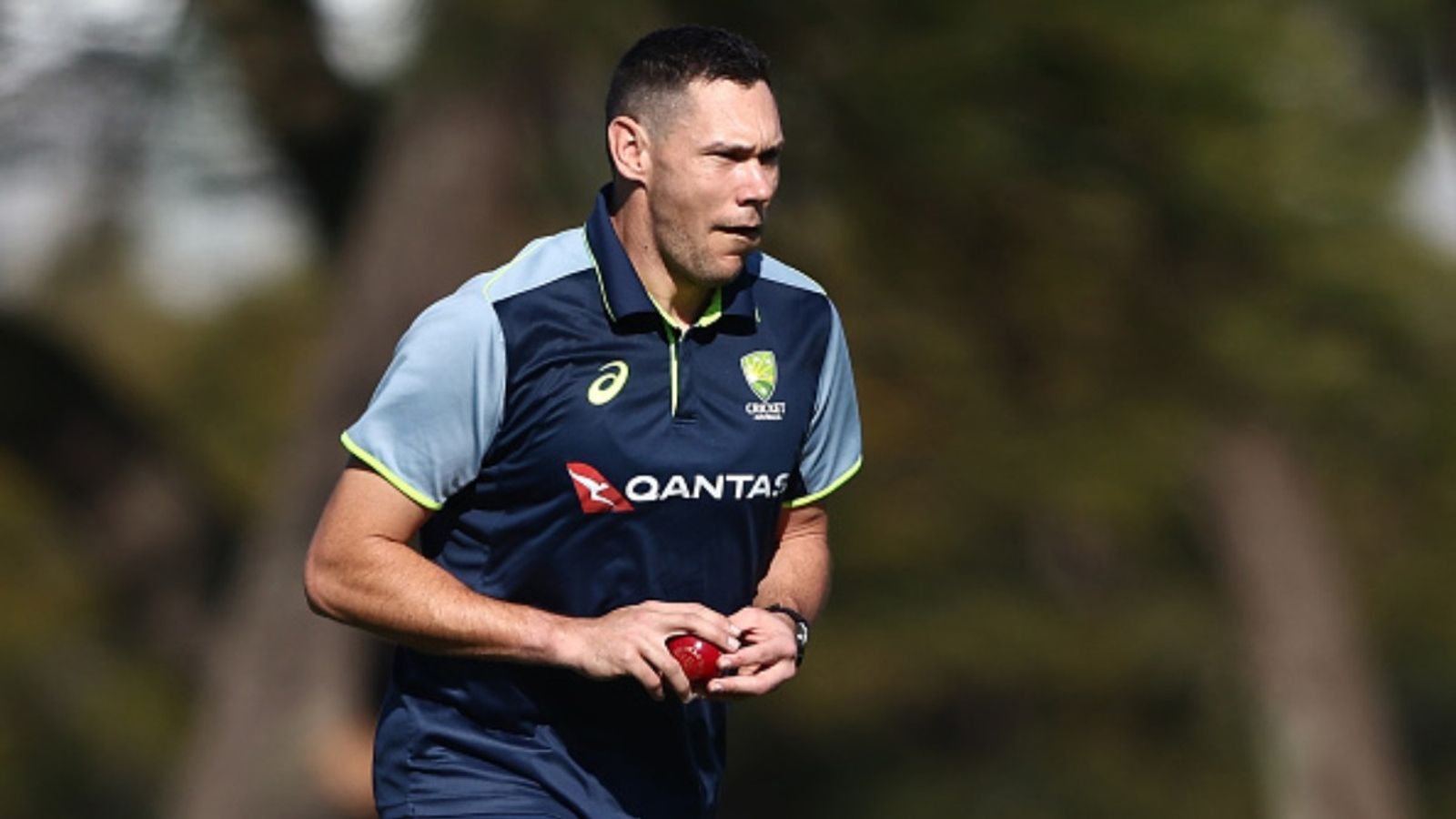
Pat Cummins has explained Australia’s decision to leave Scott Boland out of the playing XI for the first Test against Bangladesh, admitting that the selection call was extremely difficult after Boland’s impressive performances during the Ashes.
Australia will face Bangladesh in the opening Test of the two-match series in Darwin from August 13. The Australian team has opted for an experienced bowling attack featuring Mitchell Starc, Pat Cummins, Josh Hazlewood and returning spinner Nathan Lyon.
The decision means Boland, who made a strong impact during the Ashes, will have to wait for another opportunity. However, Cummins made it clear that the omission should not be interpreted as a lack of faith in the fast bowler.
Instead, Australia’s preference for Nathan Lyon and the need to create a balanced bowling attack played a crucial role in determining the final combination.
Why Australia picked Josh Hazlewood over Scott Boland
Australia’s selection decision was largely influenced by the overall structure of the bowling attack. Cummins revealed that the team was keen to include Nathan Lyon, which meant the selectors then had to decide how to arrange the available fast bowlers.
“I think we were pretty certain we wanted Lyno [Lyon] inside, so just kind of working out what the make-up of the quicks were,” Cummins said.
That explanation is important because it shows that Boland’s omission was not simply a decision based on recent form. Australia were trying to build a complete attack rather than select their bowlers individually.
With Lyon occupying the specialist spinner’s role, Australia settled on Cummins, Starc and Hazlewood as their three frontline fast bowlers.
The decision gives Australia a familiar pace combination while also providing the team with a specialist spinner capable of controlling long periods of an innings.
Scott Boland’s Ashes form made the decision tougher
Scott Boland’s omission has attracted attention because of the quality of cricket he produced during the Ashes. His performances strengthened his reputation as one of Australia’s most dependable Test fast-bowling options.
Boland’s greatest strength is his ability to maintain pressure. Rather than relying exclusively on extreme pace, he can repeatedly attack disciplined areas and force batters to play difficult deliveries.
That quality makes him particularly valuable in Test Cricket, where sustained pressure can be just as important as producing spectacular individual spells.
However, Australia’s current pace depth means even strong recent performances do not guarantee selection in every match.
Cummins acknowledged the difficult nature of the decision and made it clear that Australia remain fully aware of Boland’s quality.
“We obviously know Scotty’s class. It’s always a pretty tight call,” Cummins said.
The comment underlines the difference between being dropped because of poor form and being left out because of team balance. In Boland’s case, the latter appears to be the key factor.
Josh Hazlewood returns after a long absence
Josh Hazlewood’s selection is also significant because he is returning to Australia’s Test team after a lengthy absence from international red-ball cricket.
Hazlewood has not played for Australia since October last year, with injury keeping him out of the entire Ashes series. His return therefore gives the Australian attack an experienced option who has played a major role in the team’s Test success over the years.
Hazlewood is particularly valuable because of his control and consistency. He can build pressure through repeated deliveries in testing areas, allowing Australia’s captain to maintain an attacking field without constantly searching for breakthroughs.
His return also restores a familiar combination with Cummins and Starc. The three bowlers have extensive experience operating together at Test level.
For Australia, that familiarity can be useful when managing a Test match over several days, particularly when the captain needs different bowlers to perform specific roles.
Nathan Lyon played a key role in the selection equation
The return of Nathan Lyon is arguably the most important factor behind the decision to leave Boland out.
Lyon has been Australia’s specialist Test spinner for many years and provides something the team cannot replicate with another fast bowler. His ability to bowl long spells gives Australia a different method of attacking opposition batters.
After recovering from a hamstring injury, Lyon is back in the playing XI for the Bangladesh Test. Cummins confirmed that the team was fairly certain it wanted Lyon involved before finalising the pace combination.
This demonstrates how Test selection is often about balance rather than simply choosing the most in-form players.
If Australia had selected Boland alongside Starc, Cummins and Hazlewood, they would have had to reconsider the overall bowling structure. By choosing Lyon, the team gets a specialist spinner and three established fast bowlers.
Australia’s playing XI for the first Bangladesh Test
| Player | Role |
|---|---|
| Jake Weatherald | Top-order batter |
| Travis Head | Top-order batter |
| Marnus Labuschagne | Top-order batter |
| Steven Smith | Top-order batter |
| Cameron Green | All-rounder |
| Alex Carey | Wicketkeeper-batter |
| Beau Webster | All-rounder |
| Mitchell Starc | Fast bowler |
| Pat Cummins | Captain and fast bowler |
| Nathan Lyon | Specialist spinner |
| Josh Hazlewood | Fast bowler |
What Australia’s selection says about their fast-bowling depth
The biggest takeaway from Boland’s omission is arguably the strength of Australia’s fast-bowling resources.
Australia can leave an Ashes performer out of a Test match and still field an attack containing Starc, Cummins and Hazlewood. That level of depth gives the team significant flexibility across a demanding international schedule.
It also allows Australia to manage workloads more carefully. Test cricket places enormous physical demands on fast bowlers, and having a proven replacement available reduces the pressure on the same group of players to appear in every match.
Boland’s situation therefore highlights a broader advantage for Australia. Selection competition can be uncomfortable for individual players, but it gives the team greater security when injuries or workload concerns arise.
Why Boland can still play a major role
Cummins also suggested that Boland’s absence is unlikely to be permanent. With plenty of Test cricket ahead, Australia have every reason to keep rotating their fast-bowling resources when circumstances require it.
“There’s a lot of cricket coming up, but he knows his worth and how good he is, and I’m sure he’ll be out there at some point pretty soon,” Cummins said.
That is a significant message from the captain. Boland does not need to prove his value from scratch. His recent performances have already established his credentials.
The situation could change quickly if Australia decide that conditions favour another style of fast bowling, if a bowler needs workload management, or if an injury affects the attack.
Hazlewood vs Boland: What is the real difference?
Both bowlers offer Australia control and accuracy, but their selection can provide slightly different tactical options depending on the conditions and match situation.
| Factor | Josh Hazlewood | Scott Boland |
|---|---|---|
| Experience | Extensive international Test experience | Established Test experience |
| Recent context | Returning after injury absence | Coming off strong Ashes performances |
| Strength | Accuracy, discipline and sustained pressure | Accuracy, movement and relentless pressure |
| Current selection | Selected for first Bangladesh Test | Named outside the XI |
The comparison shows why the selection was so difficult. Australia were not deciding between an established bowler and an unproven alternative. They were choosing between two experienced Test performers.
The strategic importance of Australia’s bowling combination
Australia’s attack for the first Test gives Cummins several ways to control the game.
Starc provides left-arm pace and the ability to attack the opposition with the new ball. Hazlewood offers relentless accuracy, while Cummins can operate as both a strike bowler and a leader who controls the tempo of the attack.
Lyon then provides the major change of angle and style. His presence means Australia can maintain pressure even when the fast bowlers need rest.
The combination also reduces the temptation to overuse any individual bowler. In a Test match, preserving energy across several days can be just as important as taking early wickets.
What this means for the Bangladesh series
For Bangladesh, Australia’s selection provides a clear indication of the visitors’ approach. They have chosen experience and bowling variety rather than simply selecting the four most obvious fast-bowling candidates.
The first Test will therefore offer an early indication of how Hazlewood looks after his return and how effectively Australia’s four-man bowling core can work together.
Boland’s absence will also remain an interesting subplot. If the selected attack performs strongly, Australia’s decision will receive immediate validation. If Australia need an additional pace option later in the series, Boland will already be waiting in the wings.
Pat Cummins faces a selection problem many teams would want
There is an interesting irony in Cummins’ explanation: the Australian captain is facing criticism for leaving out a bowler who performed well, but the reason is that Australia have too many credible options.
That is a selection problem most international teams would happily accept.
The challenge now is managing those resources fairly while ensuring the team continues to select the attack best suited to each match.
Boland’s omission should therefore be viewed less as a demotion and more as evidence of Australia’s extraordinary fast-bowling depth.
Conclusion: Australia choose balance over individual form
Pat Cummins’ explanation makes the decision to select Josh Hazlewood over Scott Boland easier to understand. Australia wanted Nathan Lyon in the team, and once the specialist spinner was included, the captain and selectors had to settle on the combination they believed offered the best balance.
Boland’s strong Ashes performances clearly remain respected within the Australian camp. His omission does not erase that form, nor does it appear to close the door on his return to the XI.
For Hazlewood, the Bangladesh Test represents an important return to international red-ball cricket. For Australia, it is an opportunity to reunite an experienced pace attack while bringing Lyon back into the bowling unit.
The larger story is Australia’s remarkable depth. When a bowler of Boland’s quality can miss out after performing well in the Ashes, it shows just how difficult selection has become in the Australian Test setup. With a busy period of cricket ahead, that depth could prove to be one of Australia’s biggest advantages.
For breaking news and live news updates, like us on Facebook or follow us on Twitter and Instagram. Read more on Latest Cricket on thefoxdaily.com.






COMMENTS 0