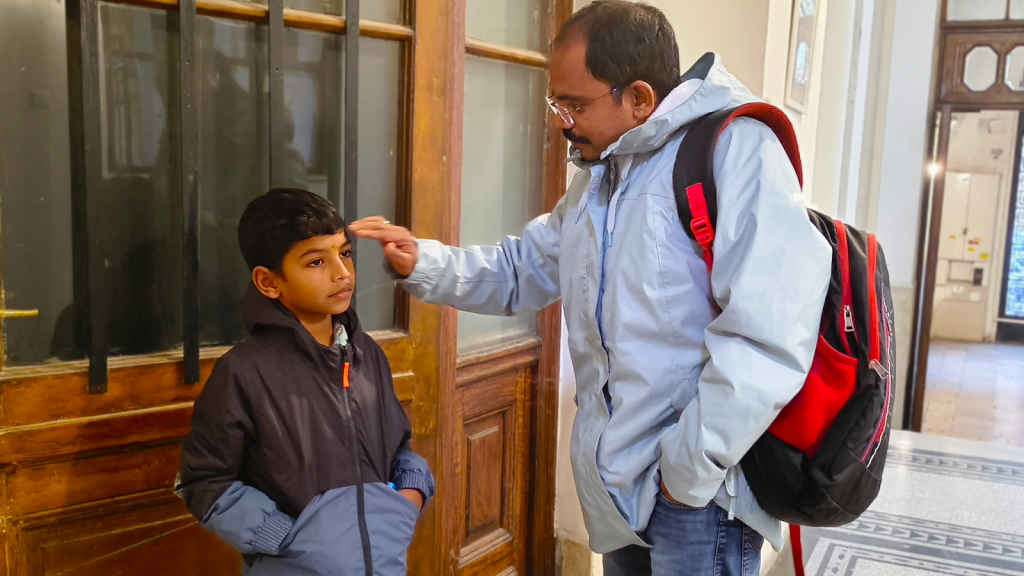
Budapest has increasingly become a second home for Indian Chess players, from established Grandmasters competing for major prizes to young talents travelling across Europe to earn Elo rating points and international norms. With tournaments taking place throughout much of the year, the Hungarian capital offers Indian players regular competitive opportunities, professional playing conditions and convenient access to events in other European countries.
The growing Indian presence is visible across tournaments of different levels. At the Kanizsa Open in August, held in Nagykanizsa, 59 of the 226 participants were Indian, representing more than a quarter of the field. At Budapest events such as First Saturday, SixDays, One Week Chess and Vezérképző, Indian players sometimes account for nearly half of the participants.
From Praggnanandhaa to young Indian talents, Budapest attracts players at every level
At the Anantara New York Palace in Budapest, Indian chess stars Praggnanandhaa and Vaishali are competing for prize money and valuable experience at a pilot event of the Total Chess tour. The tournament features a distinctive 45-minute Fast Classic format, attracting some of the biggest names in the game.
Meanwhile, around two kilometres away, a different group of Indian players is pursuing its own ambitions. Thirteen young competitors, including nine-year-old Tamizh Amudhan and 13-year-old Aarav Sarbalia, are participating in SixDays, a 40-player tournament.
For these youngsters, the main objectives are not necessarily prize money or recognition. They are focused on gaining Elo rating points, achieving norms and building international experience against players from different countries.
The contrast between the two venues reflects Budapest’s growing importance in Indian chess. The city provides opportunities for both established professionals and emerging players who want to develop their careers through regular international competition.
Why Indian chess players started moving to Budapest
International Master Srinath Rao is among the Indian players who recognised Budapest’s potential as a chess destination years ago. He recalled that travelling around India for tournaments did not always provide enough opportunities to earn the norms needed for career progression.
“I was playing 20-30 tournaments a year in India around 2016, but there were no real possibilities to earn norms. To make those, I’d have to fly to Europe, which was an expensive proposition. I moved my base to Budapest since there would be around two tournaments every month. Now, there are even more,” says International Master Srinath Rao.
For Rao, relocating to Budapest offered a more practical way to access European tournaments. The city’s location also made it easier to travel to competitions in neighbouring countries without relying on expensive flights.
“I had very little money when I moved there. Whenever I needed money to pay rent, I would just play a tournament in Germany and win. The prize money was enough to take care of a month’s rent. Budapest is like the centre of Europe. From there I could travel anywhere by bus,” says Rao.
Rao spent four years in the Hungarian capital. Other Indian players have also established connections with the city. Sahithi Varshini moved there as a teenager with her father and stayed for just over a year, while Grandmaster Sahaj Grover has been living in Budapest for the past few years.
Affordable accommodation and reliable tournaments make a difference
Budapest’s affordability was once another major attraction for Indian chess aspirants. Rao said the cost of living was relatively low when he first moved there. However, prices increased significantly after the Russia-Ukraine War began, making long stays more expensive for visiting players and their families.
As a result, some Indian players have started looking for alternative arrangements to control expenses. International Master Krishna Teja, who now works as a coach in India, rented an apartment in Budapest with a couple of chess friends for a month to share the accommodation costs.
Teja also highlighted the organisation and playing conditions at Budapest tournaments as important reasons behind the city’s popularity among Indian competitors.
“Tournaments in Budapest are serious tournaments. In other European countries, I have seen tournaments being organised on the first floor with a noisy bar on the ground floor. It just doesn’t fit in with the chess culture of Indians,” says Krishna Teja.
He also pointed to the reliability of tournament organisers. According to Teja, Indian players have sometimes booked non-refundable flights and accommodation for competitions in other European countries, only for organisers to cancel events at the last minute because of insufficient participation.
“Budapest organisers also won’t cancel the event at the last minute. This has happened to many Indians. They have booked non-refundable flights and accommodation only for organisers to cancel because they could not get enough players to play. These things won’t happen in Budapest. For them Indians are almost the primary source of income.”
For players travelling internationally on limited budgets, dependable tournament schedules can make a significant difference. Budapest’s established chess calendar gives them more confidence when planning trips and arranging accommodation.
Budapest offers chess tournaments throughout the year
One of the biggest advantages of the city is the frequency of its competitions. First Saturday tournaments are held every month, while SixDays, One Week Chess and Vezérképző events take place multiple times throughout the year.
The tournament calendar provides several opportunities for players to compete without having to wait months for another event. Early 2027, for example, will feature four tournaments between January 18 and February 13: One Week Chess, two separate SixDays events and a First Saturday competition.
The schedule becomes even busier during the summer. Eight tournaments are planned in Budapest between June and August 2027, giving visiting players multiple opportunities to build experience and work towards their rating and title goals.
This regular calendar helps explain why the city attracts such a large Indian contingent. Instead of travelling to Europe for a single competition, players can plan longer stays and participate in several events during one trip.
Indian youngsters combine Budapest tournaments with European chess tours
Budapest also serves as a convenient base for players who want to compete elsewhere in Europe. Several cities and tournament destinations are accessible by bus or train, allowing competitors to build multi-country schedules around their visits.
Thirteen-year-old Aarav Sarbalia, who has been visiting Budapest regularly since 2023, has already played around 15 tournaments in the city across five different trips. After completing SixDays, he plans to compete in Serbia before travelling to the London Classic.
Tamizh Amudhan, meanwhile, began travelling to Europe only this year but has already made his second trip to Budapest within four months. His current European stay lasts 16 days and costs his family slightly more than Rs 2 lakh.
The family’s original plan included tournaments in the Netherlands, Croatia and Germany before heading to Hungary. However, a visa delay forced them to miss the first two events. They travelled directly to Germany before continuing to Budapest.
Indian food and familiar comforts in Budapest
For families spending several weeks abroad, access to familiar food and everyday essentials can make an extended chess trip easier. Budapest has multiple Indian supermarkets, offering products that Indian visitors might otherwise struggle to find during their stay.
Yatin Sarbalia, Aarav’s father, explained that the family has been able to find familiar packaged food and household products in the city. He recalled buying packaged panipuri from a major Indian brand when Aarav wanted a taste of home.
“One time we got packaged panipuri from one of the big Indian brands because Aarav was craving it. Similarly you can get everything from coconut oil from Indian brands,” says Yatin Sarbalia.
Such conveniences are particularly useful for young players and their families, who may spend extended periods travelling between tournaments while managing training, preparation and competition schedules.
Tamizh Amudhan’s remarkable rise in chess
Tamizh, who comes from Sivakasi in Tamil Nadu, has already attracted international attention for his performances. Earlier this year, he made headlines after defeating German Grandmaster Vincent Keymer, one of the world’s leading players, in an online Freestyle Friday blitz tournament.
The circumstances surrounding that victory made the achievement even more remarkable. Tamizh was only eight years old at the time and played the online tournament on a laptop with a dying battery. A power cut had left his home illuminated only by candlelight.
His success reflects the potential of young Indian players who are gaining exposure to international competition at an early age. Events in Budapest offer youngsters like Tamizh an opportunity to test themselves against a wider range of opponents and continue developing their skills.
For young Indian players, chess comes before sightseeing
Despite spending time in one of Europe’s most recognisable cities, Tamizh has not devoted much attention to sightseeing during his visits. Asked whether he had explored Budapest’s tourist attractions, he mentioned visiting a park and the Hungarian Parliament, which is just two minutes from his playing venue.
He was also asked whether he planned to visit the Total Chess event to meet stars such as Magnus Carlsen, Praggnanandhaa and Vincent Keymer for photographs or autographs. His response was brief:
“No time,” he says.
That answer captures the priorities of many young Indian competitors in Budapest. While the city offers cultural attractions and opportunities to meet some of the world’s biggest chess names, the youngsters are focused on their immediate goals: improving their ratings, earning norms and gaining valuable experience.
From established Grandmasters competing at high-profile events to children working towards their first major milestones, Budapest has developed into an important destination for Indian chess. Its year-round tournament calendar, international accessibility and established playing environment continue to attract players seeking opportunities to progress in the sport.
(The writer is in Budapest on the invitation of Total Chess.)
For breaking news and live news updates, like us on Facebook or follow us on Twitter and Instagram. Read more on Latest Sports on thefoxdaily.com.






COMMENTS 0