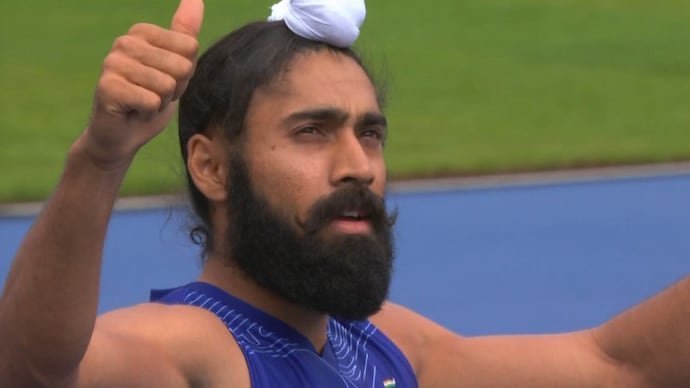
Gurindervir Singh‘s Commonwealth Games 2026 campaign ended in disappointment despite what initially appeared to be a strong performance in the men’s 100m heats. The Indian sprint star finished second in his heat, a result that would normally suggest progression to the next round. However, the qualification format for Glasgow 2026 told a different story.
Instead of advancing automatically based on finishing position, athletes had to meet a much tougher requirement—posting one of the fastest overall times across all heats. Gurindervir’s timing of 10.39 seconds ultimately proved insufficient, ending his campaign before the semifinals and highlighting just how competitive international sprinting has become.
While the result was disappointing for Indian Athletics fans, it also served as an important reminder that modern championship sprint events often reward raw speed over finishing position, especially when large athlete fields are involved.
Why Did Gurindervir Singh Not Qualify for the Semifinals?
The biggest source of confusion came from the qualification rules rather than Gurindervir’s finishing position.
A total of 76 athletes were entered in the men’s 100m, making it impractical to promote the top two or three finishers from every heat directly into the semifinals. Instead, organizers adopted a combined qualification system based primarily on overall timings.
Seven athletes had already secured automatic byes into the semifinals before the heats began, leaving only 17 qualifying places available from the opening round.
That meant every athlete was effectively racing against the clock as much as against competitors in their own heat.
How the Qualification System Worked
Unlike traditional knockout races, Glasgow’s qualification format rewarded the fastest performers across all heats rather than simply the highest finishers within each race.
| Qualification Rule | Explanation |
|---|---|
| Total Athletes | 76 |
| Number of Heats | 11 |
| Automatic Semifinal Byes | 7 athletes |
| Remaining Qualification Places | 17 fastest athletes from heats |
| Requirement | Fast overall time, not just finishing position |
As a result, finishing second guaranteed nothing unless the performance ranked among the fastest overall times recorded during the heats.
Gurindervir Singh’s Race Performance
Running in Heat 4, Gurindervir produced a solid start and stayed close to Jamaica’s Rohan Watson during the opening stages of the race.
However, Watson gradually increased his advantage over the final 30 to 35 metres, crossing the finish line first in 10.13 seconds.
Gurindervir followed in second place with a time of 10.39 seconds.
Although finishing second appeared encouraging, the time ultimately ranked only 28th among athletes competing in the qualifying heats, well outside the top 17 needed for progression.
The Time That Made the Difference
The final qualifying place for the semifinals went to Barbados sprinter Kuron Griffith, who clocked 10.24 seconds.
That meant Gurindervir missed qualification by 0.15 seconds—a sizeable margin in elite sprinting, where races are frequently decided by hundredths of a second.
| Athlete | Country | Time | Result |
|---|---|---|---|
| Rohan Watson | Jamaica | 10.13 sec | Qualified |
| Kuron Griffith | Barbados | 10.24 sec | Last Qualifier |
| Gurindervir Singh | India | 10.39 sec | Eliminated |
In sprinting, a difference of 0.15 seconds can represent more than a metre at the finish line, illustrating just how demanding international competition has become.
Why Expectations Were So High
Gurindervir entered the Commonwealth Games carrying enormous expectations after producing one of the greatest performances in Indian sprint history.
Earlier this year at the Federation Cup in Ranchi, he clocked an outstanding 10.09 seconds, becoming the first Indian sprinter to break the 10.10-second barrier in the men’s 100m.
That performance established him as India’s fastest man and generated excitement that he could challenge for a semifinal or even a historic sub-10-second run in the near future.
Compared to that national-record performance, his Glasgow run was considerably slower.
Comparing His Best Performance
| Event | Time | Outcome |
|---|---|---|
| Federation Cup 2026 | 10.09 sec | National Record |
| CWG Heat | 10.39 sec | Eliminated |
| Difference | 0.30 sec slower | Significant at elite level |
While three-tenths of a second may appear minor to casual fans, it represents a major difference in world-class sprinting.
Did Weather Conditions Affect the Race?
Weather likely played an important role in overall performances during the heats.
Glasgow presented athletes with temperatures around 15 degrees Celsius along with intermittent rain, creating conditions very different from those in Ranchi where Gurindervir set his national record.
Sprinters generally produce their fastest times in warm temperatures because muscles remain looser and generate explosive power more efficiently.
Wet tracks can also reduce confidence during acceleration and top-speed phases, even when the surface remains safe.
Although every athlete competed under the same conditions, adapting quickly often separates medal contenders from the rest of the field.
The Global Standard Continues to Rise
The Commonwealth Games once again demonstrated the remarkable depth of international sprinting.
Ghana’s Benjamin Azamati led the qualifiers with an exceptional 10.00-second run, while compatriot Abdul-Rasheed Saminu followed closely with 10.01 seconds.
Those performances illustrate just how competitive the event has become, with multiple athletes operating within touching distance of the prestigious sub-10-second barrier.
Against such elite competition, even a respectable performance can quickly become insufficient for qualification.
What Gurindervir Can Learn from This Experience
Despite the early exit, the Commonwealth Games provides valuable experience for India’s leading sprinter.
- Understanding championship qualification formats.
- Adapting to cold-weather competition.
- Managing pressure against elite international sprinters.
- Improving race execution over the final 30 metres.
- Building consistency closer to his national-record pace.
These lessons are often critical in helping athletes perform better at future global events.
What This Means for Indian Athletics
Gurindervir’s elimination should not overshadow the remarkable progress Indian sprinting has made over recent years.
Breaking the national record and consistently running close to international standards demonstrates that India is producing athletes capable of competing against some of the world’s fastest runners.
The challenge now lies in delivering those performances consistently on the biggest stages, regardless of weather, travel, or championship pressure.
As India’s sprinting ecosystem continues to improve through better coaching, sports science, and international exposure, performances like Gurindervir’s national record are becoming increasingly realistic rather than exceptional.
Future Outlook
Although Gurindervir Singh’s Commonwealth Games journey ended earlier than expected, the result should be viewed as a temporary setback rather than a reflection of his true ability. His national-record run of 10.09 seconds earlier this season remains proof that he possesses the speed required to compete internationally.
The Glasgow experience highlights how unforgiving elite sprinting can be, where qualification often depends on fractions of a second and changing weather conditions can significantly influence performances. With continued international exposure, improved consistency, and experience competing under different championship formats, Gurindervir remains one of India’s brightest medal hopes in global athletics.
His immediate objective will likely be returning closer to his personal best, while the long-term target remains even more ambitious—becoming the first Indian sprinter to officially break the historic 10-second barrier. If his recent progress is any indication, that milestone remains well within reach in the coming years.
For breaking news and live news updates, like us on Facebook or follow us on Twitter and Instagram. Read more on Latest Sports on thefoxdaily.com.






COMMENTS 0