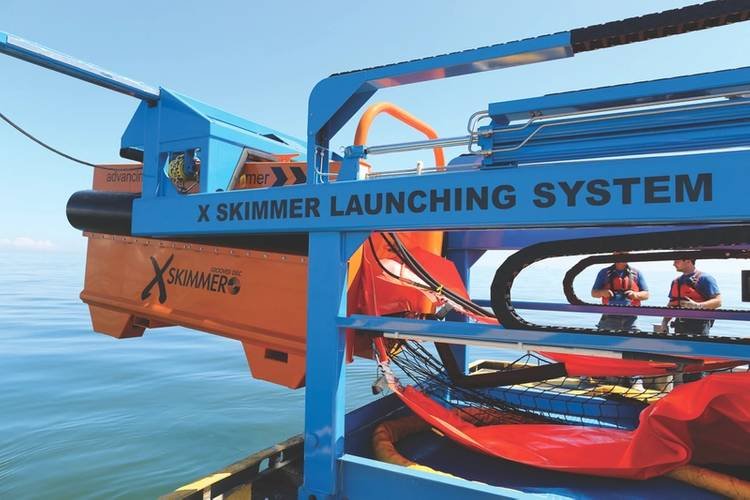
A $1.4 million technology competition backed by philanthropist Wendy Schmidt helped produce an oil-recovery system capable of collecting an average of 4,670 gallons of oil per minute. Developed by Elastec/American Marine, the winning Grooved Disc Skimmer achieved an oil recovery efficiency of 89.5%, setting a notable benchmark for equipment designed to respond to marine oil spills.
The Wendy Schmidt Oil Cleanup XCHALLENGE was launched in 2010, following the Deepwater Horizon disaster in the Gulf of Mexico. The competition invited engineers, scientists and companies from around the world to develop equipment that could recover floating oil more quickly while collecting as little water as possible.
Organised by the XPRIZE Foundation, the challenge attracted more than 350 submissions. Ten finalist teams advanced to controlled testing at OHMSETT, the US government’s oil-spill response research and testing facility in New Jersey. The winning technology demonstrated how a relatively straightforward mechanical principle, combined with engineering improvements, could address a persistent problem in environmental emergency response.
Deepwater Horizon disaster exposed weaknesses in oil-spill response
The motivation behind the competition came from one of the most serious environmental disasters in modern US history. On April 20, 2010, an Explosion aboard the Deepwater Horizon offshore drilling rig in the Gulf of Mexico killed 11 workers and triggered a massive oil spill.
Oil continued escaping from the damaged well for months, releasing millions of barrels into the Gulf. The pollution threatened marine wildlife, coastal ecosystems and communities whose livelihoods depended on fishing, tourism and other activities connected to the sea.
The disaster also demonstrated the difficulties of responding to an oil spill on such a large scale. Containing floating oil and recovering it from the water required equipment capable of operating under challenging conditions and processing substantial volumes of polluted water.
Mechanical skimmers are among the technologies used in oil-spill response. They collect oil floating on the water’s surface, allowing it to be removed and stored for further handling. However, conventional systems can recover considerable amounts of water alongside the oil, reducing the efficiency of the operation.
This limitation became an important engineering problem. A system that collects large volumes of water may need additional processing capacity, storage space and transportation resources. Improving the amount of oil recovered while reducing unwanted water collection could therefore make cleanup operations more efficient.
Recognising the need for better equipment, Wendy Schmidt funded a competition that would reward measurable improvements rather than ideas alone.
Why Wendy Schmidt launched the $1.4 million Oil Cleanup XCHALLENGE
The Wendy Schmidt Oil Cleanup XCHALLENGE was designed to encourage the development of practical technologies for recovering oil from the surface of water. Rather than funding one predetermined design, the competition invited different teams to develop and demonstrate their own approaches.
Wendy Schmidt, a philanthropist and the wife of former Google chief executive Eric Schmidt, supported the initiative through a prize-based model. The competition offered a total of $1.4 million in awards to teams that could demonstrate superior oil-recovery performance under controlled testing conditions.
The approach was intended to bring together established environmental equipment manufacturers, engineers and other innovators. Each participant had to demonstrate that its technology could meet specific performance requirements, making the competition a test of practical engineering rather than a contest based on presentations or theoretical designs.
The challenge also addressed an important gap between developing a technology and proving that it could work in an operational setting. By requiring teams to test their equipment under comparable conditions, organisers could evaluate the systems using measurable results.
What were the requirements of the Wendy Schmidt Oil Cleanup XCHALLENGE?
The competition established two central performance targets. Participants had to develop equipment capable of recovering more than 2,500 gallons of oil per minute while achieving an oil recovery efficiency of at least 70%.
These requirements addressed two different aspects of oil-spill cleanup. The first measured how quickly a system could collect oil from the water. The second evaluated how effectively it could separate oil from water during the recovery process.
Both measurements mattered because a skimmer that collects oil rapidly but also takes in large quantities of water may not provide the most efficient solution. Similarly, a system that separates oil effectively but operates too slowly may struggle to respond to a large spill.
The competition therefore encouraged teams to improve recovery speed and separation efficiency together. More than 350 submissions were received from around the world, reflecting the interest generated by the challenge.
After an initial selection process, ten finalist teams were invited to demonstrate their equipment at OHMSETT, the National Oil Spill Response Research and Renewable Energy Test Facility in New Jersey.
OHMSETT provided a controlled environment for testing
Testing oil-spill response equipment in open water can be difficult because conditions such as waves, currents, wind and changing temperatures influence how oil behaves. Differences in testing conditions can also make it harder to compare competing technologies fairly.
OHMSETT provided a controlled environment where the finalist teams could demonstrate their equipment against common performance standards. The facility is used for research, development and testing of oil-spill response technologies.
By bringing the competing systems to the same testing location, organisers could assess their recovery rates and efficiency under comparable conditions. This helped establish whether a technology could meet the challenge’s requirements through demonstrated performance.
The testing programme also gave manufacturers an opportunity to identify the strengths and limitations of their designs. For the winning team, the results provided an independently assessed demonstration of the potential of its mechanical oil-recovery approach.
How Elastec’s Grooved Disc Skimmer recovered 4,670 gallons per minute
The winning technology came from Elastec/American Marine, an environmental equipment company with operations in Illinois and Florida. Its Grooved Disc Skimmer used a series of rotating plastic discs to collect oil floating on the surface of the water.
The technology relies on the tendency of oil to adhere to certain surfaces. As the grooved discs rotate through the water, oil sticks to their surfaces and is carried out of the water. The grooves help retain the oil during this movement, while the design limits the amount of water collected alongside it.
Once the discs emerge from the water, mechanical scrapers remove the accumulated oil. The recovered material is then directed into a collection system and pumped away for storage or further handling.
The process allows the equipment to continuously collect oil as the discs rotate. Instead of relying on a large absorption material that must be replaced or processed, the system uses a mechanical collection mechanism that can operate repeatedly during a cleanup operation.
During the XCHALLENGE trials, the Grooved Disc Skimmer recorded an average oil recovery rate of 4,670 gallons per minute and an efficiency of 89.5%.
The result substantially exceeded the competition’s minimum requirements of 2,500 gallons per minute and 70% efficiency. It demonstrated that the disc-based design could recover large quantities of oil while limiting the amount of water collected during the process.
Engineering improvements behind the winning design
The Grooved Disc Skimmer built on Elastec’s earlier experience in designing oil-recovery equipment. Company founders Donnie Wilson and Jeff Cantrell had explored ways to improve mechanical skimming after encountering limitations in systems that collected excessive amounts of water.
The central engineering challenge was to create a surface that would attract and retain oil without behaving in the same way towards water. The grooved discs provided a mechanism for carrying oil away from the water’s surface, while scrapers made it possible to remove the collected material continuously.
The design illustrates how improving an existing engineering concept can sometimes produce a significant performance gain. Rather than depending on an entirely new method of oil recovery, the company refined a mechanical process and demonstrated its potential through controlled testing.
The competition’s performance measurements also provided a clear way to evaluate the result. The recovery rate showed how much oil the equipment could collect in a given period, while the efficiency figure indicated how effectively the system separated oil from water.
How much prize money did Elastec receive?
The Wendy Schmidt Oil Cleanup XCHALLENGE offered a total prize purse of $1.4 million, which was distributed among the leading teams following the testing programme.
Elastec/American Marine secured the first-place award of $1 million for its Grooved Disc Skimmer. Norway-based NOFI finished in second place and received $300,000 after recording an average recovery rate of 2,712 gallons per minute and an efficiency of 83%.
The awards were announced in October 2011. Both leading teams exceeded the minimum performance requirements, although Elastec achieved a higher recovery rate and efficiency.
The prize money was intended to reward demonstrated engineering performance while encouraging the development of equipment that could eventually be manufactured and used in real oil-spill response operations.
For Elastec, winning the competition also provided international recognition for its technology. The controlled testing results offered evidence that the design could deliver substantial oil-recovery performance under the conditions used during the challenge.
What happened to the winning oil-cleanup technology?
Elastec continued developing its oil-recovery equipment after the competition. The company adapted the technology into commercial products, including the X150 oil skimmer, designed for oil-spill response applications.
Its wider equipment range includes oil skimmers, containment booms and other products used to manage pollution in waterways and marine environments. These technologies serve different purposes within an oil-spill response operation.
Skimmers are used to recover floating oil, while containment booms help control the movement of oil across the water’s surface. Used together, such equipment can support efforts to prevent pollution from spreading and make recovery operations more manageable.
Winning the XCHALLENGE helped demonstrate the potential of Elastec’s disc-based approach to a wider audience. It also showed how a competition focused on measurable results could help an existing technology gain attention and move towards broader commercial development.
However, the performance recorded during the competition should be understood in the context of its controlled testing conditions. Actual oil-spill operations can involve different oil types, weather conditions, waves, debris and other environmental challenges. Equipment performance in the field may therefore vary according to the circumstances of an incident.
Why faster oil recovery matters during marine disasters
Oil spills can cause extensive environmental damage, particularly when large quantities of petroleum products spread across coastal waters and sensitive marine habitats. Oil can affect seabirds, fish, marine mammals and other wildlife through direct contact, ingestion and contamination of their habitats.
Coastal communities can also face economic consequences when pollution affects fishing grounds, beaches, tourism and other marine activities. The longer oil remains in the environment, the more difficult and expensive cleanup operations can become.
Mechanical recovery is one part of a wider oil-spill response strategy. Depending on the incident, response teams may use containment booms, skimmers, absorbent materials and other methods to control and remove pollution.
Improving skimmer performance can help response teams recover more oil using available equipment. A system that processes large quantities of oil while limiting water collection may also reduce the volume of material that needs to be handled and stored.
Nevertheless, no single technology can address every type of spill. The suitability of a skimmer depends on factors such as the characteristics of the oil, the condition of the water and the location of the incident. Effective response generally requires several technologies and coordinated operational planning.
How the XCHALLENGE demonstrated a different model for environmental innovation
The Wendy Schmidt Oil Cleanup XCHALLENGE offered an alternative model for supporting Environmental Technology development. Instead of selecting one research team to receive funding in advance, the competition invited multiple innovators to demonstrate what their equipment could achieve against common performance targets.
This approach allowed established manufacturers and other engineering teams to compete on the basis of measurable results. It also gave organisers a way to compare different designs without requiring participants to follow a single prescribed technical solution.
Prize-based competitions can be useful when a problem has a clearly measurable objective but several possible technological solutions. In this case, the goal was to improve the speed and efficiency of oil recovery, while the testing process provided a common framework for evaluating performance.
The competition did not eliminate the challenges associated with major marine oil spills. It also did not mean that the winning equipment could independently prevent or resolve a disaster on the scale of Deepwater Horizon. Instead, it demonstrated that targeted Investment and open competition could encourage practical improvements in an important area of environmental protection.
A $1.4 million challenge produced a measurable engineering result
The Deepwater Horizon disaster highlighted the limitations of existing oil-spill response systems and the need for more effective recovery equipment. Wendy Schmidt’s $1.4 million challenge turned that need into a measurable engineering competition, attracting more than 350 submissions from around the world.
Elastec/American Marine emerged as the winner with a Grooved Disc Skimmer that recovered an average of 4,670 gallons of oil per minute at 89.5% efficiency during the competition’s testing programme. Its performance exceeded the required recovery rate and efficiency, earning the company the $1 million first-place prize.
The initiative’s wider significance lies in the way it connected an urgent environmental problem with a clear performance target. By rewarding demonstrated results, the competition helped bring attention to a practical oil-recovery technology and showed how financial incentives can encourage Engineering Innovation for environmental challenges.
For breaking news and live news updates, like us on Facebook or follow us on Twitter and Instagram. Read more on Latest Technology on thefoxdaily.com.

COMMENTS 0