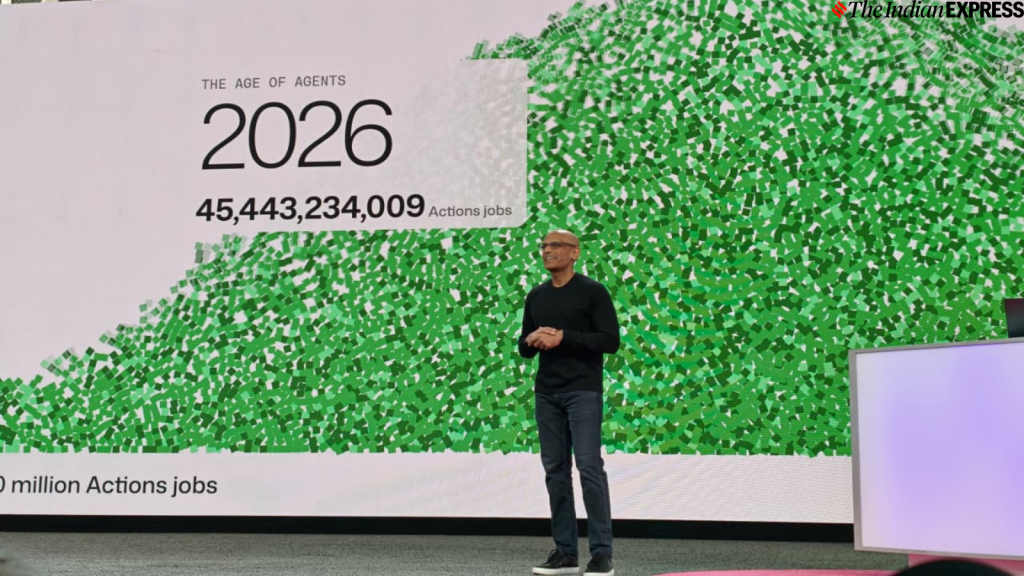
Artificial Intelligence is becoming increasingly expensive for businesses as companies expand their use of advanced models and autonomous AI Agents. While major Technology companies are investing heavily in AI infrastructure and data centres, organisations adopting these technologies are under growing pressure to control spending and demonstrate measurable returns on their investments.
The rising costs are particularly noticeable among heavy AI users, including software developers who rely on AI tools for complex, multi-step tasks. As AI agents take on more work, they consume additional computing resources, increasing the amount organisations pay to run them.
Microsoft is addressing this challenge through tools that allow businesses to monitor AI usage, select models according to their needs and establish spending limits. Jay Parikh, Executive Vice President of CoreAI at Microsoft, outlined these approaches in an interview with The Indian Express on the sidelines of GitHub Universe in San Francisco.
Parikh said businesses need controls that show how AI is being used across their organisations, who is using it and what activities are consuming resources. These insights can help companies identify unnecessary spending and establish policies that keep AI adoption within budget.
For example, an organisation could allocate $100 per week to each developer and restrict access to particular models. It could also use spending limits and detailed reports to monitor consumption and prevent costs from exceeding the allocated budget.
The challenge is becoming more important as businesses move beyond basic chatbots towards AI systems that can write code, plan tasks and carry out actions with less human intervention. Managing costs now involves not only choosing the right subscription but also deciding which models should handle different tasks and how autonomous systems should be controlled.
Why AI Usage Is Becoming More Expensive
AI tools have become widely accessible, with many entry-level chatbots offering free services. However, consumers, developers and businesses often need paid subscriptions to access higher usage limits, advanced models and specialised capabilities.
Services such as ChatGPT, Claude and GitHub Copilot offer paid options, with some entry-level plans starting at around $8 per month, according to the supplied report. Users handling longer conversations or more demanding workloads may pay considerably more, while advanced users can face higher costs as their AI usage increases.
Software developers are particularly exposed to these expenses because their work can involve repeated interactions with AI models, large codebases, complex reasoning and multiple stages of problem-solving. An agent working through a task may make several model calls rather than generating a single response, increasing overall consumption.
This change is important because AI costs are influenced not only by the number of requests users submit but also by the complexity and length of those requests. A simple question may require relatively little processing, while an extended coding task can involve substantial input, generated output and repeated reasoning.
As organisations integrate AI into everyday workflows, they must consider how frequently employees use these systems, which models they select and whether the resulting productivity gains justify the expense.
Technology companies are also facing pressure to turn widespread AI adoption into sustainable revenue. Providers initially offered free access to encourage users to try their products, but developing larger models and operating the infrastructure needed to serve them involve significant costs.
As training and infrastructure expenses grow, providers have increasingly sought to monetise AI through subscriptions, usage-based pricing and higher-priced access to advanced capabilities. Businesses consequently need a clearer understanding of what they are paying for and how to control consumption.
Understanding AI Tokenomics
One of the key factors behind AI spending is token consumption. Tokens are the units AI models use to process input and generate output. They may represent whole words, parts of words or other text elements, depending on the model’s tokenisation system.
When a user sends a prompt to an AI system, the model processes the input tokens and generates a response using output tokens. The cost of a request depends on factors such as the model selected, the amount of input and output processed, and the provider’s pricing structure.
In many AI services, input tokens cost less than output tokens. Generating a response requires computational resources, and longer responses can increase the total expense. Tasks involving extended reasoning or repeated interactions can add further costs.
More advanced models may also charge higher rates because they are designed to handle demanding tasks and complex reasoning. However, the relationship between model capability and cost varies by provider and model, meaning businesses need to compare the available options rather than assume that every advanced model has the same pricing structure.
For organisations using AI agents, token consumption can accumulate quickly. An agent may analyse information, develop a plan, execute an action, review the result and repeat parts of the process before completing a task. Each stage can involve additional processing.
This is why a task that appears simple from the user’s perspective may require considerably more computation than a single chatbot response. The resulting costs can become difficult to predict if employees and automated systems use AI without clear limits or monitoring.
Understanding token usage allows businesses to examine where their spending comes from and determine whether a less expensive model could complete a task effectively.
How Microsoft Wants Businesses to Control AI Spending
Parikh said Microsoft provides enterprises and individuals with controls to understand how AI is being used by their teams. These tools include model-access settings, spending limits and detailed usage reports.
Businesses can use these features to establish budgets for employees or teams, determine which models they are permitted to use and monitor consumption over time. This approach allows organisations to manage AI spending as part of their wider technology budgets rather than treating every request as an isolated expense.
Parikh illustrated the approach with a hypothetical allocation of $100 per week for each developer. An organisation could decide which models developers can access, set spending limits and review reports showing how the available budget is being used.
These controls serve several purposes:
- Model access: Organisations can decide which AI models employees are permitted to use for their work.
- Spending limits: Businesses can establish budgets and apply hard limits to help prevent costs from exceeding them.
- Usage reporting: Detailed reports can help identify who is using AI, how it is being used and where spending is concentrated.
- Product insights: Usage information can help organisations identify opportunities to reduce unnecessary consumption or choose more affordable options.
- Governance: Centralised controls allow businesses to establish policies for AI use across individuals, departments and the wider organisation.
The broader objective is to make AI spending more visible and manageable. Without usage information, companies may struggle to identify which teams are driving costs or whether employees are using expensive models for tasks that could be completed by less costly alternatives.
Spending limits can also help organisations establish financial boundaries before deploying AI at scale. Instead of waiting for a large bill to reveal excessive consumption, businesses can monitor activity and apply restrictions as part of their operating policies.
However, cost controls alone do not guarantee that an organisation will get good value from AI. Businesses must also assess whether the tools are producing useful results, saving employee time or improving the quality of their work.
Why Model Choice Matters for AI Costs
Not every AI task requires the most advanced model available. Routine work may be handled by smaller or less expensive models, while more complicated assignments may justify using systems with stronger reasoning or coding capabilities.
Microsoft is emphasising model choice as a way to balance quality, affordability and operational resilience. Parikh said organisations should not be locked into a single model provider or one model, arguing that a diverse selection can improve quality, business continuity, cost efficiency and affordability.
He described an approach that offers a range of models, including closed-weight and open-weight options, while allowing users to bring their own models where appropriate.
Closed-weight models generally keep their internal model parameters under the provider’s control, while open-weight models make model weights available under their respective terms. The practical differences between these options can affect how organisations deploy, customise and manage AI systems.
Giving businesses a choice can help them match the model to the task rather than relying on the same system for every request. For example, a company may prefer an inexpensive model for straightforward text processing but select a more capable system for work that requires deeper reasoning or more sophisticated coding.
The objective is not simply to choose the cheapest model. It is to find an appropriate balance between cost and the quality of the result.
GitHub Copilot Fusion and Automated Model Selection
Parikh discussed GitHub Copilot Fusion as a system designed to manage model selection and orchestration for coding tasks. The approach aims to reduce the need for developers to decide manually which model should handle each assignment.
According to Parikh, users can set preferences based on the outcome they want. They can prioritise the highest quality, choose a balanced result or select the most affordable option.
The system then uses an ensemble of different models to help achieve the selected objective. Rather than requiring developers to manage every model choice themselves, the process is designed to handle much of that complexity automatically.
Parikh explained that users seeking the highest-quality results may pay more, while those focused on affordability can use smaller or less expensive models. A combination of models may also be used to meet the requirements of a task.
This approach reflects a wider shift towards model orchestration, in which software determines how different AI models should be used within a workflow. The aim is to match computational resources to the work being performed, instead of sending every request to the same model regardless of its complexity.
For developers, automated selection could reduce the effort involved in comparing models and configuring workflows. For organisations, it offers a potential way to manage costs while retaining access to more capable systems when necessary.
However, the value of such an approach depends on whether the selected models produce results that meet the user’s requirements. Businesses still need to evaluate quality, reliability and total costs rather than assuming that automated model selection will always deliver the optimal result.
Balancing Quality, Affordability and Reliability
Model diversity can help businesses avoid dependence on a single provider or technology. If one model becomes more expensive, unavailable or unsuitable for a particular task, access to alternatives can provide additional flexibility.
Parikh highlighted quality, business continuity, affordability and efficiency as reasons to avoid being tied to a single model company. Allowing organisations to use different models can make it easier to adapt to changing requirements and costs.
There is nevertheless a trade-off between price and performance. A cheaper model may be sufficient for routine work but could struggle with a complex assignment. A more capable model may deliver a better result but consume more of the organisation’s budget.
Businesses therefore need to decide which tasks require higher levels of capability and where a less expensive option is adequate. These decisions can vary by department, workflow and the consequences of an incorrect result.
A cost-conscious approach should also account for the possibility that a cheaper model may need more attempts or corrections to complete a task successfully. The lowest price per request does not necessarily translate into the lowest total cost of achieving the desired outcome.
Automated orchestration can help manage these choices, but organisations still need clear performance expectations and oversight. The aim is to achieve the required result at an appropriate cost, not simply to minimise token consumption.
Agentic AI Creates New Governance Challenges
As organisations adopt AI agents capable of completing multi-step tasks with limited human intervention, managing costs becomes only one part of a larger governance challenge.
Traditional chatbots primarily respond to user prompts. AI agents can take a more active role by planning tasks, interacting with tools, processing information and carrying out actions. Depending on their design and permissions, they may perform several operations before asking a human to review the result.
This changes the relationship between employees and technology. An AI system is no longer simply generating text or answering questions; it may be acting within business workflows and interacting with company resources.
Parikh said the industry needs a framework for governing agents. He noted that expectations differ: some users want agents to behave more like human colleagues, while others want them to remain clearly identifiable and observable as machines.
The distinction raises questions about transparency, accountability and control. Organisations need to understand when an agent is acting, what information it can access and which actions it is authorised to perform.
These questions become particularly important when agents can access sensitive information, interact with business systems or make changes that affect other users. A governance framework must address not only what an agent produces but also what it does while completing a task.
Microsoft’s Approach to AI Agent Security
Parikh said agents need to be governed and secure. He also described work within Microsoft CoreAI on standards such as “agent hooks” to manage inputs, outputs and runtime containment.
These controls are intended to provide ways to monitor how agents interact with their environment and restrict their behaviour where necessary. Managing inputs and outputs can help organisations understand what information enters an agent’s workflow and what it produces, while runtime containment relates to limiting an agent’s activity as it operates.
Parikh also said Microsoft assigns agents unique identifiers and tracks their activities through systems such as Agent 365. These mechanisms allow organisations to monitor agents and block or restrict their access to particular resources.
The controls can be configured at different levels, including individual users, departments and the wider organisation. This gives businesses a way to apply different rules according to the responsibilities of a team or the sensitivity of the resources involved.
Unique identifiers and activity tracking can also help distinguish an agent’s actions from those performed directly by a human employee. That distinction is important when investigating unexpected behaviour, reviewing access or determining which system carried out a particular operation.
Organisations deploying agents must consider permissions carefully. An agent should have access to the resources needed for its assigned task without automatically receiving unrestricted access to every system or dataset.
Security and governance also need to account for the possibility that an agent may behave unexpectedly or perform an action that does not match the user’s intention. Monitoring, restrictions and clear accountability can help organisations manage these risks as agentic AI becomes more widely used.
Why AI Governance Must Extend Beyond Chatbots
The growing use of AI agents is changing the scope of technology governance. With a conventional chatbot, organisations may focus on the accuracy and appropriateness of the responses it generates. With an agent, they must also consider the actions it takes, the systems it accesses and the consequences of its decisions.
This means governance policies need to cover more than acceptable prompts or the final output of a model. They also need to address permissions, monitoring, activity records and the ability to intervene when an agent exceeds its authorised role.
Businesses may also need different controls for different uses. An agent helping an employee organise information may require fewer permissions than one authorised to interact with important business systems. The appropriate level of oversight depends on the task and the potential consequences of an error.
Parikh’s comments point to the need for clear standards as the industry moves towards systems that operate with greater autonomy. The challenge is to make agents useful without sacrificing transparency, security or the ability to hold systems and their operators accountable.
Cost management and governance are closely connected. An organisation that understands what its agents are doing can better monitor resource consumption, identify inefficient workflows and restrict unnecessary activity. At the same time, spending limits cannot replace controls over data access, security and authorised actions.
India’s Growing Importance in the Developer Community
Parikh also highlighted India’s position as one of the world’s largest and most vibrant developer communities, pointing to the country’s contributions to open-source projects.
Open-source development allows programmers to collaborate on software, share code and contribute improvements that can be used by other developers. These communities play an important role in software development and in the wider technology ecosystem.
As AI tools become more integrated into coding workflows, developers will need to evaluate not only how much these tools cost but also how effectively they support software development. Model selection, automation and governance are likely to remain important considerations for organisations building AI-assisted workflows.
Parikh’s comments place developer productivity alongside cost efficiency and security as key concerns for companies adopting AI. The challenge for businesses is to use these tools where they provide value while ensuring that their consumption and activities remain manageable.
What Rising AI Costs Mean for Businesses
The increasing use of AI agents is making spending management a more immediate concern for companies. As AI moves from occasional chatbot interactions to workflows involving repeated model calls and automated actions, organisations need better visibility into usage and clearer rules governing access.
Microsoft’s approach, as described by Parikh, combines spending limits, usage reports, model choice and agent governance. These measures address different parts of the problem: financial controls help prevent unexpected bills, model selection can match costs to task requirements, and monitoring can make agent activity more visible.
Model orchestration offers another potential way to improve efficiency by selecting models according to users’ preferences for quality, balance or affordability. However, businesses still need to evaluate whether the results justify the costs and whether the systems are operating within their intended limits.
For organisations, the central challenge is no longer simply deciding whether to adopt AI. It is determining how to deploy it responsibly, choose suitable models, measure the value produced and ensure that both spending and automated actions remain under control.
As AI agents become more capable, cost management and governance are likely to become increasingly connected. Businesses that can see how their systems are being used, establish clear limits and monitor what agents do will be better equipped to manage the financial and operational demands of AI adoption.
Disclosure: The writer attended GitHub Universe at the invitation of GitHub US. Microsoft covered the writer’s travel and accommodation expenses.
For breaking news and live news updates, like us on Facebook or follow us on Twitter and Instagram. Read more on Latest Technology on thefoxdaily.com.






COMMENTS 0