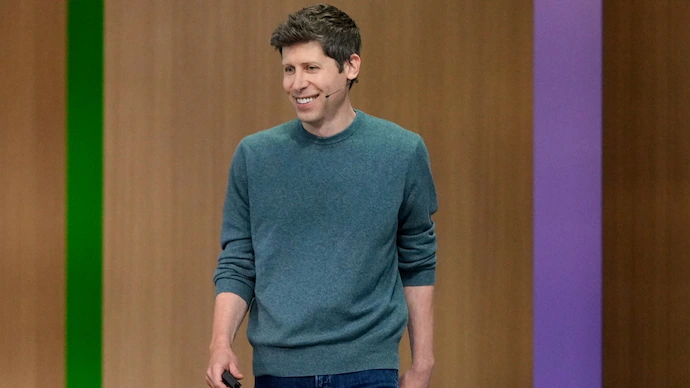
OpenAI CEO Sam Altman has broken his silence on Jensen Huang’s sudden departure from Nvidia, saying the Artificial Intelligence industry will continue to grow despite losing one of its most influential leaders. Speaking at Semafor’s Silicon Valley & The World event on Monday, November 16, Altman acknowledged Huang’s exceptional contribution to the technology sector but said the industry’s strong demand and rising revenues would help it remain resilient.
Huang, who co-founded Nvidia and led the company for more than three decades, resigned last week following revelations about extramarital relationships, including one involving Alice Huang, a businesswoman suspected by US authorities of having links to Chinese intelligence. The allegations have triggered a leadership crisis at the chipmaker and raised questions about its future direction.
Nvidia has appointed its longtime Chief Financial Officer Colette Kress as interim CEO while its board searches for a permanent successor. Huang’s departure has also prompted concern among technology executives and investors who believe his ambition and willingness to make large financial commitments played a major role in accelerating the AI boom.
Sam Altman Calls Jensen Huang a Personal Hero
During his conversation at the Semafor event, Altman spoke warmly about Huang’s contribution to the technology industry. He said it was difficult to imagine the AI revolution without Huang and the company he built.
Altman described the former Nvidia chief as someone he had admired for a long time, while acknowledging that even highly respected leaders have personal shortcomings.
“Jensen has long been a hero of mine. Heroes have flaws,” Altman said.
His remarks reflected the complicated position Huang occupies in the technology industry. Nvidia’s chips have become essential to the development and deployment of modern AI systems, while Huang’s leadership helped turn the company into one of the most influential businesses in the global technology market.
Altman also highlighted the early relationship between Nvidia and OpenAI. Both companies made important bets on each other during the development of the AI ecosystem, and their partnership has since become increasingly significant as demand for advanced computing infrastructure has expanded.
Altman Declines to Say Whether Huang Should Return to Nvidia
Huang’s resignation has prompted calls from several prominent technology figures and investors for Nvidia to consider bringing him back. The campaign reflects concerns that the company could lose some of its strategic ambition without the founder who guided its growth for decades.
However, Altman avoided taking a position on whether Huang should return as CEO. Asked directly whether the former chief executive should be reinstated, he responded: “I don’t think I know enough to answer that question.”
Altman also expressed personal empathy for Huang, drawing a comparison with his own experience at OpenAI in November 2023. At the time, OpenAI’s board unexpectedly removed him as CEO, triggering a major internal crisis before he returned to the position several days later.
By recalling that episode, Altman indicated that he understood the personal and professional difficulties associated with suddenly losing control of an organisation one has helped build. However, he did not suggest that the circumstances surrounding his departure and Huang’s resignation were identical.
Why Altman Believes the AI Industry Can Survive Without Huang
Despite recognising Huang’s importance, Altman said he was not convinced that his departure would derail the broader AI industry. He pointed to the growing demand for AI products and the rapid expansion of revenues as reasons for his confidence.
Altman described Nvidia as a behemoth and suggested that its financial strength and established position would continue to support confidence among customers, partners and investors.
He also emphasised that the AI market is no longer dependent on the decisions of a single individual. Although Huang played an unusually important role in driving the industry forward, the demand for computing power, AI applications and infrastructure has expanded across multiple businesses and sectors.
“I think there’s so much demand, and it’s so clear that AI is real, and people want to use it, and the revenues and demand are growing so strongly that I think the industry will be fine,” Altman said.
His assessment does not mean Nvidia’s leadership transition will be without consequences. Huang’s departure could influence how aggressively the company invests in AI infrastructure, supports customers and enters large financing arrangements. However, Altman believes the underlying commercial demand for AI remains strong enough to sustain the industry’s momentum.
Nvidia’s Relationship With OpenAI Faces a Major Test
OpenAI and Nvidia have developed a close commercial relationship as the demand for advanced AI computing has increased. Nvidia supplies the specialised processors needed to train and operate large AI models, while OpenAI is among the major developers requiring substantial computing capacity.
The relationship has also expanded beyond conventional chip purchases. Nvidia has increasingly participated in financing arrangements connected to AI infrastructure projects, creating a more interconnected relationship between chip suppliers, technology developers and data centre operators.
One prominent example is Nvidia’s agreement to guarantee up to $105 billion in support of OpenAI’s planned data centre project in Ohio. The arrangement highlights the scale of investment required to expand computing capacity for increasingly demanding AI systems.
These types of deals have attracted attention because they can create a circular financing structure. Money invested or guaranteed by a technology supplier can help finance infrastructure that subsequently purchases the supplier’s products. Such arrangements may accelerate expansion, but they also raise questions about how much demand is ultimately supported by independent customer spending.
Altman appeared confident that Nvidia’s financial commitments would remain credible despite the leadership change. He said people continued to trust the company’s guarantees and did not indicate that OpenAI expected its relationship with Nvidia to be disrupted.
For OpenAI, continuity in Nvidia’s investment and supply relationships is important because access to advanced chips is central to its ability to train and operate AI models. Any significant change in Nvidia’s financial or commercial strategy could therefore have implications beyond the chipmaker itself.
Technology Leaders Push for Jensen Huang’s Return
While Altman expressed confidence in the AI industry’s resilience, other prominent figures have voiced concerns about Nvidia’s future without Huang. Much of the debate centres on whether the company will continue taking the large financial and strategic risks that helped expand the AI infrastructure market.
Huang was known for his ambitious approach to technology development and willingness to make major long-term bets. Some executives and investors believe his leadership was particularly important in persuading the industry to invest heavily in computing infrastructure before the full commercial potential of generative AI became clear.
Several influential figures have publicly supported the idea of bringing him back. Tesla CEO Elon Musk and Epic Games CEO Tim Sweeney are among those who have backed calls for Huang’s reinstatement. US President Donald Trump has also expressed support for the possibility of his return.
Some Nvidia investors have urged the board to consider all available options. Altimeter Capital founder Brad Gerstner has been among those who have communicated with the board about the company’s leadership situation.
A public campaign titled “Stand with Jensen” has also attracted significant support online, with its petition approaching 180,000 signatures according to reports accompanying the campaign.
Meanwhile, reports suggest that Huang is working with influential Silicon Valley figures to organise a campaign for his possible reinstatement. The reported effort reflects the strength of his support among parts of the technology community, although any decision about Nvidia’s leadership ultimately rests with the company’s board.
Colette Kress Takes Charge as Nvidia Searches for a Permanent CEO
Following Huang’s resignation, Nvidia appointed Colette Kress, its longtime chief financial officer, as interim CEO. Kress joined the company in 2013 and has played a central role in managing its finances during a period of extraordinary expansion.
She will continue serving as CFO while overseeing the company until a permanent successor is appointed. Nvidia’s board has said it will consider both internal and external candidates as part of the search.
The transition presents a significant challenge because Nvidia’s business extends well beyond selling graphics processing units. The company has become a central supplier of computing infrastructure for AI developers, cloud service providers and data centre operators.
Investors will be watching whether the new leadership maintains the strategic priorities established under Huang, particularly its investment commitments, product development plans and relationships with major AI companies.
Kress’s financial expertise and familiarity with Nvidia’s operations provide continuity, but the company must also demonstrate that its technology strategy and long-term ambitions can remain strong without its longtime leader.
Huang’s Departure Raises Questions About the Future of the AI Boom
Huang’s resignation comes at a critical moment for the global AI industry. Technology companies are investing heavily in data centres, advanced processors and computing infrastructure to meet the growing demand for AI services.
Nvidia has been at the centre of this expansion because its chips and software ecosystem are widely used to develop and operate modern AI models. Its leadership transition has therefore become a matter of interest not only to shareholders but also to companies that depend on its technology.
The central question is whether Nvidia can preserve the pace of investment and strategic decision-making that helped it become a defining force in the AI revolution. The company has an established leadership team, a substantial business and long-standing relationships with major customers, but Huang’s personal influence was unusually significant.
Altman’s comments offer reassurance that the broader industry is unlikely to stop growing simply because one influential executive has departed. At the same time, his praise makes clear that Huang’s contribution cannot easily be separated from the development of the modern AI ecosystem.
For now, Nvidia faces the immediate task of restoring confidence in its leadership while maintaining its commercial commitments. Whether Huang eventually returns or the company moves forward under a new permanent CEO, the transition will test how much of Nvidia’s success depends on its founder and how effectively its wider organisation can carry his vision forward.
For breaking news and live news updates, like us on Facebook or follow us on Twitter and Instagram. Read more on Latest Technology on thefoxdaily.com.





COMMENTS 0