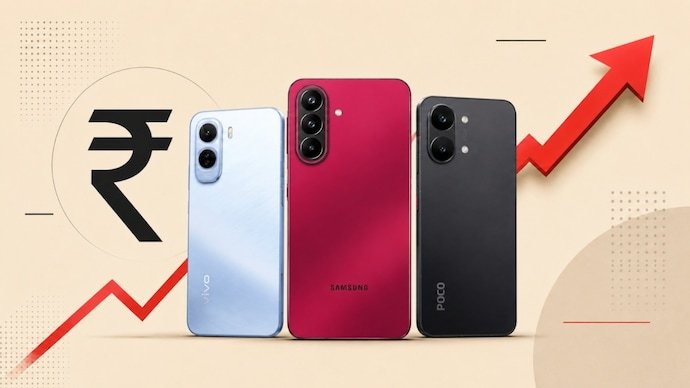
If you’ve been planning to buy a new smartphone, waiting a little longer may now cost you more. Several popular smartphone brands have revised prices across their product portfolios, with some devices becoming as much as Rs 8,000 more expensive within weeks of launch.
Samsung, Vivo and Poco are the latest manufacturers to increase prices in India, joining a growing list of companies responding to higher production costs. The biggest jump comes from Samsung’s newly launched Galaxy M47, while Vivo has increased prices across multiple T-series smartphones and Poco has revised prices for its premium X-series as well as budget M-series devices.
The latest price revisions are not isolated incidents. They reflect broader changes affecting the global electronics industry, including rising memory prices, supply chain constraints, stronger demand for AI hardware, and increasing manufacturing costs. Here’s a detailed look at what’s changing, why smartphone prices are rising, and what consumers should expect next.
Why Are Smartphone Prices Increasing?
The current wave of price hikes is being driven by several industry-wide factors rather than individual company decisions.
1. Global Memory Chip Shortage
One of the biggest reasons behind the recent smartphone price hikes is the sharp increase in the cost of DRAM (RAM) and NAND flash storage.
Memory manufacturers have shifted a significant portion of production toward high-performance chips used in Artificial Intelligence (AI) servers and data centres. As demand from cloud computing companies continues to surge, smartphone manufacturers are paying considerably more for the same memory components.
Since RAM and storage account for a substantial portion of smartphone manufacturing costs, companies have started passing some of those expenses on to consumers.
2. Rising Manufacturing Costs
Modern smartphones now include larger batteries, brighter OLED displays, advanced camera sensors, AI processors, and faster charging technologies. These upgrades improve the user experience but also increase manufacturing costs.
Premium chipsets manufactured using advanced semiconductor nodes have also become more expensive, contributing to higher production costs across flagship and upper mid-range smartphones.
3. Supply Chain Pressures
Although global supply chains have improved compared to previous years, manufacturers continue to face higher logistics, packaging, and component procurement costs.
Many brands are now reviewing pricing strategies instead of absorbing rising expenses, especially for newly launched devices.
Samsung Galaxy M47 Gets Price Hike Within Days of Launch
Samsung has implemented one of the most significant smartphone price revisions seen this year.
The Galaxy M47, launched on June 29, 2026, has received a price increase across every storage variant only days after becoming available for purchase.
The move surprised many buyers because smartphones typically receive price cuts over time—not increases immediately after launch.
| Samsung Galaxy M47 Variant | Launch Price | New Price | Increase |
|---|---|---|---|
| 6GB + 128GB | Rs 25,999 | Rs 32,999 | Rs 7,000 |
| 8GB + 128GB | Rs 28,999 | Rs 36,999 | Rs 8,000 |
| 8GB + 256GB | Rs 33,999 | Rs 41,999 | Rs 8,000 |
The revised prices are already reflected on Samsung’s official website, making the Galaxy M47 one of the fastest smartphones to receive such a significant post-launch price revision.
Vivo Increases Prices Across Multiple T-Series Smartphones
Vivo has once again revised prices across several popular smartphones after implementing earlier increases just weeks ago.
The latest revision affects the Vivo T5 Pro, Vivo T5x, and Vivo T4 Lite series.
| Vivo Smartphone | Previous Price | New Price | Increase |
|---|---|---|---|
| Vivo T5 Pro (8GB + 128GB) | Rs 32,999 | Rs 35,999 | Rs 3,000 |
| Vivo T5 Pro (8GB + 256GB) | Rs 36,999 | Rs 39,999 | Rs 3,000 |
| Vivo T5x (8GB + 128GB) | Rs 26,999 | Rs 27,999 | Rs 1,000 |
| Vivo T5x (8GB + 256GB) | Rs 28,999 | Rs 30,999 | Rs 2,000 |
| Vivo T4 Lite (4GB + 64GB) | Rs 14,999 | Rs 16,999 | Rs 2,000 |
| Vivo T4 Lite (4GB + 128GB) | Rs 16,999 | Rs 18,999 | Rs 2,000 |
| Vivo T4 Lite (6GB + 128GB) | Rs 18,999 | Rs 20,999 | Rs 2,000 |
| Vivo T4 Lite (8GB + 256GB) | Rs 20,999 | Rs 23,999 | Rs 3,000 |
These revisions follow an earlier round of price hikes, indicating that Vivo continues to adjust pricing in response to increasing component costs.
Poco Smartphones Also Become More Expensive
Poco has joined Samsung and Vivo by increasing prices across several smartphones in both the premium and affordable segments.
| Poco Smartphone | Previous Price | New Price | Increase |
|---|---|---|---|
| Poco X8 Pro Max (12GB + 256GB) | Rs 44,999 | Rs 46,999 | Rs 2,000 |
| Poco X8 Pro Max (12GB + 512GB) | Rs 48,999 | Rs 50,999 | Rs 2,000 |
| Poco X8 Pro (8GB + 256GB) | Rs 34,999 | Rs 36,999 | Rs 2,000 |
| Poco X8 Pro (12GB + 256GB) | Rs 37,999 | Rs 39,999 | Rs 2,000 |
| Poco M8 5G (6GB + 128GB) | Rs 20,999 | Rs 21,999 | Rs 1,000 |
| Poco M8 5G (8GB + 128GB) | Rs 21,999 | Rs 23,999 | Rs 2,000 |
| Poco M8 5G (8GB + 256GB) | Rs 23,999 | Rs 25,999 | Rs 2,000 |
While Poco’s increases are smaller than Samsung’s, they reinforce the growing trend of manufacturers revising smartphone prices upward.
Smartphone Brands That Have Increased Prices Recently
Samsung, Vivo and Poco are not the only companies adjusting prices.
Over recent weeks, several other manufacturers have also revised pricing for selected smartphones.
- Samsung
- Vivo
- Poco
- Nothing
- Realme
This suggests that the pricing trend is becoming industry-wide rather than being limited to one or two brands.
How Rising Memory Prices Are Affecting Smartphones
Every smartphone relies on two essential memory components:
- DRAM (RAM): Responsible for multitasking and application performance.
- NAND Flash Storage: Used for storing apps, photos, videos and operating system files.
Both components have experienced sharp price increases due to growing demand from artificial intelligence infrastructure.
Technology companies building AI models require enormous quantities of high-performance memory chips for servers and GPUs. Since semiconductor manufacturers have limited production capacity, increased AI demand has tightened supply for smartphone makers.
Industry analysts believe memory prices could remain elevated for several more quarters, potentially affecting future smartphone launches as well.
Will More Smartphone Prices Increase?
The current market signals suggest that additional price hikes remain possible.
Brands launching new smartphones later this year may either:
- Introduce higher launch prices, or
- Increase prices shortly after launch if component costs continue rising.
Mid-range smartphones between Rs 20,000 and Rs 40,000 appear particularly vulnerable because manufacturers often operate with relatively thin profit margins in this segment.
Impact on Indian Consumers
For buyers, these price revisions mean paying more for devices that were significantly cheaper only weeks ago.
The increases may also influence purchasing decisions in several ways:
- Consumers may postpone upgrades.
- Demand for older discounted models could increase.
- Exchange offers and bank discounts may become more important.
- Refurbished smartphones could see higher demand.
Budget-conscious buyers may also start considering previous-generation flagship devices instead of newly launched mid-range smartphones.
Should You Buy Now or Wait?
If you are planning to purchase a smartphone in the near future, waiting may not necessarily result in better pricing.
Unless manufacturers receive relief from falling component costs, prices could remain elevated throughout the coming months.
However, major festive sales, online shopping events, and bank offers could still provide temporary discounts that offset part of these increases.
Comparing effective prices after cashback, exchange bonuses, and EMI offers may provide better value than waiting for permanent price reductions.
Expert Insight: AI Is Changing Smartphone Economics
While consumers often associate artificial intelligence with features like AI photo editing or smarter voice assistants, the technology is also reshaping smartphone manufacturing behind the scenes.
The rapid expansion of AI data centres has dramatically increased demand for memory chips and advanced semiconductors. Since chip manufacturers prioritize higher-margin enterprise customers, smartphone brands are facing increased procurement costs.
This shift represents one of the biggest structural changes in the smartphone supply chain in years. As AI infrastructure Investment continues worldwide, manufacturers may need to rethink pricing strategies, production planning, and product positioning.
Future Outlook
The recent price hikes from Samsung, Vivo, and Poco could be the beginning of a broader pricing trend across the smartphone industry.
If memory shortages persist and AI-related demand continues to absorb semiconductor capacity, smartphone prices may remain under upward pressure through the rest of the year. Consumers can expect manufacturers to focus more on premium features, AI capabilities, and higher-margin devices while carefully managing rising production costs.
Conclusion
Samsung, Vivo, and Poco have significantly increased smartphone prices across multiple models, with hikes ranging from Rs 1,000 to Rs 8,000. The revisions highlight the growing impact of rising memory costs, AI-driven semiconductor demand, and higher manufacturing expenses on the global smartphone industry.
For Indian consumers, the changes serve as a reminder that smartphone prices are no longer guaranteed to fall after launch. As component costs continue to fluctuate, buyers may need to pay closer attention to launch pricing, festive offers, exchange deals, and overall value rather than assuming better discounts will arrive later.
For breaking news and live news updates, like us on Facebook or follow us on Twitter and Instagram. Read more on Latest Technology on thefoxdaily.com.






COMMENTS 0