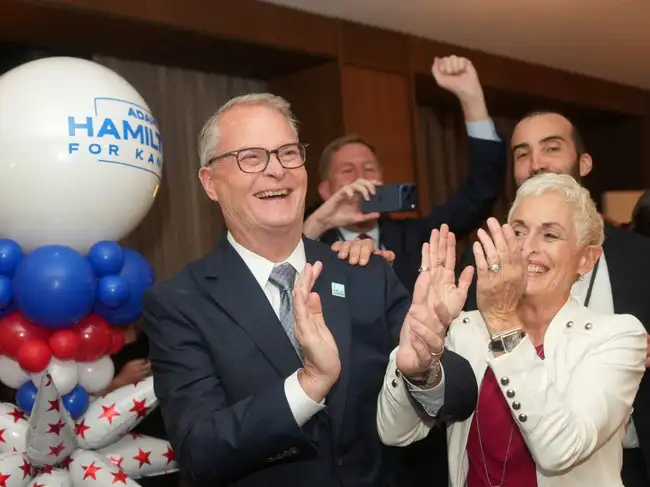
Democrat Adam Hamilton has won the Kansas Senate race, defeating incumbent Republican Senator Roger Marshall and ending a 94-year Democratic drought in the state’s US Senate elections. The result marks a significant political development in a state that has traditionally supported Republican candidates in federal elections.
Hamilton’s victory was projected by CBS News on November 3, following a closely watched contest that had attracted national attention. Marshall, who had received the backing of President Donald Trump, was seeking another term in the Senate. However, Hamilton’s campaign gained momentum by focusing on affordability, healthcare costs and a message of political cooperation.
The result is particularly notable because Kansas had not elected a Democrat to the US Senate since 1932, when George McGill won the state’s Senate election. The outcome also represents a setback for Republicans as they sought to defend their Senate seats during the 2026 midterm elections. :chatgpt-content-reference{index=”0″}
Who is Adam Hamilton, the Democrat who won in Kansas?
Adam Hamilton, 62, is a pastor, author and public speaker who leads the Church of the Resurrection, the largest United Methodist congregation in the United States. Based in the Kansas City area, he entered the Senate contest as a Democratic candidate seeking to attract voters beyond the traditional Democratic base.
A fifth-generation Kansan, Hamilton presented himself as a centrist and independent-minded Democrat. Rather than relying exclusively on party loyalty, his campaign attempted to build support among moderate Democrats, independent voters and Republicans dissatisfied with the direction of national politics.
His campaign placed affordability at the centre of its message, highlighting the cost of everyday necessities, including fuel, energy, groceries and healthcare. He also emphasised bipartisanship and argued that elected representatives should work across party lines to address issues affecting residents.
Hamilton’s approach was significant in a state where Republicans have traditionally enjoyed an advantage in federal elections. His campaign sought to demonstrate that a Democrat could compete statewide by appealing to voters concerned about economic pressures and political divisions. :chatgpt-content-reference{index=”1″}
Roger Marshall loses despite Trump’s backing
Republican Senator Roger Marshall, who represented Kansas in the Senate, was seeking a second term when he faced Hamilton. A medical doctor and former obstetrician-gynecologist, Marshall had previously served in the US House of Representatives before entering the Senate in 2021.
Marshall was a reliable supporter of Trump’s agenda and received the president’s endorsement during the campaign. Trump and Vice President JD Vance also campaigned for Republican candidates in the region as the party sought to defend vulnerable seats ahead of the midterms.
Despite the support from national Republican figures, Marshall faced a competitive challenge in a state that Trump had carried by more than 16 percentage points in the 2024 presidential election.
Marshall’s campaign attempted to defend his record and connect Hamilton with national Democratic leaders. In the final weeks, the Republican senator also sought to distance himself from some administration positions, including criticism of federal immigration enforcement.
National Republican groups redirected significant resources towards defending the Kansas seat as the race became increasingly competitive. However, the effort was not enough to prevent Hamilton from defeating the incumbent. :chatgpt-content-reference{index=”2″}
Why the Kansas Senate race became competitive
Kansas has generally been regarded as a Republican-leaning state in national elections. Before the 2026 contest, Democrats had gone 94 years without winning a US Senate election there. That history initially made the race appear difficult for Hamilton.
However, several issues helped bring the contest into national focus. Rising living costs, higher fuel prices and dissatisfaction surrounding the prolonged US war with Iran became important subjects during the campaign.
Economic concerns were particularly relevant in Kansas, where diesel prices affect agricultural operations and transportation. Hamilton used affordability as a central campaign issue, while criticising policies he argued were contributing to higher costs.
Marshall, meanwhile, defended his record and continued supporting the administration’s broader agenda. The competing approaches turned the election into a closely watched test of whether a Democratic candidate could attract enough moderate and independent voters to overcome the state’s Republican lean.
The campaign also drew attention to Marshall’s former medical practice, which had been the subject of reporting about lawsuits against hundreds of patients over unpaid medical bills. Hamilton’s campaign highlighted the issue, while Marshall defended his handling of debt collection. :chatgpt-content-reference{index=”3″}
Hamilton focused on affordability and bipartisanship
Hamilton’s campaign strategy centred on presenting himself as a candidate who could appeal to voters across party lines. He described himself as an independent-minded Democrat and sought to distance his campaign from positions that might alienate moderate and conservative voters in Kansas.
Affordability remained one of his most prominent themes. His campaign highlighted the cost of groceries, healthcare, energy and fuel, arguing that economic concerns should receive greater attention from elected representatives.
He also emphasised the need for cooperation in Washington rather than allowing political disagreements to prevent action on public concerns. This message was intended to appeal to voters who might not traditionally support Democratic candidates but were open to considering an alternative.
Hamilton’s campaign demonstrated how a candidate in a Republican-leaning state could build a broader coalition by focusing on local economic concerns and presenting a moderate political identity. His victory ended the state’s long Democratic Senate losing streak. :chatgpt-content-reference{index=”4″}
Trump and JD Vance’s involvement brought national attention
The Kansas contest attracted attention from senior Republican leaders because of its potential implications for the party’s Senate position. Trump and Vice President JD Vance campaigned for Republican candidates as the party attempted to defend seats in states where Democrats were mounting competitive challenges.
Trump’s support for Marshall underlined the importance Republicans attached to retaining the seat. The president had won Kansas comfortably in 2024, making the possibility of a Democratic Senate victory particularly significant.
Hamilton’s win therefore represents more than a change in Kansas’s Senate representation. It also adds to the wider political developments emerging from the 2026 midterm elections, in which control of Congress and the balance of power in Washington have been major issues.
The result could prompt further discussion within the Republican Party about the challenges facing its candidates in traditionally conservative states. However, the specific political consequences will depend on the overall election results and the composition of the next Senate. :chatgpt-content-reference{index=”5″}
Why the 94-year Democratic Senate drought matters
Kansas’s last Democratic Senate victory came in 1932, when George McGill was elected. Since then, Republican candidates had maintained the state’s Senate representation through successive election cycles.
The long gap made the 2026 contest historically significant. Hamilton’s victory breaks a political pattern that had lasted for nearly a century and establishes a new chapter in the state’s representation in Washington.
The result also challenges the assumption that a Republican-leaning state is beyond the reach of Democratic candidates. Hamilton’s campaign focused on issues that could appeal to voters across party lines, particularly economic pressures and the desire for a less polarised political approach.
For Democrats, the victory provides an important breakthrough in a state where the party had struggled to win Senate elections for generations. For Republicans, losing an incumbent senator in Kansas represents a setback in a state that had previously been considered a strong part of their electoral base.
What Hamilton’s victory means for the US Senate
The Kansas result is part of the wider political contest surrounding the 2026 US Midterm Elections. Senate races across the country are important because they determine which party will hold influence over legislation, committee assignments, nominations and the chamber’s broader agenda.
Hamilton’s victory gives Democrats a significant result in a state that had not elected a Democratic senator since 1932. It also highlights the importance of affordability and local economic concerns in elections where national political issues are shaping voter debates.
However, the broader impact on Senate control depends on results from other states. A single victory does not by itself determine the chamber’s final balance of power, but the Kansas outcome is a major development in the 2026 election cycle.
A historic result for Kansas politics
Adam Hamilton’s defeat of Roger Marshall ends a 94-year Democratic Senate drought in Kansas and delivers one of the most closely watched results of the 2026 midterm elections.
His campaign combined an affordability-focused message with an appeal to moderate and independent voters, while Marshall entered the race with the backing of Trump and national Republican support.
The outcome marks a historic change in Kansas’s Senate representation and raises questions about the political factors influencing voters in traditionally Republican states. Hamilton’s next challenge will be to translate his campaign message into his work in the US Senate, while the wider implications of the result become clearer as the remaining midterm election outcomes emerge.
For breaking news and live news updates, like us on Facebook or follow us on Twitter and Instagram. Read more on Latest World on thefoxdaily.com.






COMMENTS 0