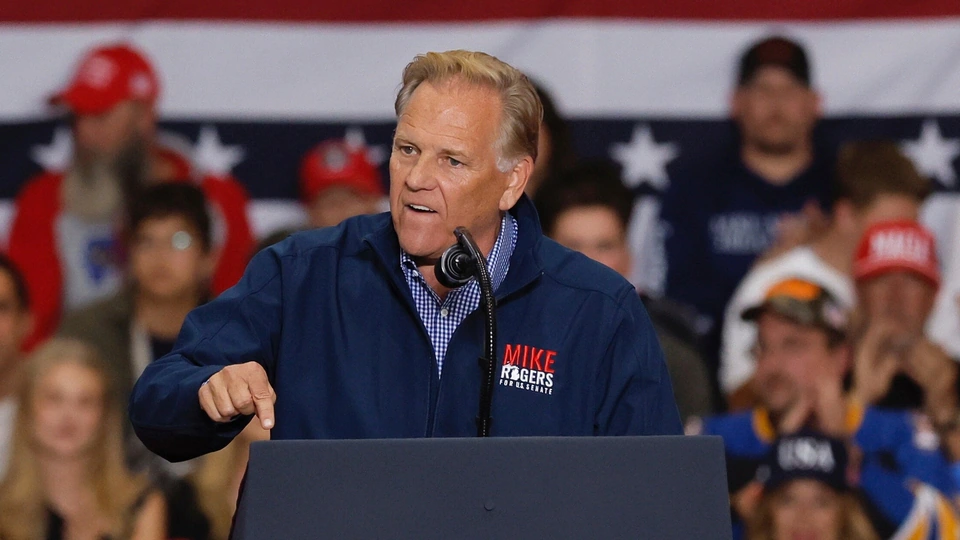
Michigan’s closely watched US Senate race moved into sharper focus on Sunday, October 25, as President Donald Trump campaigned alongside Republican candidate Mike Rogers in Port Huron. The rally came a day after former President Barack Obama appeared in Detroit to support Democratic candidate Abdul El-Sayed, highlighting the national political attention surrounding the contest ahead of the November midterm elections.
But before taking the stage alongside Trump, Rogers faced a question about his own political identity. During an interview with NBC’s Kristen Welker, the Michigan Republican was asked directly whether he considered himself a “MAGA Republican.” He did not provide a straightforward answer, instead shifting the discussion toward criticism of El-Sayed and concerns he raised about the Democratic candidate’s political positions.
The exchange put a spotlight on a central issue in the campaign: how Rogers is positioning himself within Trump’s political movement while trying to appeal to voters across Michigan. It also highlighted the increasingly heated rhetoric surrounding El-Sayed, particularly over claims about his views and alleged connections to the Muslim Brotherhood.
Mike Rogers avoids a direct answer on MAGA identity
In his interview with Welker ahead of the Port Huron rally, Rogers was asked whether he considered himself a MAGA Republican, a label associated with Trump’s political movement. Rather than answering yes or no, Rogers criticized what he described as the national media’s treatment of the Michigan Senate race.
He argued that journalists were not paying enough attention to criticism of El-Sayed from figures and groups traditionally associated with the Democratic Party. Rogers referred to the former chairman of the Democratic Party and claimed that the individual had said he could not vote for El-Sayed.
Rogers also cited what he described as opposition from Jewish Democrats and African-American voters in Detroit, Pontiac and Flint. He invoked Senator Cory Booker, claiming that Booker had characterized El-Sayed as a fringe candidate following a meeting.
These were claims made by Rogers during the interview. The supplied account does not independently establish the scale of the alleged opposition or provide additional details about the remarks he referenced.
Despite the question being about Rogers’s own political affiliation, his response remained focused on El-Sayed and the Democratic coalition. He did not clearly state whether he identified as a MAGA Republican.
The distinction matters in a campaign where Trump’s endorsement and personal participation can be major political assets for a Republican candidate. At the same time, a direct answer about the MAGA label can carry significance for voters who support Trump, as well as those who prefer a Republican candidate with a more independent political identity.
Rogers’s appearance with Trump in Port Huron placed the two men together publicly, but it did not resolve the question Welker had raised about how Rogers personally describes his political identity.
Rogers responds to concerns from Michigan’s Muslim community
Welker also challenged Rogers over how his remarks about El-Sayed might affect Muslim constituents who feel alienated by the campaign’s rhetoric. The question shifted the interview from Rogers’s political identity to the potential impact of his attacks on a candidate whose background and alleged political associations have become part of the debate.
Rogers responded by arguing that his criticism was not directed at Islam or the way Muslims practice their faith. Instead, he framed his objections as opposition to what he called a “radical Islamic agenda.”
He referred to the Muslim Brotherhood, saying the organisation was banned in five Muslim-majority countries. He then argued that Muslim residents of Michigan were an important part of their communities and understood the dangers of bringing what he described as hatred, division and anger into the state.
Rogers also claimed that a broad Democratic coalition was forming around his campaign. He used the response to return to his criticism of El-Sayed rather than directly addressing how Muslim voters who disagreed with his characterisation might view his remarks.
The exchange illustrates the sensitivity of the issue in Michigan, where Muslim communities are part of the state’s political and civic life. Statements linking a political candidate to religious extremism can influence how voters interpret a campaign, particularly when the claims involve an entire religious community or organisations associated with it.
It is important, however, to distinguish Rogers’s allegations from independently established facts. The material provided for this report does not offer evidence establishing that El-Sayed adheres to a radical Islamic agenda or has a connection to the Muslim Brotherhood. Rogers’s assertions should therefore be understood as campaign rhetoric rather than verified findings.
Trump repeats Muslim Brotherhood allegations against Abdul El-Sayed
Trump intensified the controversy during his rally with Rogers in Port Huron. The president also invoked the Muslim Brotherhood in discussing El-Sayed and questioned whether the Democratic candidate should be allowed to enter the halls of the US Capitol without additional security screening.
Trump said El-Sayed should never be allowed inside the Capitol and suggested that he should have to pass through a metal detector before entering the Senate. His remarks turned the dispute over El-Sayed’s alleged political associations into a broader attack on the candidate’s suitability for office.
The rhetoric echoed the allegations raised during Rogers’s interview. Both Republicans framed their criticism around claims involving the Muslim Brotherhood, while the supplied material does not provide independent evidence establishing the alleged association.
Trump’s comments also went beyond ordinary policy criticism by suggesting that El-Sayed should face a security measure specifically because of who he is. The remarks added another layer to an already contentious campaign, in which political disagreements have become intertwined with questions about religion, identity and national security.
For voters assessing the competing campaigns, the distinction between a substantiated security concern and an unsupported political allegation is significant. The material provided does not establish a factual basis for Trump’s proposed treatment of El-Sayed at the Capitol.
Trump and Obama bring national attention to Michigan’s Senate race
The back-to-back appearances by Trump and Obama underscored the importance both parties are placing on Michigan as the November midterm elections approach. Obama appeared in Detroit on Saturday to campaign with El-Sayed, while Trump travelled to Port Huron the following day to support Rogers.
The duelling events gave the candidates a platform to draw on prominent national political figures and attract attention beyond the state. Trump’s appearance offered Rogers the opportunity to campaign alongside the president, while El-Sayed received support from a former Democratic president.
The timing also intensified scrutiny of the candidates’ messages. Rogers used his NBC interview to challenge the Democratic candidate’s standing among some voters and to defend his own criticism of El-Sayed. Trump then reinforced the attack at the rally, focusing on allegations involving the Muslim Brotherhood and proposing additional security screening for the Democratic candidate.
For Rogers, the interview presented an opportunity to explain his relationship with Trump’s movement in his own words. Instead, his decision not to answer the MAGA question directly left that aspect of his political identity unresolved in the exchange.
For El-Sayed, the controversy illustrates how claims about religious and political affiliations can become a major feature of an election campaign. Whether such attacks persuade voters or provoke backlash will depend on how Michigan residents assess the candidates’ statements, policies and credibility.
What the interview reveals about Rogers’s campaign strategy
Rogers’s response to Welker offers a snapshot of the approach he took during the interview: redirecting attention from a question about his own political label toward criticism of his opponent. By highlighting alleged disagreements within the Democratic coalition, he sought to challenge El-Sayed’s support among voters who might otherwise be expected to back a Democratic candidate.
His answer on Muslim constituents followed a similar pattern. Although he said his criticism was not about Islam or how Muslims pray, he continued to describe El-Sayed’s positions using language associated with religious extremism. That approach allowed Rogers to present his argument as a matter of political ideology while also raising questions about how voters from the Muslim community might interpret the distinction.
Rogers’s refusal to provide a clear answer on whether he is a MAGA Republican leaves room for different interpretations. It does not, by itself, establish that he is distancing himself from Trump or rejecting the movement. His joint campaign appearance with the president demonstrates their public political alignment, but the interview did not produce an explicit statement from Rogers about the label.
The episode also shows how national political identities and local electoral concerns can overlap. In a competitive Senate contest, candidates must explain their positions to voters while responding to the influence of national figures and broader ideological debates. Rogers’s interview became a discussion not only about his political identity but also about the claims his campaign is making against El-Sayed.
Key questions remain ahead of the November midterms
Several questions remain central to the Michigan Senate contest. One is how Rogers’s association with Trump will affect his appeal to voters with different views of the president and the MAGA movement. Another is whether the campaign’s attacks on El-Sayed will shift attention toward the Democratic candidate’s positions or generate further scrutiny of the evidence behind those allegations.
The interview also raises questions about how candidates address concerns from communities that feel targeted by campaign rhetoric. Rogers argued that his objections were about ideology rather than religion, but the impact of such statements will ultimately depend on how voters understand them and whether they find the distinction convincing.
Trump’s participation adds further weight to the dispute. His comments about metal detectors and the Capitol escalated the criticism of El-Sayed beyond a disagreement over policy, while the supplied material does not establish the factual basis for the allegations used to justify that rhetoric.
With both Trump and Obama appearing on the campaign trail over the weekend, Michigan’s Senate race is attracting significant national attention. Rogers’s interview with Welker has added a new point of discussion: despite campaigning alongside Trump, the Republican candidate declined to identify himself directly as a MAGA Republican when asked.
As the midterms approach, the contest will test how voters respond to national political endorsements, competing claims about candidates and increasingly sharp rhetoric. For now, Rogers’s answer to Welker remains notable for what it did not include: a clear yes-or-no response about whether he considers himself part of Trump’s MAGA movement.
For breaking news and live news updates, like us on Facebook or follow us on Twitter and Instagram. Read more on Latest World on thefoxdaily.com.




COMMENTS 0