For years, Bangladesh was held up as an unlikely development success story. Despite political instability, weak institutions and widespread governance problems, the South Asian country achieved rapid economic growth, reduced poverty and expanded its manufacturing exports. Its Garment Industry became a major source of employment and foreign exchange, while improvements in health and education helped transform living standards.
That progress is now under pressure. A banking crisis built on years of questionable lending, political influence and corruption has left financial institutions struggling with enormous volumes of unpaid loans. At the same time, labour unrest is disrupting garment factories, inflation is reducing household purchasing power and businesses are facing weaker access to credit.
The political transition following the removal of former Prime Minister Sheikh Hasina in 2024 has created an opportunity to address longstanding problems. However, the government led by the Bangladesh Nationalist Party (BNP) is inheriting an economy in which financial weaknesses and political uncertainty are closely connected.
The challenge is no longer simply to maintain economic growth. Bangladesh must restore confidence in its banks, protect its export industries and rebuild the institutions needed to sustain development.
Bangladesh’s Banking Crisis Has Reached a Critical Level
One of the clearest signs of the country’s economic difficulties is the condition of its Banking Sector. Depositors at several institutions have reported problems accessing their savings, while weak banks struggle with liquidity and deteriorating loan portfolios.
The underlying problem is the accumulation of non-performing loans (NPLs). These are loans on which borrowers have stopped making payments for a specified period or which are otherwise classified as unlikely to be repaid. When bad loans accumulate, banks have fewer resources available to support new lending and must set aside more money to cover potential losses.
Bangladesh Bank data showed that classified loans reached approximately 33.2% of total outstanding loans in June 2026. In practical terms, roughly one out of every three taka lent by banks had been classified as a non-performing loan. The central bank has also identified Islamic banks and state-owned institutions as particularly vulnerable. :chatgpt-content-reference{index=”0″}
The problem is not limited to individual banks. Weak asset quality and inadequate capital have affected the wider financial system, reducing its ability to provide credit to businesses and households.
Bangladesh Bank’s monetary policy review reported that the banking system’s overall capital-to-risk-weighted-assets ratio had fallen to -2.64% in December 2025. The figure indicates the severity of capital shortages and the need for substantial financial repair. :chatgpt-content-reference{index=”1″}
For ordinary depositors, the crisis is particularly damaging because bank savings often represent years of accumulated income. For businesses, unreliable banking services and limited credit make it harder to pay suppliers, purchase raw materials and expand operations.
How Political Influence and Bad Lending Weakened Banks
Bangladesh’s banking problems developed over many years and became closely connected to the country’s political and business networks. During Sheikh Hasina’s 15-year rule, politically connected individuals were accused of gaining influence over financial institutions and using their positions to secure loans for affiliated companies.
According to economists examining the legacy of the previous administration, weak oversight and politically influenced lending allowed large amounts of money to flow towards borrowers who were unable or unwilling to repay their debts.
Some of the worst problems are concentrated in state-owned banks and Islamic financial institutions. These banks had senior appointments linked to political networks, while the country’s better-performing commercial lenders have generally faced less severe asset-quality problems.
One frequently discussed example is Islami Bank Bangladesh, a major lender whose ownership and management became controversial after its takeover by the S Alam Group. The group and its owner, Mohammed Saiful Alam Masud, have faced allegations concerning the bank’s lending and control. Masud has denied wrongdoing, while Jamaat-e-Islami has argued that earlier allegations against the bank were used to transfer control to politically favoured interests.
The case illustrates how banking institutions can become vulnerable when lending decisions are influenced by political connections rather than borrowers’ financial strength and repayment capacity.
Restoring the sector will therefore require more than providing banks with additional money. Authorities must also improve governance, examine questionable loans, strengthen supervision and ensure that influential borrowers are treated according to the same rules as other customers.
Why Bangladesh’s Official Bad-Loan Figures Changed So Sharply
The increase in Bangladesh’s reported non-performing loans does not mean that all the financial damage occurred recently. Part of the rise reflects a change in how authorities classify overdue loans.
In 2019, Bangladesh Bank introduced a special rescheduling arrangement that allowed certain borrowers to make a relatively small repayment and defer further payments. Under the arrangement, loans could receive extended repayment periods and avoid being classified as non-performing under the previous rules.
This made the official figures appear healthier than the underlying financial position. The International Monetary Fund warned in 2020 that the actual proportion of bad loans could be substantially higher than the reported level.
In 2025, the interim government changed the classification framework to bring it closer to international standards, including the treatment of loans that remain overdue for 90 days. The adjustment exposed a much larger volume of troubled lending that had previously been concealed or treated more leniently.
The distinction matters. A higher reported NPL ratio partly reflects the recognition of existing losses rather than an equivalent amount of new defaults occurring in a short period. However, the scale of the problem confirms that the banking system needs deeper reform.
Garment Industry Protests Add to Bangladesh’s Economic Pressure
Bangladesh’s garment industry is another major source of concern. The sector employs millions of workers and generates the overwhelming majority of the country’s merchandise export earnings. It has been central to the country’s development model, providing jobs and connecting domestic manufacturers to international markets.
However, workers have been protesting over wages and living costs. Many garment employees say their earnings have failed to keep pace with inflation, forcing families to reduce spending on food, healthcare and education.
In November 2026, fresh demonstrations over demands for a higher minimum monthly wage disrupted production in several industrial areas. Workers have called for the minimum wage to rise from 12,500 taka to 30,000 taka, while factory owners have warned that prolonged unrest and higher operating costs could threaten businesses.
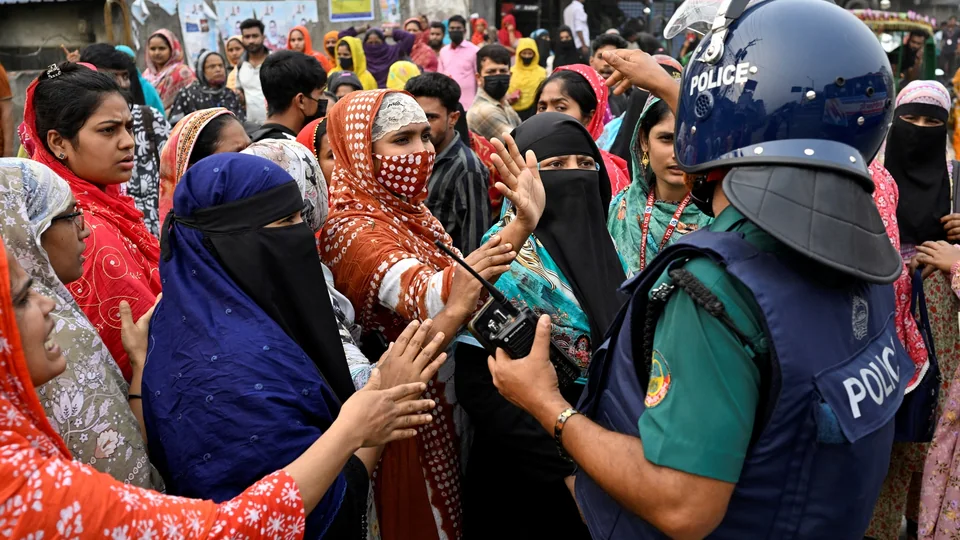
Factories in areas including Gazipur, Savar and Ashulia have faced closures and disruption. Police have used tear gas and other measures to disperse demonstrations, while reports have documented clashes and damage during the unrest. :chatgpt-content-reference{index=”2″}
The dispute presents a difficult economic balancing act. Workers need higher wages to cope with rising prices, but manufacturers operate in a competitive international market where production costs influence orders and investment decisions.
Prolonged factory closures could affect delivery schedules, damage relationships with international buyers and weaken export earnings. At the same time, suppressing wage demands without addressing workers’ living conditions risks further unrest and instability.
For the government, resolving the dispute is important not only for labour relations but also for protecting one of Bangladesh’s most valuable sources of economic growth.
Political Transition Has Not Yet Delivered Economic Stability
Sheikh Hasina’s government was removed from power in August 2024 after student-led protests developed into a nationwide uprising. Her departure ended a 15-year period of Awami League rule and opened the way for an interim administration to oversee the transition.
The political change raised expectations that Bangladesh could address corruption, strengthen democratic institutions and reform public bodies weakened by years of political influence.
Following elections in February 2026, the Bangladesh Nationalist Party replaced the interim administration and took responsibility for governing the country. However, the new government has inherited serious economic and political challenges.
The BNP must address the banking crisis while managing labour unrest, inflation and pressure on public finances. It must also demonstrate that political influence will no longer determine how banks operate or how public resources are distributed.
Meanwhile, Sheikh Hasina remains a source of political tension. She has been sentenced to death in absentia over her role in the crackdown on protesters, and reports of a possible return to Bangladesh have added to uncertainty. Recent bomb attacks and other incidents have further complicated the security environment.
The government has blamed the Awami League for some of the violence, although responsibility for individual incidents must be established through investigations. The political situation remains sensitive because any renewed confrontation between rival groups could distract the administration from economic reforms.
Economic Growth Is Slowing as Poverty Rises
The banking crisis and political uncertainty are affecting Bangladesh’s wider economic performance. Weak banks are less capable of providing loans to businesses, while uncertainty discourages companies from making long-term investments.
The World Bank’s October 2026 Bangladesh Development Update projected economic growth of 3.4% in both FY2026 and FY2027. It identified financial-sector vulnerabilities, energy constraints, weak revenue collection and subdued investment as major obstacles to recovery. :chatgpt-content-reference{index=”3″}
This represents a significant slowdown compared with the stronger growth rates Bangladesh recorded during much of the previous decade.
The consequences are visible in household finances. Persistent inflation has reduced the purchasing power of workers, while job creation has weakened. The World Bank reported that approximately 2.1 million more people were living in poverty in FY2026 than in the previous year. :chatgpt-content-reference{index=”4″}
Rising poverty is particularly concerning because reducing it was one of the most important achievements of Bangladesh’s development model. A prolonged slowdown could make it harder for low-income families to afford education, healthcare and other essential services.
The pressure also extends to young people entering the labour market. Slower investment and weaker industrial activity can limit opportunities for new workers, while existing employees face concerns about wages and job security.
Energy Shortages and the Iran War Have Added to the Pressure
Bangladesh’s economic slowdown cannot be explained by banking and political problems alone. Energy supply difficulties and international developments have also affected industrial production.
Bangladesh depends heavily on imported energy to support its electricity generation and industrial activity. Disruptions in international fuel supplies can increase costs and make it harder for factories to maintain consistent production.
The conflict in the Middle East has added uncertainty to energy markets and raised concerns about the cost and availability of imported fuel. For a country with limited fiscal resources, higher energy import costs can create additional pressure on the budget and foreign exchange reserves.
Factories need reliable electricity and fuel to meet production schedules. When supplies become uncertain, manufacturers may reduce output, delay orders or incur additional costs. These problems can affect export competitiveness, particularly in industries operating on tight delivery schedules.
The World Bank has identified energy-sector weaknesses and external shocks as important risks to Bangladesh’s recovery. It has also warned that the country’s limited fiscal space makes it harder to absorb prolonged disruptions. :chatgpt-content-reference{index=”5″}
Government Faces a Difficult Bank Rescue
One of the most difficult tasks facing the BNP government is deciding how to stabilise the banking system without placing an unsustainable burden on public finances.
The central bank has already provided emergency liquidity support to weaker institutions. However, liquidity assistance cannot solve a deeper capital problem when banks have accumulated large losses and borrowers are unable to repay their loans.
Moody’s has estimated that Bangladesh’s banking sector could require recapitalisation equivalent to around 10% of GDP over several years. Such a programme would require substantial public resources and careful decisions about which institutions can be repaired and which may need restructuring.
The government has limited room to finance a rescue. Bangladesh collects a relatively small share of its economic output in taxes, restricting the money available for public investment, social protection and financial-sector support.
The World Bank reported that revenue collection stood at approximately 8.3% of GDP in FY2026, among the lowest levels internationally. It also highlighted the widening fiscal deficit and the pressure created by subsidies and other public spending commitments. :chatgpt-content-reference{index=”6″}
That creates a difficult choice. A large bank rescue could divert resources from essential services and infrastructure, while delaying intervention could allow financial weaknesses to spread further through the economy.
Why Repeated Loan Rescheduling Could Make the Crisis Worse
Another concern is the use of loan rescheduling to support distressed borrowers. In June, the government introduced a new interest-rescheduling arrangement for certain borrowers, while further rules affected how banks could price lending risks.
Rescheduling can be useful when a financially viable business faces temporary difficulties and needs more time to repay its debts. However, repeatedly extending repayment periods for borrowers who cannot realistically repay their loans can hide the true condition of bank balance sheets.
If banks continue to carry loans that are unlikely to be recovered, they may lack the capital needed to support productive businesses. This can create a cycle in which weak lending practices damage banks, weak banks restrict credit and limited credit slows economic growth.
Finance Minister Amir Khosru Mahmud Chowdhury has defended the government’s approach, saying the objective is to clean up bank balance sheets while giving viable borrowers additional time where appropriate.
The challenge is to distinguish between businesses that need temporary support and borrowers whose debts have become effectively unrecoverable. Without transparent rules, loan relief could create opportunities for politically connected individuals to avoid responsibility for financial losses.
Can Bangladesh Recover Its Development Momentum?
Bangladesh still has important economic strengths. Its garment manufacturing base, established export relationships, large workforce and overseas remittance flows provide foundations for recovery. The country also has experience in reducing poverty and expanding access to essential services despite institutional weaknesses.
However, those strengths cannot compensate indefinitely for a banking system that struggles to finance businesses, a government with limited revenue and an industrial sector facing repeated disruption.
Restoring confidence will require a credible programme of banking reform. That means recognising genuine losses, recovering assets where possible, improving supervision and preventing political interference in lending decisions.
The government will also need to strengthen tax collection so that it has more resources to invest in infrastructure, education, healthcare and social protection. A stronger revenue system would reduce dependence on borrowing and give the state greater flexibility during economic shocks.
In the garment sector, a sustainable agreement between workers, factory owners and the government will be essential. Better wages and working conditions need to be balanced with measures that protect the industry’s competitiveness and support investment in higher-value production.
Political stability will matter just as much. Investors need confidence that rules will be applied consistently, contracts will be respected and economic institutions will operate independently of political networks.
Bangladesh’s Development Success Is Facing Its Biggest Test
Bangladesh’s rise from a poor and vulnerable newly independent country to a major manufacturing and development success was never guaranteed. Its progress came despite political instability and institutional weaknesses, supported by export growth, remittances, social improvements and the expansion of the garment industry.
But the same weaknesses that were once overshadowed by economic growth are now becoming harder to ignore. Bad loans have damaged banks, weak tax collection limits the government’s ability to respond, and political uncertainty is affecting confidence among workers and businesses.
The BNP government has inherited an opportunity to address problems that accumulated over many years. Whether it can do so will depend on its willingness to pursue transparent reforms rather than repeat the practices that contributed to the crisis.
Bangladesh is not without economic strengths, but its development model can no longer rely on growth alone to conceal institutional failures. Restoring trust in banks, protecting workers and strengthening public finances will be essential if the country is to regain its earlier momentum.
The next phase of Bangladesh’s development will therefore be determined not only by how quickly its economy grows, but by whether its political and financial institutions can become strong enough to support that growth.
For breaking news and live news updates, like us on Facebook or follow us on Twitter and Instagram. Read more on Latest World on thefoxdaily.com.






COMMENTS 0