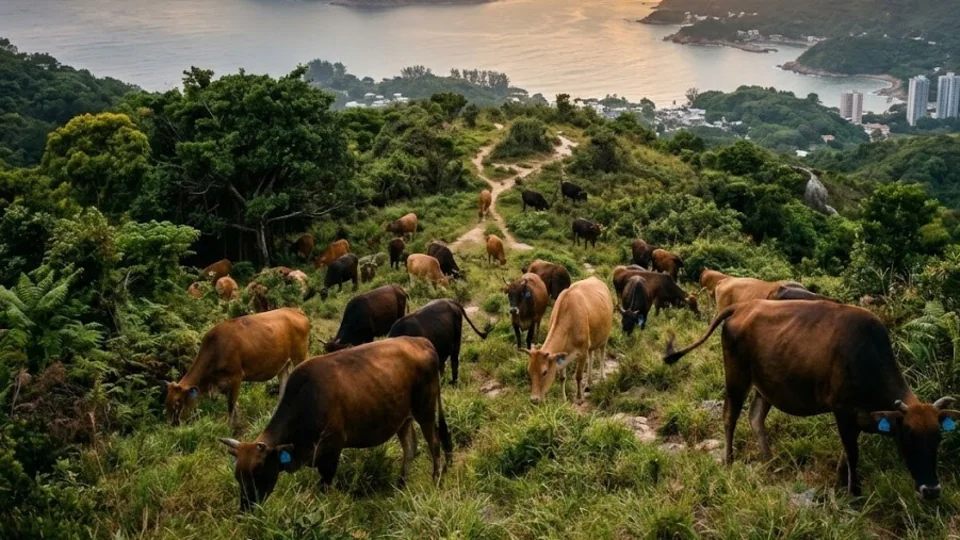
A population of feral cattle roaming the hills and countryside of Hong Kong is offering scientists a rare opportunity to investigate how domesticated animals change after generations without regular human management. A 2026 genome study sequenced 30 feral Hong Kong cattle and compared their DNA with that of 116 cattle from four major populations, uncovering clues about their genetic ancestry, diversity and possible adaptations to the local environment.
The findings suggest that these cattle have a complex evolutionary history. Although they are most closely related to East Asian indicine cattle, their genomes also contain genetic signatures associated with ancient ancestry from wild bovines, including banteng and gaur. Researchers identified genomic regions potentially connected to heat stress response, immunity, metabolism, bone density and coat pigmentation.
One of the study’s most notable findings was that the feral population retained relatively high genetic diversity despite its small size and evidence of inbreeding. This combination makes the Hong Kong herd particularly interesting to researchers investigating how population isolation and natural selection influence genetic variation.
The findings do not establish that every identified genetic difference is an adaptation. Instead, they provide potential explanations for the animals’ distinctive characteristics and offer directions for future research into how cattle respond to environmental pressures after human management declines.
How Did Domestic Cattle Become Feral in Hong Kong?
The history of Hong Kong’s feral cattle is closely connected to changes in the territory’s agricultural economy. Cattle once played an important role as working animals for farmers, helping support traditional farming practices. As economic conditions changed, however, cattle farming declined and the need for working animals diminished.
During the 1970s, some cattle were abandoned and began roaming freely. Over subsequent generations, their descendants formed a distinctive feral population living largely without the controlled breeding, veterinary care and protection associated with conventional livestock management.
Rather than being deliberately bred to survive particular environmental conditions, these animals have faced the challenges of their surroundings with much less direct human intervention. Their history provides an opportunity to investigate how domesticated cattle populations change when the selective pressures imposed by farming are reduced.
Researchers estimate that Hong Kong’s feral cattle population numbers approximately 1,000 animals. The study’s samples were collected mainly from Sai Kung, Lantau Island, and the eastern and northern New Territories.
These locations provide the geographical context for examining the cattle as a population shaped by isolation and generations of free-ranging life. The animals’ continued presence also connects modern Hong Kong to an earlier period when cattle were more closely associated with farming and rural livelihoods.
Why Are Hong Kong’s Feral Cattle Important for Genetic Research?
Feral animals can help scientists investigate what happens when domesticated populations become less dependent on people. Conventional livestock are commonly managed through controlled breeding, veterinary treatment and other practices designed to improve productivity and maintain herd health.
Feral cattle experience a different set of conditions. Without the same degree of human management, their survival and reproduction are influenced more directly by their environment, the animals with which they breed and the genetic variation present in the population.
This does not mean that every characteristic observed in feral animals developed because of natural selection. Some traits may reflect genetic inheritance from earlier cattle populations, while others could result from random changes in a relatively isolated population. Distinguishing between these explanations is an important part of genetic research.
Hong Kong’s feral cattle are particularly valuable because earlier research had already suggested that the population was genetically distinctive and carried evidence of ancestry linked to wild bovines.
The 2026 study builds on that earlier work by examining the animals’ genomes at much greater resolution. Its results offer a broader picture of their genetic history and identify regions that may be relevant to how the population has changed over time.
How the 2026 Study Analysed the Cattle’s DNA
The researchers sequenced the genomes of 30 feral Hong Kong cattle at a coverage depth of 30x. Genome sequencing makes it possible to examine genetic variation across a much broader portion of an animal’s DNA than approaches that focus on a limited selection of genetic markers.
The team compared the results with data from 116 cattle belonging to four major populations. This comparison helped researchers examine the relationship between Hong Kong’s feral cattle and other cattle groups, investigate evidence of historical genetic mixing and identify characteristics that distinguish the Hong Kong population.
Genome-wide analysis can reveal patterns that may be difficult to detect when researchers examine only selected regions of DNA. By considering variation across the genome, scientists can investigate population relationships and search for signatures of ancestry, isolation and possible natural selection.
The study also examined copy-number variation, a type of genetic difference involving the number of copies of particular DNA segments. These variations can affect how genes function and may contribute to differences in physical characteristics.
However, identifying an association between a genetic region and a trait is not the same as demonstrating that the region causes that trait. The study identifies several candidate regions that require additional investigation before their biological effects can be confirmed.
Hong Kong Cattle Are Closely Related to East Asian Indicine Cattle
One of the central findings was that Hong Kong’s feral cattle were most closely related to East Asian indicine cattle. Indicine cattle are a major cattle group, and the genetic similarities identified in the study help place the Hong Kong animals within a broader population history.
Despite this relationship, the feral cattle displayed a genetic signature of their own. Their distinctiveness suggests that their history cannot be understood simply by treating them as an unchanged sample of another East Asian cattle population.
Generations of isolation may have contributed to the development of their distinctive genetic profile. Changes in population size, breeding patterns and environmental conditions can all influence the distribution of genetic variants over time.
The researchers also found evidence that the ancestors of Hong Kong’s feral cattle received genetic contributions from two wild bovines: banteng and gaur. This finding adds another layer to the population’s history, suggesting that the ancestry of today’s animals includes genetic influences that predate their existence as a feral herd in Hong Kong.
These results are important because they distinguish between the animals’ recent history and the much older events that helped shape their genomes. Although the cattle began roaming freely in Hong Kong after their abandonment in the 1970s, some of their genetic characteristics appear to have originated thousands of years earlier.
Ancient Banteng and Gaur Ancestry Found in the Genome
The study identified genetic contributions from banteng and gaur in the ancestry of the cattle’s predecessors. Both are wild bovines, and their genetic signatures provide clues about ancient interactions between different bovine lineages.
According to the study’s estimates, genetic introgression from banteng occurred approximately 8,900 years ago, while introgression from gaur occurred around 9,900 years ago.
Introgression refers to the movement of genetic material from one population or species into another through hybridisation and subsequent breeding. When such genetic contributions persist across generations, they can become part of the recipient population’s genome.
The estimated dates suggest that these genetic contributions entered the lineage long before cattle were abandoned in Hong Kong during the 1970s. They therefore represent part of the animals’ deeper evolutionary background rather than changes that necessarily developed during their recent feral existence.
The distinction is important when interpreting the results. The modern herd’s distinctive genetic profile reflects a combination of historical ancestry and the effects of more recent population processes. Its wild-bovine genetic contributions may help scientists reconstruct relationships among cattle lineages, but the presence of those contributions does not by itself prove that they provide a particular survival advantage.
Further research would be needed to establish whether specific inherited variants from banteng or gaur influence traits that are useful under the environmental conditions experienced by Hong Kong’s feral cattle.
Why High Genetic Diversity Matters in a Small Cattle Population
Another notable finding was the relatively high genetic diversity of the Hong Kong cattle population. Although researchers found evidence of inbreeding and a decrease in effective population size, the animals retained substantial genomic variation.
Genetic diversity refers to the range of genetic differences present within a population. A population with greater diversity contains more variation in its genetic makeup, while a population with lower diversity has fewer genetic differences among its members.
This variation matters because it can influence how populations respond to environmental changes, diseases and other pressures. Different genetic variants may affect characteristics such as physiology, immunity and the ability to tolerate particular conditions.
However, high genetic diversity does not automatically mean that a population is free from genetic risks. The researchers also identified evidence of inbreeding, demonstrating that the herd’s genetic history involves more than one process.
Understanding Inbreeding and Effective Population Size
Inbreeding occurs when closely related animals reproduce, increasing the likelihood that their offspring inherit matching copies of genetic variants from shared ancestors. Depending on the variants involved, this can increase the expression of harmful recessive traits.
Effective population size is a genetic measure related to how many individuals contribute to the next generation. It is not necessarily the same as the total number of animals counted in the wild. Differences in reproductive success, population structure and breeding patterns can cause effective population size to be smaller than the actual number of animals.
The Hong Kong cattle findings illustrate why researchers need to examine several measures when assessing a population’s genetic condition. A herd can retain considerable genetic variation while also showing evidence of inbreeding and a reduced effective population size.
The study also found that the Hong Kong cattle had longer segments of matching DNA sequences than several other indicine populations. Such patterns can provide information about relatedness and population history, although their interpretation depends on the wider genetic context.
Together, these findings offer a more detailed picture of the herd’s genetic structure. They also raise questions about how the population’s diversity may change in future generations if isolation and breeding patterns remain similar.
Possible Genetic Adaptations to Hong Kong’s Environment
To investigate whether environmental pressures may have shaped the cattle’s genomes, the researchers searched for regions showing evidence consistent with natural selection. Natural selection occurs when inherited traits influence an organism’s survival or reproduction, causing some genetic variants to become more common over generations.
The team identified genomic regions associated with traits that could be relevant to survival, including heat resistance, bone density and coat pigmentation. Other regions were linked to biological functions involving development, immunity and metabolism.
These findings suggest possible connections between the cattle’s genetic profile and the conditions in which they live. However, the associations should be interpreted cautiously. A genomic region associated with a particular biological function is a candidate for further investigation, not definitive proof that a specific variant evolved to improve survival.
Confirming an adaptation typically requires additional evidence about how the genetic variation affects the organism, how the trait influences survival or reproduction, and whether the pattern is consistent with natural selection rather than other evolutionary processes.
ADRA1A and the Heat Stress Response
One of the specific regions highlighted in the study was associated with the ADRA1A gene, which the researchers linked to heat stress response.
Heat tolerance is a potentially relevant characteristic for cattle living outdoors in a warm environment. Animals must maintain normal physiological functions while dealing with changes in temperature and other environmental conditions.
The identification of a genomic region associated with heat stress response provides a possible direction for future research. Scientists could investigate whether particular variants influence measurable heat-related traits and whether those differences affect the cattle’s ability to cope with local conditions.
Nevertheless, the study’s findings do not establish that ADRA1A alone determines heat tolerance in Hong Kong’s feral cattle. Heat response is a complex biological characteristic that may involve multiple genes, physiological processes and environmental factors.
The reported association should therefore be treated as a candidate genetic clue rather than confirmation of a fully understood adaptation.
Genetic Regions Linked to Immunity, Development and Metabolism
Beyond heat stress response, the researchers identified other genomic regions associated with biological functions involving immunity, development and metabolism.
Immunity is important for the body’s ability to respond to pathogens, while metabolism involves the processes through which organisms obtain and use energy. Development includes the biological processes that influence how an animal grows and its body takes shape.
These functions are relevant to the biology of free-ranging animals, which encounter environmental conditions without the same level of veterinary care and controlled management as conventional livestock. Even so, the presence of a genetic association does not demonstrate that the cattle have superior immunity, a particular metabolic advantage or a specific developmental adaptation.
Further research would be needed to connect the candidate genomic regions to measurable traits in the animals. Scientists would also need to establish whether any observed differences have a genetic basis and whether they affect survival or reproductive success.
Could Genetic Variation Explain the Cattle’s Distinctive Appearance?
Hong Kong’s feral cattle display a range of physical characteristics, including varied fur patterns, different horn shapes, asymmetrical humps and irregular body profiles. These visible differences provide another reason to investigate the population’s genetic variation.
The study examined copy-number variation in several genes, including NINL, DEXI and CIITA. The researchers suggested that variation involving these genes may help explain differences in coat colour.
Copy-number variation occurs when individuals differ in the number of copies of a particular DNA segment. Such differences can influence biological processes, depending on the genes and genomic regions involved.
By examining these variations, scientists can investigate whether particular genetic patterns are associated with differences in coat pigmentation or other physical characteristics. This approach may help explain why animals within the same feral population can display visibly different appearances.
However, the study does not establish that the identified genes fully explain the range of physical traits seen in Hong Kong’s cattle. Nor does it confirm that every unusual body feature is an adaptation to free-ranging life.
The researchers identified candidate regions that need further testing. Additional work would be required to establish how the genetic variations affect coat colour and whether other genes, environmental influences or developmental factors contribute to the animals’ appearance.
What Earlier Research Discovered About Hong Kong’s Cattle
The 2026 research builds on an earlier study published in 2020, which had already found that Hong Kong cattle were genetically distinctive and showed evidence of ancestry connected with wild bovines.
That earlier investigation examined 21 Hong Kong cattle alongside 703 animals representing 36 cattle populations and wild species, including gaur and banteng. The work provided an initial picture of the population’s genetic relationships and suggested that its ancestry included contributions from wild bovines.
The newer research expands on those findings by examining the full genomes of 30 feral Hong Kong cattle. The researchers sequenced the animals at 30x coverage depth, allowing them to investigate genetic variation across the genome rather than relying mainly on selected genetic markers.
The broader analysis made it possible to examine ancestry, population structure and candidate regions associated with traits of potential biological significance. It also provided evidence about the coexistence of high genetic diversity, inbreeding and a reduced effective population size.
The two studies therefore contribute different levels of detail to understanding the same population. The earlier research established that the Hong Kong cattle were genetically distinctive, while the 2026 study explored their genome-wide variation and identified additional clues about ancient ancestry and possible adaptation.
What the Findings Mean for Understanding Animal Evolution
The Hong Kong cattle study offers a case study of how domesticated animals can change when human management declines. The population’s current genetic profile reflects ancient ancestry, population isolation and the effects of generations of free-ranging life.
Its combination of high genetic diversity and inbreeding is particularly relevant to understanding the effects of population structure. It demonstrates that the genetic condition of a population cannot be described accurately using a single measure alone.
The findings about banteng and gaur ancestry also illustrate how present-day animal populations can preserve genetic traces of events that occurred thousands of years ago. Such evidence can help researchers reconstruct relationships between populations and investigate how genetic material has moved between lineages.
Meanwhile, the candidate regions associated with heat stress response, immunity, metabolism, bone density and pigmentation provide opportunities to study the biological effects of genetic variation. Future research could investigate which associations have measurable effects and whether any of them contribute to the animals’ ability to survive in their environment.
The study does not show that feral cattle necessarily become better adapted than managed cattle in every respect. Instead, it highlights how reduced human management creates a different context in which inherited variation, breeding patterns and environmental conditions interact.
Why the Findings Matter for Hong Kong
Beyond their scientific value, the feral cattle are a living reminder of Hong Kong’s agricultural history. Their presence reflects a period when cattle were used as working animals and the later economic changes that led to the decline of traditional cattle farming.
The animals’ transition from managed livestock to a free-ranging population has created a distinctive research opportunity. Their genomes preserve clues about their deeper ancestry while also recording aspects of their more recent population history.
Studying the herd can help scientists better understand the relationship between domestication, isolation and environmental pressures. It may also provide information relevant to the genetic diversity and long-term population history of cattle more broadly.
The research does not, however, provide a complete explanation for every feature of the animals or establish the long-term outlook for the population. Its findings identify patterns and candidate genetic regions that require additional investigation.
As a result, the cattle have significance beyond their unusual presence in the landscape. They offer a connection between Hong Kong’s agricultural past and current scientific efforts to understand animal genetics and Evolution.
What Researchers Still Need to Investigate
Although the genome study provides several important clues, further research is needed to determine how the identified genetic differences affect the animals in practice.
One priority is to test candidate genomic regions associated with heat stress response and other biological functions. Researchers would need to investigate whether specific variants influence measurable traits and whether those traits affect survival or reproduction under local environmental conditions.
Another area for future investigation is the relationship between genetic diversity, inbreeding and effective population size. Understanding how these factors interact could help clarify the population’s genetic structure and how it may change across generations.
The candidate genes associated with coat pigmentation also require further examination. Researchers would need to establish whether the copy-number variations involving NINL, DEXI and CIITA directly contribute to differences in coat colour or are associated with other genetic factors.
The ancient ancestry findings raise additional questions about the effects of banteng and gaur genetic contributions. Further studies could investigate whether these inherited sequences have identifiable functional effects or mainly provide information about the population’s evolutionary history.
These questions are important because genome-wide studies often identify potential relationships before scientists understand the underlying biological mechanisms. The Hong Kong cattle research provides a foundation for further work, but the candidate associations should not be treated as final explanations.
Conclusion: A Small Feral Herd With a Complex Genetic History
The 2026 genome study of 30 feral Hong Kong cattle reveals a population with a distinctive genetic profile shaped by ancient ancestry, isolation and generations of life outside conventional livestock management.
The cattle were found to be most closely related to East Asian indicine cattle, while also carrying genetic contributions associated with banteng and gaur that may have entered their lineage approximately 8,900 and 9,900 years ago, respectively. The study also identified relatively high genetic diversity alongside evidence of inbreeding and a reduced effective population size.
Researchers identified candidate genomic regions associated with heat stress response, bone density, coat pigmentation, immunity, development and metabolism. Variations involving genes such as NINL, DEXI and CIITA may help explain differences in coat colour, while the ADRA1A region was associated with heat stress response. These findings remain candidates for further testing rather than definitive proof of specific adaptations.
Ultimately, Hong Kong’s feral cattle offer scientists an unusual opportunity to investigate how domesticated animals evolve when human influence diminishes. Their genomes connect the territory’s agricultural history with ancient bovine ancestry and modern questions about genetic diversity, natural selection and adaptation.
While many details remain to be confirmed, the study shows how a relatively small population of free-ranging cattle can preserve a complex evolutionary history and provide valuable clues for understanding the processes that shape animal populations over time.
For breaking news and live news updates, like us on Facebook or follow us on Twitter and Instagram. Read more on Latest World on thefoxdaily.com.


COMMENTS 0