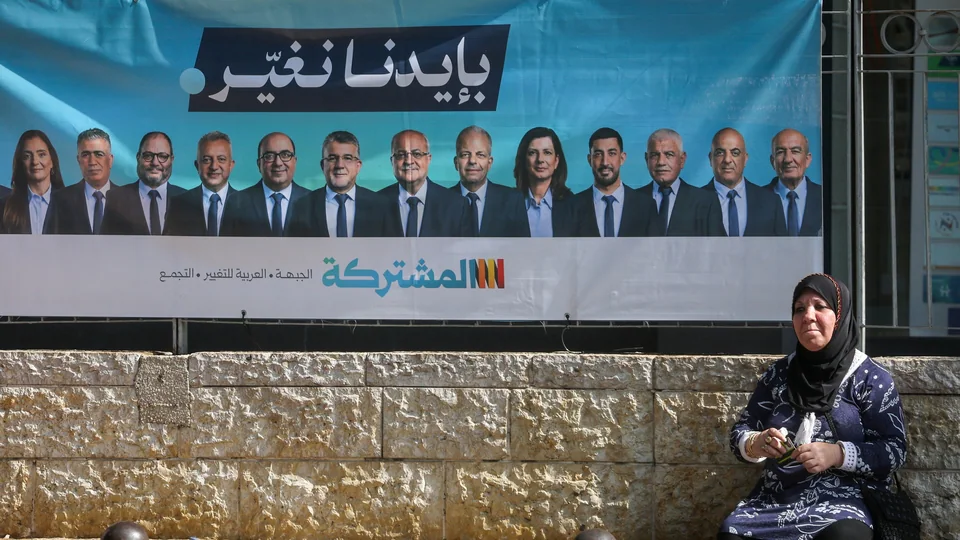
Arab voters could emerge as kingmakers in Israel’s upcoming election, with Palestinian leaders urging the country’s Arab minority to turn out in large numbers to challenge Prime Minister Benjamin Netanyahu and his right-wing governing alliance.
Israel’s Arab citizens, who make up approximately 21% of the population and are largely of Palestinian heritage, could influence the complex negotiations required to form the next government. Their votes may prove particularly important if an alliance led by former military chief Gadi Eisenkot wins the most seats but fails to secure a parliamentary majority.
Mansour Abbas, leader of the United Arab List party, believes a strong Arab turnout could help bring about a change in government. Speaking to Reuters in Nazareth, Israel’s most populous Arab city, Abbas said Arab voters could help create a new political direction.
“We can ensure the formation of a new government of change,” Abbas said, making the case for greater participation by Arab citizens in the election.
The contest is shaping up as a significant test of whether Arab parties can translate electoral support into political influence, even as questions remain over whether Eisenkot and his allies would be willing to work with them.
Arab Voter Turnout Expected to Rise
Israeli pollsters expect Arab voter participation to exceed the levels recorded in previous elections in 2022 and 2020. The Stat-Net Research Institute, based in an Arab Druze town near Haifa, projects turnout at 63%, compared with 56% in 2022, according to Reuters.
The expected increase could have important implications for the distribution of seats in the 120-member Knesset, Israel’s parliament. Under the country’s parliamentary system, a party or political bloc must secure the support of at least 61 lawmakers to command a majority.
Arab parties are not large enough to form a government independently, but their seats could become decisive if the main Jewish-led political blocs remain short of the threshold. Their support could take the form of joining a governing coalition or backing a minority government from outside it.
For Arab political leaders, encouraging voters to participate is therefore about more than increasing representation. They hope a stronger electoral showing will give them greater leverage over the formation of the next government and the policies it pursues.
Campaign organisers in Nazareth are seeking to mobilise voters frustrated by the policies of Netanyahu and far-right members of his government. Concerns about rising crime in Arab communities have also become a significant campaign issue.
Bezalel Smotrich, Netanyahu’s far-right finance minister, has proposed a plan to “Judaize” areas around Nazareth in northern Israel and parts of the south where Arab communities are concentrated. According to Reuters, he compared the initiative with Israeli settlement expansion in the occupied West Bank.
Such proposals have added to tensions surrounding Arab representation, land and the future of minority communities in Israel. Arab leaders are attempting to channel these concerns into electoral participation, arguing that a strong turnout could influence the country’s political direction.
Gadi Eisenkot Faces a Dilemma Over Arab Parties
Despite the potential importance of Arab votes, Eisenkot faces a political challenge over whether to cooperate with the parties that represent much of Israel’s Arab electorate.
Opinion polls cited by Reuters suggest his alliance of centrist, right-wing and left-wing parties could emerge as the largest bloc but remain short of a majority. Arab parties could provide the support needed to establish a government, yet Eisenkot has publicly rejected the prospect of forming a coalition with them.
In a podcast this month, Eisenkot reiterated his position, saying he would not align himself with any Arab party. Among the issues he cited was their refusal to describe Hamas as a terrorist organisation.
His position creates a potential contradiction between electoral arithmetic and political commitments. Even if voters deliver a strong result for parties opposed to Netanyahu, those parties may struggle to translate their combined seats into a governing majority if Eisenkot refuses cooperation with Arab representatives.
Abbas, however, believes there could be room for negotiations after the election. The final distribution of seats and the difficulty of forming a stable government could create pressure for political arrangements that candidates have ruled out during the campaign.
Whether that happens will depend on the election result, the positions of other opposition leaders and the terms under which Arab parties might be prepared to support a new administration.
Mansour Abbas Seeks a Role in the Next Government
Abbas has sought to position the United Arab List, also known as Ra’am, as a potential participant in a future governing coalition. His approach is based on the argument that Arab citizens can secure practical gains by engaging directly with Israel’s political system rather than remaining permanently outside government.
His political record offers a precedent for such cooperation. In 2021, Abbas became the first Arab Muslim politician to serve as a minister in an Israeli coalition government when his party joined an administration led by Naftali Bennett.
Bennett, a former prime minister and right-wing politician, is now part of Eisenkot’s broader political bloc. The coalition formed in 2021 brought together parties with sharply different ideological positions in an effort to end Netanyahu’s then-lengthy period in office.
That government collapsed after approximately 18 months. Disagreements between Bennett and Abbas over the occupied West Bank contributed to the difficulties confronting the administration.
Despite that experience, Abbas argues that political differences need not make cooperation impossible. He has also taken steps intended to demonstrate that his party is open to partnership with Jewish citizens and politicians.
In a move aimed at broadening its appeal, Abbas placed Yoav Segalovitz, a Jewish former police official, in the second position on his party’s electoral list.
“It sends a message of partnership with the Jewish community and with Jewish citizens,” Abbas told Reuters.
The move reflects Abbas’s attempt to present his party as a political partner capable of working across communal boundaries. However, securing a role in a future government will require cooperation from other parties, particularly those that have expressed reservations about working with Arab political groups.
Joint List Offers an Alternative Strategy
Not all Arab political leaders believe that joining a coalition is necessary to influence the next government. Leaders of the Joint List, an alliance of three Arab parties, argue that they could exert significant influence by remaining outside the governing coalition.
Ahmad Tibi, one of the alliance’s leaders, said the Joint List was prepared to act as an external support bloc to prevent a government from collapsing. Such an arrangement could allow Arab lawmakers to support specific measures without formally joining the administration.
Tibi also said the Joint List would support an Eisenkot-led government in a vote to establish an official commission of inquiry into the October 7, 2023, Hamas attacks. The investigation is a stated priority for Eisenkot and his political partners.
“Our top priority is to remove the far-right government of Netanyahu, Smotrich and Ben-Gvir,” Tibi said.
The difference between Abbas’s strategy and that of the Joint List highlights a broader debate within Arab politics in Israel. One approach seeks influence through direct participation in government, while the other prioritises parliamentary leverage without assuming responsibility for the governing coalition.
Both approaches could become relevant if the election produces a fragmented parliament. Arab parties may then have an opportunity to negotiate support for particular policies, even if they cannot secure formal coalition agreements.
Election Follows the October 7 Hamas Attack
The upcoming election is Israel’s first national vote since the Hamas-led attack on October 7, 2023, which triggered a major regional conflict and intensified domestic debate over the country’s security and political leadership.
Netanyahu, Israel’s longest-serving prime minister, faces scrutiny over his leadership and the government’s handling of the period surrounding the attack and the conflicts that followed. The election is therefore being viewed as a test of public confidence in his administration.
According to polling figures cited by Reuters, Eisenkot’s bloc is projected to win 52 seats in the Knesset, compared with 50 for Netanyahu’s religious-nationalist bloc. The United Arab List is projected to secure five seats, while the Joint List is expected to win eight.
These figures suggest that neither of the two main blocs would automatically command a parliamentary majority on its own. Arab parties could consequently hold considerable negotiating power, although polling projections remain estimates rather than final results.
The precise balance of power will depend on how voters distribute their support among the competing parties and whether smaller parties secure enough votes to enter parliament.
Netanyahu Campaign Targets Possible Arab-Opposition Cooperation
Netanyahu’s campaign has also sought to draw attention to the possibility of cooperation between Eisenkot and Arab political leaders. According to Reuters, campaign material has included doctored images and artificial intelligence-generated videos depicting opposition figures embracing Arab leaders.
One fabricated video released over the summer showed Eisenkot running across a meadow towards Abbas, who greeted him with outstretched arms. The imagery portrayed a political alliance that Eisenkot has publicly rejected.
The use of manipulated media illustrates how the prospect of Arab parties influencing the next government has become a campaign issue. The possibility of such cooperation is politically sensitive, particularly among voters who oppose Arab parties participating in a governing coalition.
For Netanyahu’s opponents, however, the arithmetic of parliament may make some form of cooperation necessary if they are to replace the existing government. That tension leaves Eisenkot facing a choice between his stated position on Arab parties and the practical challenges of building a stable majority.
Could Political Deadlock Keep Netanyahu in Power?
Even if Netanyahu’s bloc fails to secure a parliamentary majority, his departure from office is not guaranteed. Israel’s coalition system requires parties to negotiate an arrangement capable of commanding sufficient support in the Knesset.
If neither side can form a stable government, the country could face another period of political deadlock, potentially leading to fresh elections in 2027. Netanyahu would remain prime minister in the interim.
That possibility makes the negotiations following the vote nearly as important as the election itself. An opposition bloc could win more seats than Netanyahu’s alliance but still fail to govern if its component parties cannot agree on a coalition or obtain the backing of additional lawmakers.
Arab parties could therefore become central to the post-election negotiations, whether through formal coalition participation or external parliamentary support. Their influence would depend not only on how many seats they win but also on whether other parties are willing to work with them.
Arab Voters Could Shape Israel’s Political Future
With Arab leaders campaigning for higher turnout, the election could test whether increased participation by Israel’s Arab minority can translate into greater political influence. Pollsters’ projections suggest turnout may rise, while the anticipated distribution of seats gives Arab parties the potential to affect the formation of the next government.
Abbas is seeking to turn that opportunity into direct participation in government, while Tibi and the Joint List are preparing to use their parliamentary strength from outside a coalition if necessary. Both strategies aim to influence the country’s political direction, but neither can succeed without accounting for the positions of the larger Jewish-led parties.
Eisenkot’s refusal to align with Arab parties remains a major obstacle to forming an anti-Netanyahu government if the election produces the numbers currently suggested by some polls. The final result, along with the willingness of political leaders to negotiate after voting ends, will determine whether that position holds.
For Netanyahu, the challenge is to retain enough parliamentary support to remain in office. For his opponents, it is to assemble a viable alternative. In that contest, the participation and political choices of Arab voters could prove consequential, even if their parties do not formally join the next government.
For breaking news and live news updates, like us on Facebook or follow us on Twitter and Instagram. Read more on Latest World on thefoxdaily.com.





COMMENTS 0