Israeli Prime Minister Benjamin Netanyahu reportedly pressed the country’s military leadership to consider action against Iran in the run-up to a closely contested election, raising concerns about the risk of renewed conflict and the use of national security issues in domestic politics.
Reports by Israeli and international media described tensions between Netanyahu and Israel Defense Forces (IDF) Chief of Staff Lieutenant General Eyal Zamir over a military directive that could potentially trigger an immediate confrontation with Tehran. Netanyahu denied one account of the reported dispute, while Israel’s Defence Ministry denied any intention to launch military operations against Iran.
The allegations emerged as Netanyahu intensified warnings about Iran’s nuclear programme and framed the election as a choice affecting Israel’s survival. Polls cited in the supplied reporting showed his governing coalition trailing the opposition, although neither political bloc was projected to secure the 61 seats required for a majority in the Knesset.
The reports also pointed to renewed diplomatic and military tensions involving US President Donald Trump, who was said to have rejected Netanyahu’s reported efforts to secure another American assault on Iran before the US congressional elections.
Reports Detail Tensions Between Netanyahu and Military Chief
Israel’s Channel 12 reported that Netanyahu and IDF Chief of Staff Eyal Zamir had clashed in recent days over a directive that could have serious consequences for regional security. The broadcaster described the proposed instruction as potentially capable of provoking an Iranian miscalculation at a particularly sensitive moment.
According to the report, Zamir requested that the directive be provided to him in writing. The precise content of the instruction was not specified in the supplied account, leaving the nature and intended scope of the reported military action unclear.
Netanyahu denied the report. Israel’s Defence Ministry subsequently said there was no intention to carry out military operations against Iran.
The IDF also issued a statement that did not directly dismiss the media reports. Instead, it said its decisions were based exclusively on “security, professional, objective and national considerations”.
The distinction matters because reports of disagreements within a military leadership do not, by themselves, establish that an attack was ordered or that senior officers refused to carry it out. The available account does not provide the directive itself or independent confirmation of its contents.
Nevertheless, the reports attracted attention because any military action against Iran could trigger retaliation and place Israeli forces, regional infrastructure and neighbouring countries at greater risk.
CNN Report Says Netanyahu Sought Trump’s Support for Renewed Attack
The controversy widened after CNN reported on Monday that Netanyahu had tried in recent weeks to persuade Trump to launch a renewed assault on Iran. The report followed an earlier account by the Financial Times describing similar efforts.
According to the reporting, Trump had ruled out such action until after the US congressional elections scheduled for the following week. The accounts suggested a difference between Netanyahu’s reported preference for renewed military action and the timing favoured by the American president.
The claims were not presented as a confirmed joint decision by Washington and Jerusalem. Neither the supplied account nor the statements from Israeli authorities established that a new attack had been authorised.
The reports came against the background of previous US and Israeli military action against Iran. Netanyahu had publicly claimed significant achievements from those operations, including damage to Iran’s uranium-enrichment capabilities and ballistic-missile programme.
In March, Netanyahu said Israeli and American strikes had destroyed Iran’s ability to enrich uranium and produce ballistic missiles. In 2025, he described the outcome of an earlier confrontation as a “historic victory” that would stand for generations.
His more recent warnings about Iran marked a change in tone from those claims of success. Rather than emphasising a decisive strategic victory, he increasingly presented the threat from Tehran as an immediate danger to Israel’s continued existence.
Netanyahu Uses Iran Threat in Election Campaign
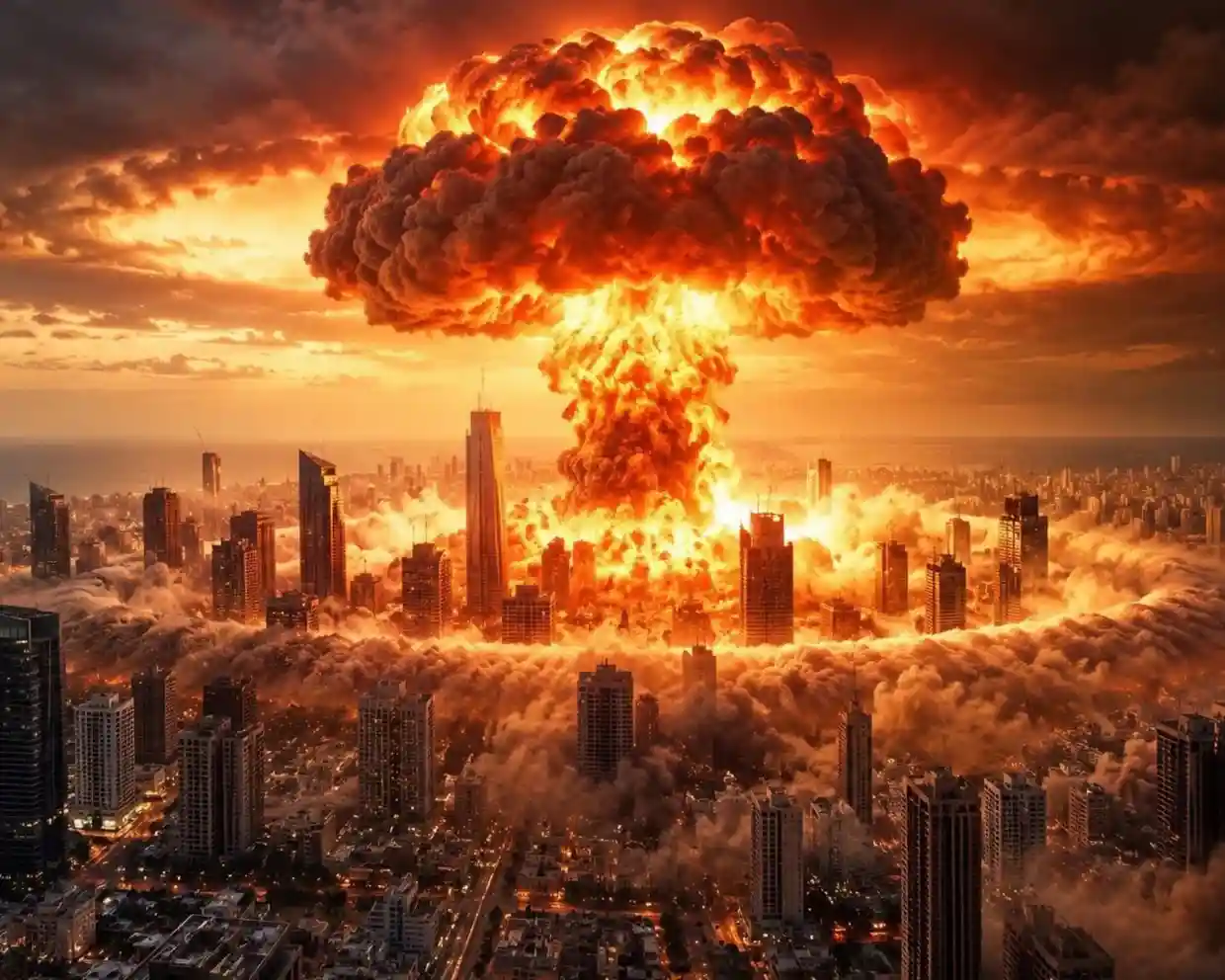
As election day approached, Netanyahu intensified his warnings about Iran’s nuclear programme. He shared an AI-generated image depicting a nuclear mushroom cloud destroying Tel Aviv and used it to urge voters to support him rather than the opposition.
In a social media post, he wrote that anyone concerned about their own physical safety and the safety of their families should have “a trembling hand” before voting for his opponents.
Speaking to Channel 14, a broadcaster known for its support of Netanyahu, he presented the election as a question of national survival. “There is a single fundamental issue here – our existence,” he said.
Netanyahu also portrayed the opposition as an alliance between the political left and Palestinian citizens of Israel, describing that combination as a threat to the state. He warned that an alliance between the left and Islam, as he characterised it, could destroy Israel.
These statements formed part of a campaign in which Netanyahu placed national security at the centre of the political debate. However, the opposition parties were not uniformly left-wing. The main groups challenging his coalition were described in the supplied reporting as right-wing or centre-right, and they shared his firm opposition to establishing a Palestinian state.
Many opposition figures had also supported the war in Gaza. Their principal point of unity was opposition to Netanyahu’s leadership, rather than agreement on a comprehensive alternative to his policies.
The use of an AI-generated nuclear image also highlighted how campaign messaging can combine an established security concern with an emotionally charged visual. The image was a political illustration, not evidence that a nuclear attack on Tel Aviv was imminent.
Opposition Leader Warns Against Politicising the Military
Gadi Eisenkot, a retired general and leader of the opposition bloc, expressed confidence in Zamir amid the reports of tension between the military chief and Netanyahu.
“We won’t allow the IDF to be turned into a pawn in Netanyahu’s survival campaign,” Eisenkot said.
His remarks reflected a broader concern raised by the reported dispute: whether military decisions could become entangled with the prime minister’s political interests during an election campaign.
However, the available reporting does not independently establish that Netanyahu’s alleged directive was motivated by electoral considerations. The allegation and the opposition’s interpretation of it remain distinct from a verified finding about the prime minister’s intentions.
The dispute nevertheless carries political significance because Israel’s military leadership is expected to assess operational decisions through security and professional considerations. The IDF’s statement emphasised precisely those principles without directly resolving the questions raised by the media reports.
Election Polls Point to a Difficult Path for Netanyahu
Most polls cited in the supplied reporting suggested that the opposition bloc led by Eisenkot was positioned to win more seats in the Knesset than Netanyahu’s governing coalition. Neither side, however, was expected to reach the 61 seats required to form a majority government independently.
The result would leave coalition negotiations central to the formation of the next government. The opposition could potentially assemble a majority by cooperating with parties representing Palestinian citizens of Israel, who make up roughly one-fifth of the country’s population.
That option faces political obstacles. Conservative elements within Eisenkot’s bloc have ruled out such an alliance, limiting the opposition’s choices even if it wins more seats than Netanyahu’s coalition.
The outcome could therefore lead to a minority government, another election or a new opportunity for Netanyahu to rebuild his political position. Seat projections alone cannot determine which scenario will occur because the final outcome would depend on negotiations among parties with different priorities and red lines.
The opposition bloc is held together largely by its shared desire to replace Netanyahu, who has dominated Israeli politics for decades. Its members do not necessarily agree on every question of security, domestic governance or relations with Palestinian political parties.
This creates a central difficulty for Netanyahu’s challengers: winning more seats would not automatically guarantee a stable governing coalition.
Netanyahu’s Legal and Institutional Battles Add to Political Pressure
Netanyahu is also facing a corruption trial, and his legal position could become more precarious if he loses political power. The trial forms part of the wider context surrounding an election in which his personal leadership is a central issue.
His government has also been involved in disputes over the independence of state institutions. Critics have accused Netanyahu of seeking to weaken judicial independence and turn the police and the Shin Bet domestic security service into political instruments.
These criticisms have helped sustain opposition to his leadership, although the parties challenging him differ in their positions on other major policy questions.
Netanyahu’s long political career has included repeated predictions of his decline followed by political recoveries. The supplied reporting noted that few observers expected his government to survive for long after the 7 October attacks, yet his coalition continued in office despite sustained pressure.
At the same time, polls had indicated for more than two years that the coalition was vulnerable to losing its narrow parliamentary majority. The election therefore presented both a test of Netanyahu’s personal political resilience and a test of whether his opponents could translate dissatisfaction into a workable government.
Trump’s Endorsement Raises Questions About Its Electoral Impact
Netanyahu highlighted his relationship with Trump during the final stages of the campaign. The US president renewed his public endorsement on Sunday, describing Netanyahu as an “outstanding warrior prime minister” and urging Israeli voters to remember his record when they went to the polls.
Israeli outlet Walla News reported that the renewed endorsement followed sustained pressure from Netanyahu’s office. The report did not establish whether that support would materially affect voting intentions.
Available polling cited in the supplied content suggested that Trump’s endorsement had not produced a visible shift in Netanyahu’s favour after an earlier expression of support on 18 October.
In one survey, 64% of respondents said Trump’s endorsement would not influence their vote. A further 17% said it made them less likely to support Netanyahu, while 12% said it strengthened their resolve to vote for his Likud party.
Those figures describe the responses in that particular survey and should not automatically be treated as representative of every Israeli voter. They nevertheless suggest that public support from a foreign leader does not necessarily translate into an electoral advantage.
The relationship between Washington and Jerusalem remains important to Israeli security, particularly given the United States’ role in military assistance and regional diplomacy. But voters may assess that relationship differently depending on their views of the war, the economy, Iran and Netanyahu’s domestic record.
Economic Warnings and Cryptocurrency Claims Draw Criticism
Alongside his warnings about Iran, Netanyahu raised concerns about Israel’s future economic position. He forecast that billions of dollars in annual US military assistance could dry up in the near future and warned of growing financial isolation.
He also suggested that Israel could use cryptocurrencies to bypass increasingly restrictive international sanctions. That claim drew an unusual public response from the Bank of Israel.
In a statement issued on Sunday evening, the central bank said cryptocurrencies could not serve as a means of circumventing sanctions. It argued that Israel should maintain economic relations with its principal trading partners and concentrate on preventing sanctions and limiting their potential damage to the economy.
The bank’s intervention highlighted the difference between political messaging and the practical constraints of international finance. Cryptocurrency transactions do not automatically remove legal or economic restrictions imposed by governments and financial authorities.
Netanyahu had previously warned that Israel might need to become a militarised “super Sparta” as it faced the prospect of isolation. He later retreated from that position after strong public criticism, according to the supplied reporting.
His renewed emphasis on economic vulnerability adds another dimension to the campaign. Security concerns, military aid, international sanctions and access to global markets are closely linked, but the implications of these risks depend on policy decisions and developments beyond the control of any single political leader.
What the Reports Mean for Israel and Regional Security
The reports about Netanyahu’s alleged pressure for military action against Iran have emerged at a politically sensitive moment, when the prime minister is attempting to retain power and the opposition is seeking to build a parliamentary majority.
If the accounts of discussions over a military directive are accurate, they raise questions about how Israel balances operational planning, the risk of Iranian retaliation and the responsibilities of its military leadership. However, the directive’s contents remain unspecified, Netanyahu has denied the reported dispute and Israeli authorities have not confirmed plans for a new operation.
The wider diplomatic picture is also uncertain. CNN and the Financial Times reported that Netanyahu sought renewed American military action, while the supplied account said Trump had ruled out an assault before the US congressional elections. These reports indicate disagreement over timing, but do not establish that a new attack will take place.
For Israel, another confrontation with Iran could have consequences extending beyond the immediate military objectives. It could trigger retaliatory strikes, increase pressure on regional infrastructure, complicate diplomatic efforts and affect economic relationships at a time when Israeli voters are also weighing domestic political and financial concerns.
The election itself presents a separate uncertainty. Polls indicating that the opposition could win more seats do not guarantee that it can form a stable majority, particularly given disagreements over cooperation with Palestinian Israeli parties.
The key questions are therefore whether the reported military tensions can be clarified, whether US-Iran relations move towards further confrontation or renewed diplomacy, and whether Israel’s opposition can agree on a governing arrangement after the election.
For now, the allegations remain reports rather than established proof that Netanyahu ordered an attack for electoral purposes. Their political significance lies in the convergence of disputed military planning, heightened rhetoric about Iran and an election that could reshape Israel’s leadership without necessarily producing a clear parliamentary majority.
For breaking news and live news updates, like us on Facebook or follow us on Twitter and Instagram. Read more on Latest World on thefoxdaily.com.






COMMENTS 0