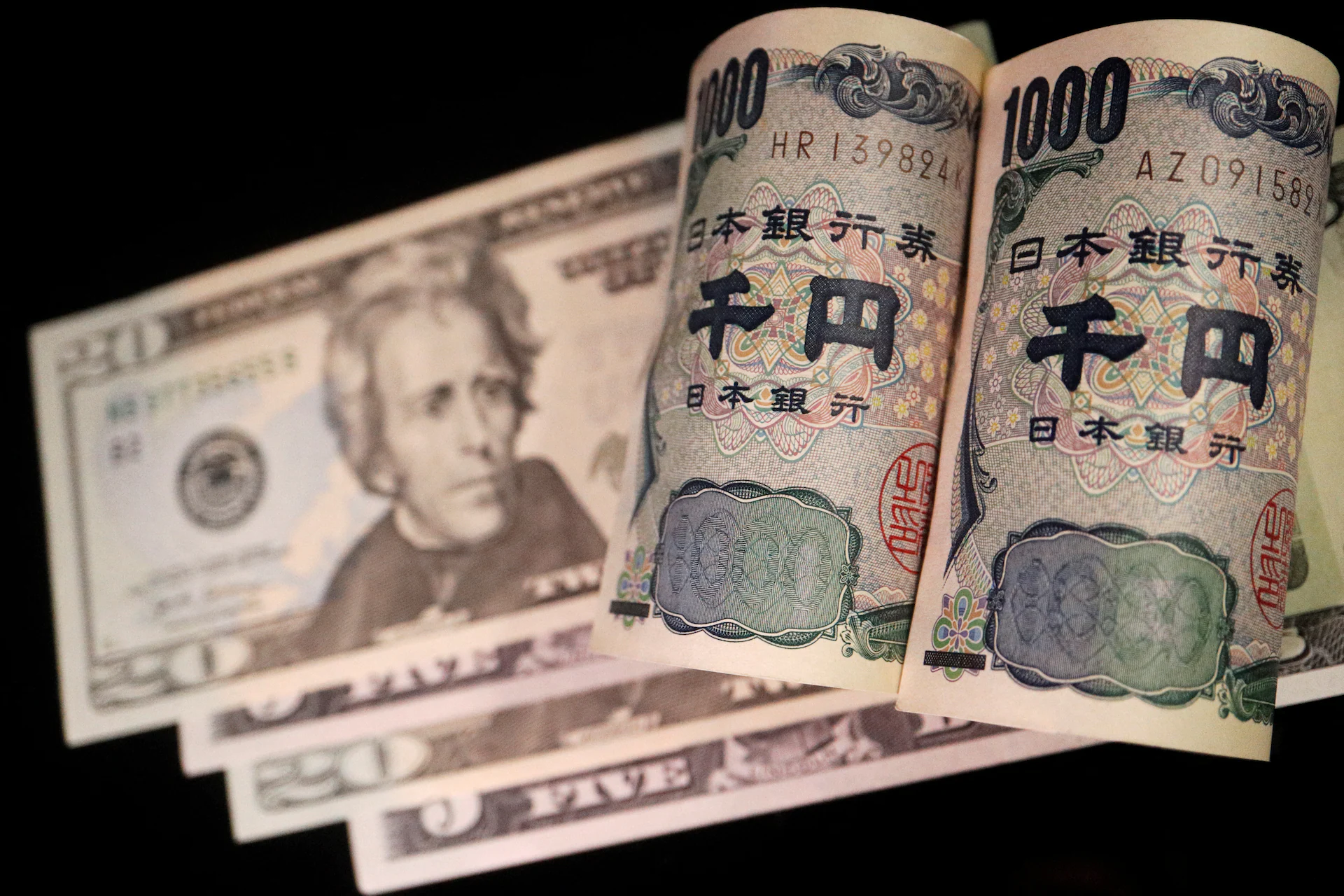
The Japanese yen strengthened against the US dollar on Tuesday, october 20, after strong demand at an auction of long-dated Japanese government bonds (JGBs) boosted investor confidence in the country’s debt market. Meanwhile, the euro recovered modestly as traders assessed political unrest in France and Italy, which has raised concerns about Europe’s fiscal and economic stability.
The yen rose 0.2% to 158.15 per dollar, ending a two-day losing streak in Asian trading. The move followed a Japanese government bond auction that attracted record demand for 20-year securities, suggesting that investors were becoming more willing to hold Japanese assets as yields remained elevated.
At the same time, the US dollar weakened against a basket of major currencies as pressure on the euro eased. The British pound, Australian dollar and New Zealand dollar also advanced, while cryptocurrency prices edged lower.
The latest currency movements reflect the influence of bond-market demand, interest rates and political developments on global financial markets. Investors are weighing the relative attractiveness of Japanese assets against uncertainty in Europe and the continuing influence of US dollar strength.
Strong Demand at Japanese Government Bond Auction Supports Yen
Japan’s auction of 20-year government bonds attracted bids worth 5.84 times the amount of securities offered, significantly exceeding the 4.01 times recorded at the previous auction in September.
The strong bid-to-cover ratio indicated that demand for the long-dated securities had increased. Investors use this measure to assess auction demand, with a higher ratio generally suggesting stronger interest in the bonds being sold.
The auction result helped lift the yen by 0.2% to 158.15 against the US dollar. It also pushed the yield on Japan’s 20-year government bond down by six basis points to 3.71%.
Bond prices and yields generally move in opposite directions. When demand for existing bonds increases, their prices tend to rise, putting downward pressure on their yields. The decline in the 20-year yield was therefore consistent with the strong demand observed at the auction.
Masahiko Loo, senior fixed-income strategist at State Street Investment Management in Tokyo, said the record auction suggested that cash previously held on the sidelines was beginning to return to the Japanese bond market.
The result could indicate a shift in investor appetite toward Japanese government debt, particularly as domestic yields make these securities more attractive to institutions seeking returns from local markets.
Higher Domestic Yields Provide Structural Support for Japanese Assets
The yen’s performance reflects more than a short-term reaction to the bond auction. According to Loo, the currency has remained relatively resilient against other major currencies, including the euro and Swiss franc.
He said higher domestic yields and returning institutional demand were becoming structural sources of support for Japanese assets, even when strength in the US dollar continued to influence the dollar-yen exchange rate.
Interest-rate differences between countries are an important factor in foreign exchange markets. When domestic bond yields rise relative to those available elsewhere, investors may become more interested in holding assets denominated in that currency, depending on their expectations for exchange rates and future monetary policy.
Higher Japanese yields can therefore improve the appeal of yen-denominated investments. However, the currency’s longer-term direction will also depend on economic growth, inflation, central bank policy and developments in other major economies.
The strong auction also comes as investors assess the role of Japanese government bonds in diversifying portfolios amid political and fiscal uncertainty elsewhere. Loo noted that JGBs were beginning to look like a relative haven compared with the volatility surrounding European Markets, particularly France.
This does not eliminate the risks associated with Japanese assets, but stronger domestic demand could help provide support for the yen even when broader movements in the US dollar create pressure.
Political Unrest in France Raises Concerns Across Europe
Political instability in Europe remained a key concern for currency and bond investors. In France, authorities imposed curfews in several cities on Monday in an effort to curb nationwide anti-government protests, adding to uncertainty surrounding President Emmanuel Macron’s remaining time in office.
The unrest has increased attention on the country’s political stability and fiscal outlook. Investors often monitor political developments closely because uncertainty over government policy, public spending and economic management can affect demand for sovereign bonds and other domestic assets.
In Italy, the government said it would dispatch 500 troops after two days of unrest. The developments added to concerns about political risk in the region, although market movements suggested that investors were not treating the situation as a full-scale European financial crisis.
The euro rose 0.2% to $1.1234 against the US dollar. French government bond futures, known as OAT futures, advanced 0.2%, while German government bond futures gained 0.1%.
The gains indicated some relief in European markets despite the political uncertainty. However, the outlook remained sensitive to further developments in France and Italy, particularly if unrest begins to affect fiscal policy, investor confidence or broader economic conditions.
Euro Resilience Suggests Investors See Limited Contagion So Far
Chris Weston, head of research at Pepperstone Group in Melbourne, said French sovereign risk was clearly being reflected in European equities. However, the euro’s resilience suggested that traders were not yet treating the situation as a systemic problem for the wider European region.
The distinction is important for financial markets. Political uncertainty in an individual country can put pressure on its government bonds, stocks and currency without necessarily triggering a broader regional crisis.
Investors will therefore be assessing whether the unrest remains concentrated in particular countries or begins to influence confidence in the wider eurozone. Any significant deterioration in France’s fiscal outlook or concerns about the stability of European policymaking could place renewed pressure on the euro.
For now, the currency’s modest recovery suggests that traders were willing to continue buying the euro despite the political risks. Movements in European bond futures also pointed to a partial recovery in sentiment during the Asian trading session.
US Dollar Weakens as Major Currencies Advance
The US dollar index, which measures the greenback against a basket of six major currencies, fell 0.2% to 101.77. The index remained near the lower end of the trading range it had occupied throughout October as pressure on the euro eased.
The dollar’s decline came alongside gains in several major currencies, including the yen, British pound and New Zealand dollar. These movements indicate that demand for the US currency had moderated during the session, although the broader outlook remained dependent on interest-rate expectations and international developments.
The British pound rose 0.4% to $1.3351. The Australian dollar gained 0.1% to $0.6989, while the New Zealand dollar advanced 0.4% to $0.5684.
Currency markets are particularly sensitive to changes in expected interest rates and the relative returns available in different countries. Political uncertainty can also influence exchange rates by changing investor appetite for risk or encouraging a shift toward assets viewed as comparatively stable.
The latest movements show that currency performance was not uniform. While the yen benefited from strong Japanese bond demand and the euro recovered, other currencies responded to their own domestic economic and political factors.
Canadian Dollar Steady After Alberta Separation Vote
The Canadian dollar strengthened 0.2% to 1.40775 per US dollar, moving closer to its strongest level of the previous month.
The currency was little changed following a vote in Alberta, where residents chose to remain part of Canada rather than begin the process toward a binding referendum on separation. It was the province’s first vote on whether to initiate that process.
Political developments involving regional autonomy can attract market attention because they may affect expectations about governance, economic policy and future investment conditions. In this case, the immediate currency reaction was limited, with the Canadian dollar showing little change after the vote.
Broader movements in the US dollar and developments affecting Canada’s economy remained relevant to the currency’s performance. The latest session showed a modest gain against the greenback, although the longer-term direction will depend on interest-rate expectations and domestic economic conditions.
Chinese Yuan Gains After PBOC Keeps Interest Rates Unchanged
The offshore Chinese yuan strengthened 0.1% against the US dollar to 6.678 after the People’s Bank of China kept interest rates unchanged, in line with market expectations.
The decision to maintain rates provided no immediate surprise for investors, who had anticipated the outcome. Central bank decisions are closely monitored because they influence borrowing costs, investment conditions and expectations for economic activity.
The yuan’s modest appreciation came as the US dollar weakened against several major currencies. Exchange-rate movements can reflect both domestic developments and broader changes in demand for the dollar, making it important to distinguish the impact of Chinese monetary policy from wider market trends.
Investors will continue to assess future policy signals from the People’s Bank of China, alongside economic data and developments in international trade, when evaluating the yuan’s outlook.
Bitcoin and Ether Edge Lower
Cryptocurrency markets moved slightly lower during the session. Bitcoin declined 0.3% to $81,674.25, while ether slipped 0.2% to $2,393.21.
The modest declines contrasted with gains across several traditional currencies. However, a single trading session does not establish a broader trend in digital assets, which can respond to a different mix of factors, including investor sentiment, liquidity and market-specific developments.
Traders will continue to monitor movements in global financial markets, although the available figures do not establish a direct link between the bond auction, European political unrest and the small declines in cryptocurrency prices.
What Investors Will Watch Next
The next direction for the yen will depend partly on whether strong demand for Japanese government bonds continues and how domestic yields compare with returns available in other major markets. Further evidence of institutional demand could support Japanese assets, while broader US dollar movements may continue to influence the dollar-yen exchange rate.
In Europe, investors will be watching political developments in France and Italy for signs of whether the current uncertainty will intensify or ease. The euro’s resilience suggests that traders have so far limited the impact of country-specific risks, but further deterioration in political or fiscal conditions could change market sentiment.
The dollar index, meanwhile, will remain sensitive to relative interest-rate expectations and changes in demand for major currencies. Developments in China, Canada and other economies will also shape exchange-rate movements as investors assess monetary policy and regional economic risks.
Outlook: Yen Strengthens as Markets Balance Bond Demand and Political Risk
The yen’s rise following Japan’s record-demand 20-year government bond auction highlights the growing importance of domestic yields and institutional investment in supporting Japanese assets. The fall in the bond yield to 3.71% also reflected the strength of demand for the securities.
Meanwhile, the euro gained ground despite political unrest in France and Italy, suggesting that traders were not yet treating the developments as a systemic threat to the wider European economy. The US dollar index eased, while the pound, Australian dollar and New Zealand dollar also advanced.
With political uncertainty continuing to influence European markets and bond demand supporting the yen, investors are likely to remain focused on central bank policy, government finances and developments affecting major economies. The latest currency movements underline how shifts in investor confidence and relative yields can reshape global foreign exchange markets within a single trading session.
For breaking news and live news updates, like us on Facebook or follow us on Twitter and Instagram. Read more on Latest World on thefoxdaily.com.






COMMENTS 0