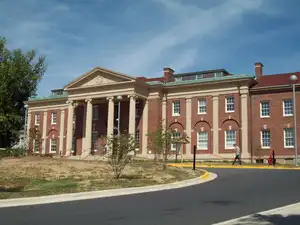
A historic mansion built in 1924 in Langley Park, Maryland, has found a new purpose after years of vacancy. The McCormick-Goodhart Mansion, once a prominent residential property and later a community hub, was restored by CASA de Maryland and adapted into a center for social services.
The renovation brought together Historic Preservation and modern environmental design. Rather than replacing the old structure with a new building, the project retained important architectural elements, including the mansion’s grand staircase, while adding features intended to improve energy performance and environmental sustainability.
CASA de Maryland purchased the property in 2009 after it had remained unused for years. The organisation’s restoration effort demonstrated how an ageing historic building can be adapted to meet contemporary community needs without losing the architectural character that makes it significant.
A Mansion Built in 1924 by Architect George Oakley Totten Jr.
The McCormick-Goodhart Mansion dates to 1924 and is associated with architect George Oakley Totten Jr., known for designing prominent residential and institutional buildings in the Washington, DC, region.
Its original design reflected the architectural ambitions of the early 20th century, when large private residences often featured formal interiors, elaborate staircases and carefully designed architectural details.
Over time, the mansion’s role changed. What began as a private residence eventually became a place connected with community activity. Its later history gave the property a significance beyond its original residential purpose, making its preservation relevant to the surrounding neighbourhood.
However, like many older properties, the mansion eventually faced a period of disuse. Years without an active purpose left the building in need of a major intervention if it was to remain useful and viable.
CASA de Maryland Purchased the Property in 2009
CASA de Maryland purchased the McCormick-Goodhart Mansion in 2009 with the aim of giving the historic property a new community-focused role.
CASA is a nonprofit organisation that works with immigrant and working-class communities. Transforming the mansion into a social services centre allowed the organisation to use an existing historic structure to support its work rather than treating the property simply as an architectural landmark.
The decision also offered a way to reconnect the building with the community after years of vacancy. A property that had once served as a residence and later as a community hub could once again become an active public-facing space.
Adapting a historic mansion for organisational and service-related activities, however, required more than basic repairs. The building needed to accommodate modern uses, accessibility expectations and environmental performance while retaining its distinctive architectural features.
Restoration Preserved the Mansion’s Grand Staircase
One of the central goals of the renovation was to retain the building’s historic character. The grand staircase was among the architectural features preserved during the restoration, helping maintain a visible connection to the mansion’s original design.
Historic staircases often serve as important interior focal points in large early-20th-century residences. Their proportions, materials and craftsmanship can reveal how a building was originally organised and how its designers intended people to move through its interior spaces.
Preserving the staircase therefore helped retain more than an attractive architectural detail. It maintained part of the building’s historical identity as the mansion was adapted for a completely different function.
The restoration approach sought to balance conservation with practical requirements. Historic buildings used as offices or service centres must support contemporary activities, which can involve updating building systems and improving interior spaces. The challenge is to introduce those changes without unnecessarily removing the features that give the property its character.
Historic Tax Credits Helped Support the Renovation
The project used historic tax credits as part of its financing strategy. These incentives are designed to encourage the rehabilitation of historically significant buildings by helping make preservation projects more financially viable.
Restoring an older property can involve substantial costs. Structural repairs, specialist craftsmanship, updated mechanical systems and the careful treatment of historic materials can make rehabilitation more complicated than constructing a conventional modern building.
Historic tax credits can help bridge that financial gap by supporting projects that retain a building’s historic features while returning it to productive use.
In the case of the McCormick-Goodhart Mansion, the use of these credits supported a broader effort to preserve the property and adapt it for social services. The approach illustrates how preservation incentives can help older buildings remain part of active neighbourhoods instead of becoming vacant or deteriorating over time.
Green Roof and Sustainable Features Modernised the Historic Property
Alongside architectural preservation, the renovation introduced environmentally focused features. One of the most visible additions was a green roof, which incorporates vegetation into the building’s roof system.
Green roofs can provide several environmental benefits when appropriately designed and maintained. They can absorb some rainfall, reduce stormwater runoff, provide insulation and help moderate roof temperatures. Depending on their design, they can also create small areas of urban habitat and contribute to the environmental quality of densely developed neighbourhoods.
Adding such a feature to a historic mansion required the renovation team to consider how modern building systems could be integrated with an older structure.
The project also aimed for LEED Gold certification, a sustainability rating associated with buildings that meet specified environmental and performance standards. The goal reflected an effort to combine the conservation of an older property with contemporary expectations for energy efficiency and responsible building design.
It is important to distinguish between a certification target and an awarded certification. The project description identifies LEED Gold as an aim of the renovation, rather than confirming that the building received the designation.
What a Green Roof Adds to an Urban Building
Green roofs are increasingly considered in sustainable building projects because they can help address some environmental challenges associated with conventional rooftops.
Managing Rainwater
Vegetation and growing materials can retain a portion of rainfall before it reaches drainage systems. This can help reduce the volume of stormwater runoff, although the amount depends on rainfall intensity, roof design and the depth of the growing medium.
Improving Roof Insulation
The layers used in a green roof can provide additional insulation and reduce direct exposure of the roof surface to extreme temperatures. This may help moderate indoor conditions and reduce some heating or cooling demands.
Reducing Urban Heat
Conventional rooftops can absorb and retain heat, contributing to higher temperatures in built-up areas. Vegetated roofs can help moderate roof-surface temperatures through shade and evaporation.
Supporting Urban Biodiversity
Depending on the plants selected and the surrounding environment, green roofs can provide habitat for insects and other small organisms. Their ecological value varies according to their size, vegetation and maintenance.
For a historic building being adapted to modern use, these benefits can complement the preservation of its original architecture.
Turning a Vacant Mansion into a Social Services Centre
The mansion’s transformation is significant because it gave the property a practical role in the community. Instead of remaining an unused historic residence, it became a centre supporting CASA de Maryland’s social services work.
Community organisations often need accessible spaces where residents can seek assistance and participate in programmes. Reusing a historic building can help meet some of those needs while retaining a recognisable part of the neighbourhood’s built heritage.
The mansion’s new function also demonstrates that historic preservation does not necessarily mean keeping a building frozen in its original use. A successful adaptive-reuse project can protect important architectural features while allowing the structure to serve people in a different way.
For CASA, the property offered an opportunity to connect its community-focused mission with the preservation of a historic local landmark.
Why Adaptive Reuse Matters for Historic Buildings
Many older buildings face a difficult choice when their original purpose disappears. Without investment or a suitable new use, they can remain vacant, deteriorate or eventually be demolished.
Adaptive reuse offers an alternative by giving existing structures new functions. Former homes can become offices, schools, cultural centres or community facilities, depending on their condition and layout.
This approach can preserve architectural heritage while making use of buildings and infrastructure that already exist. It may also reduce the need for demolition and new construction, although the environmental benefits depend on the condition of the original structure and the scale of the required renovation.
The McCormick-Goodhart Mansion illustrates how historic preservation and contemporary sustainability goals can be pursued together. Its restored staircase maintains a connection to the building’s past, while the green roof and other modern features support its adapted use.
A Historic Landmark Given a New Community Role
The restoration of the McCormick-Goodhart Mansion represents a shift from prolonged vacancy to renewed community use. Built in 1924, the property passed through different phases of residential and community life before CASA de Maryland purchased it in 2009 and undertook its transformation.
By preserving the grand staircase and introducing sustainable elements such as a green roof, the project sought to respect the mansion’s architectural identity while preparing it for modern needs.
The use of historic tax credits also highlights the role financial incentives can play in making complex restoration projects possible. Meanwhile, the effort to achieve LEED Gold certification reflected an ambition to combine heritage conservation with environmental responsibility.
Ultimately, the mansion’s renewed purpose shows that preserving historic buildings does not have to mean preserving them as empty monuments. With thoughtful restoration and a suitable new use, older properties can continue contributing to the communities around them.
For breaking news and live news updates, like us on Facebook or follow us on Twitter and Instagram. Read more on Latest World on thefoxdaily.com.





COMMENTS 0