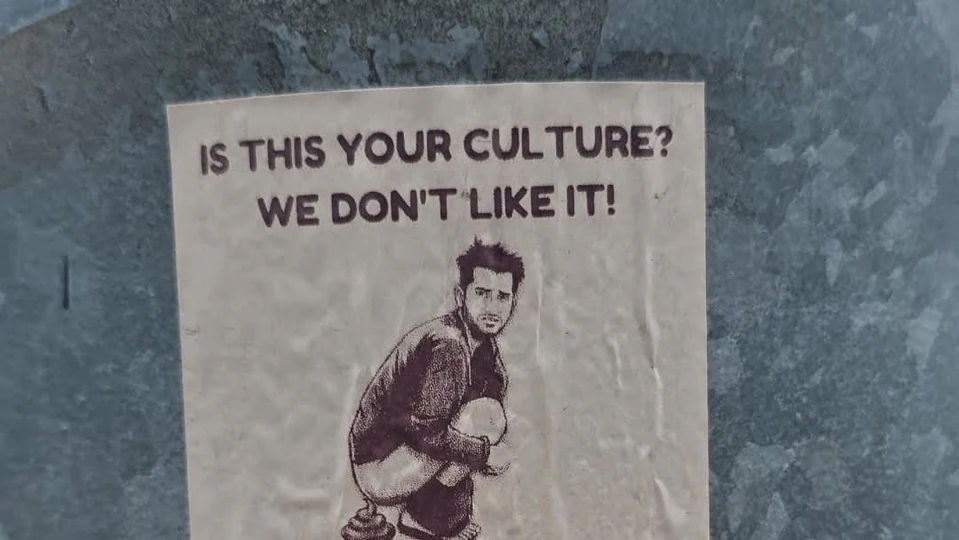
An alleged racist sticker targeting Indians has sparked condemnation in Cessnock, a town in New South Wales, Australia, after a message questioning Indian culture appeared alongside a derogatory image. Federal lawmaker Dan Repacholi denounced the material, saying racism would not be tolerated in the local community and urging residents to report its locations so it could be removed.
The sticker reportedly carried the message, “Is this your culture? We don’t like it,” above an image depicting a man defecating on a street. It also included claims about Australia’s foreign-born population, singled out India and called for “REMIGRATION NOW!”
The incident has drawn attention to anti-Indian messaging in Australia and the challenges of responding to material that targets people on the basis of their national or cultural background. Repacholi said those responsible did not represent the community and called on residents not to give the material unnecessary publicity.
Racist Sticker in Cessnock Prompts Political Condemnation
The stickers were reportedly placed in Cessnock, located about 150 kilometres from Sydney, according to a report by news agency PTI. The material targeted Indians through a derogatory portrayal and language intended to associate an entire cultural group with offensive behaviour.
Repacholi, the federal member of the House of Representatives for the Hunter electorate in New South Wales, shared an image of the sticker on Facebook while condemning its message. He described the material as “disgusting” and urged people who encountered it to report where it had been displayed.
In his Facebook post, Repacholi wrote: “Racism isn’t welcome in Cessnock. It isn’t welcome in the Hunter. And it won’t go unchallenged.”
He also rejected attempts to spread division within the community, saying the people responsible for the stickers did not speak for local residents.
“We’re better and stronger than the hate and division these people are trying to spread. If you’ve seen one, let me know where it was located so it can be reported and removed. Don’t give these cowards any more publicity than they deserve,” Repacholi said.
His response focused on identifying the locations of the stickers and getting them reported and removed. The supplied account does not establish who produced or distributed the material, how many stickers were displayed, or whether anyone had been identified in connection with the incident.
What the Sticker Says About Immigration and ‘Remigration’
Beyond its offensive image, the sticker promotes an anti-immigration message. It claims that 32 per cent of Australia’s population was born overseas, identifies India as being at the top of that list and demands “REMIGRATION NOW!”
These statements combine a demographic claim with a political demand. The population figure is presented as part of the sticker’s argument against immigration, while the reference to India directs the message specifically at Indians and people perceived to be of Indian origin.
The figure printed on the sticker should not be treated as independently verified simply because it appears in the material. Establishing the proportion of Australia’s population born overseas requires reference to official population statistics and the relevant reporting period. Similarly, the sticker’s assertion about India’s position should be assessed against comparable data rather than accepted without scrutiny.
What does ‘remigration’ mean?
The term “remigration” is used in some political movements advocating the return or removal of migrants to their countries of origin. Its meaning can vary according to the political group using it, but the term has also become associated with demands for large-scale deportations and the removal of people from minority backgrounds.
In the Cessnock incident, the demand appears alongside an image and wording that single out Indian culture. This context distinguishes the material from a general discussion about immigration levels, visa rules or government migration policy.
Debates over immigration can involve legitimate questions about housing, employment, public services, population growth and border management. However, those policy questions are different from portraying an entire national or cultural group through a degrading image. The sticker’s language targets Indians collectively rather than identifying a specific policy or addressing an individual’s conduct.
Repacholi’s response rejected that approach, arguing that the people spreading the material did not represent the wider community.
Why the Incident Matters to Australia’s Indian Community
Australia is home to a substantial Indian Diaspora, with Indian-born residents and people of Indian heritage contributing to communities across the country. The appearance of material that singles out Indians on cultural grounds can therefore have implications beyond the immediate location where the stickers were found.
For people who live, work, study or run businesses in Australia, racist messaging can raise concerns about whether they are accepted as members of their local communities. Public displays of hostility can also affect people who are not directly targeted but recognise that the same language could be directed at them.
The incident is particularly relevant to New South Wales, Australia’s most populous state and home to Sydney, a major centre for business, education and international migration.
According to the Consulate General of India in Sydney, the Indian community in New South Wales and South Australia together accounts for about 38 per cent of Australia’s Indian diaspora, numbering roughly 175,000. The figure provides an indication of the community’s presence in the consulate’s jurisdiction, although it should not be interpreted as a current count of every person of Indian origin living in those states.
Indian Australians are not a single, uniform group. They include people with different languages, religions, regional backgrounds and migration histories, as well as Australian-born citizens of Indian heritage. A message that treats Indian identity as one set of cultural practices overlooks that diversity.
For the same reason, an image depicting an individual cannot reasonably establish the behaviour or customs of millions of people. The sticker’s attempt to connect an offensive image with Indian culture relies on precisely that generalisation.
Who Is Dan Repacholi?
Dan Repacholi is the Australian Labor Party member of the House of Representatives for the Hunter electorate in New South Wales. He was elected in 2022 and re-elected in 2025.
Hunter is a federal electorate in New South Wales, and Cessnock is part of the broader Hunter region. Repacholi’s response placed the incident within the context of the community he represents, rather than treating the stickers as an acceptable expression of local opinion.
His Facebook post called for residents to identify where the material had appeared so it could be reported and removed. He also urged people not to give those responsible unnecessary publicity.
The distinction matters because condemning racist material and establishing responsibility for distributing it are separate tasks. A public statement can reject the message, while identifying the people responsible requires further evidence.
The supplied information does not establish whether the individuals responsible have been identified, whether a formal investigation has been opened or whether any legal action has followed. Those questions should remain open unless confirmed by the relevant authorities.
Removal of the Stickers Is Only One Part of the Response
Repacholi’s request for residents to report the locations of the stickers points to an immediate, practical response: document where the material has appeared and enable it to be removed.
That approach also avoids confusing the removal of offensive material with proof that the underlying problem has been resolved. Taking down a sticker can address a visible display, but it does not necessarily identify who placed it or explain whether the material has been distributed elsewhere.
Residents who encounter similar material can help by recording its location and reporting it through appropriate local or official channels. Where safe and appropriate, a photograph may help document the incident. People should avoid confronting suspected perpetrators if doing so could put them at risk.
There is also a balance between documenting an incident and amplifying its message. Sharing images without context can spread the very material being challenged, particularly when the image is designed to provoke anger or hostility. Repacholi explicitly cautioned against giving the people responsible additional publicity.
At the same time, responsible reporting can help establish what happened, where the material appeared and whether similar incidents are connected. The aim is to preserve relevant evidence and make the issue visible without presenting the racist message as an ordinary or representative view of the community.
What Happens Next?
The immediate questions concern the removal of the stickers, the extent of their distribution and whether those responsible can be identified. Repacholi has publicly called for locations to be reported, but the available information does not confirm the outcome of those efforts.
Any further response will depend on the evidence gathered and the circumstances in which the material was displayed. Whether the incident leads to an investigation or other official action has not been established by the supplied reporting.
The political response is already clear: Repacholi has rejected the stickers’ message and said racism would not be accepted in Cessnock or the wider Hunter region. His comments also underline the difference between debating immigration policy and targeting people because of their national origin.
For Australia’s Indian community, the incident raises a broader question about how public disagreement over immigration is expressed. A country can debate migration settings, population growth and integration without treating an entire community as responsible for an offensive stereotype.
The stickers’ presence does not establish that their message reflects the views of Cessnock residents as a whole. Equally, their removal alone would not demonstrate that anti-Indian prejudice has disappeared. The facts about who distributed the material, how widely it circulated and whether further action follows remain important to understanding the full incident.
The Wider Significance
The Cessnock incident centres on a specific act of alleged racist messaging, but its significance extends to how communities respond when national or cultural identity becomes a target of public hostility.
Repacholi’s condemnation offers a clear rejection of the stickers’ attempt to associate Indians collectively with a degrading image. His appeal to residents to report the material provides a practical next step, while leaving questions about responsibility and any official investigation unresolved.
The central distinction is between criticism of immigration policy and the denigration of people because they are Indian. The former is a matter for public debate; the latter uses national identity to stigmatise an entire group.
What happens next will depend on whether the material is removed, whether those responsible are identified and whether further evidence emerges. For now, the public record establishes the appearance of the alleged racist stickers and a forceful response from the federal lawmaker representing the region.
For breaking news and live news updates, like us on Facebook or follow us on Twitter and Instagram. Read more on Latest World on thefoxdaily.com.






COMMENTS 0