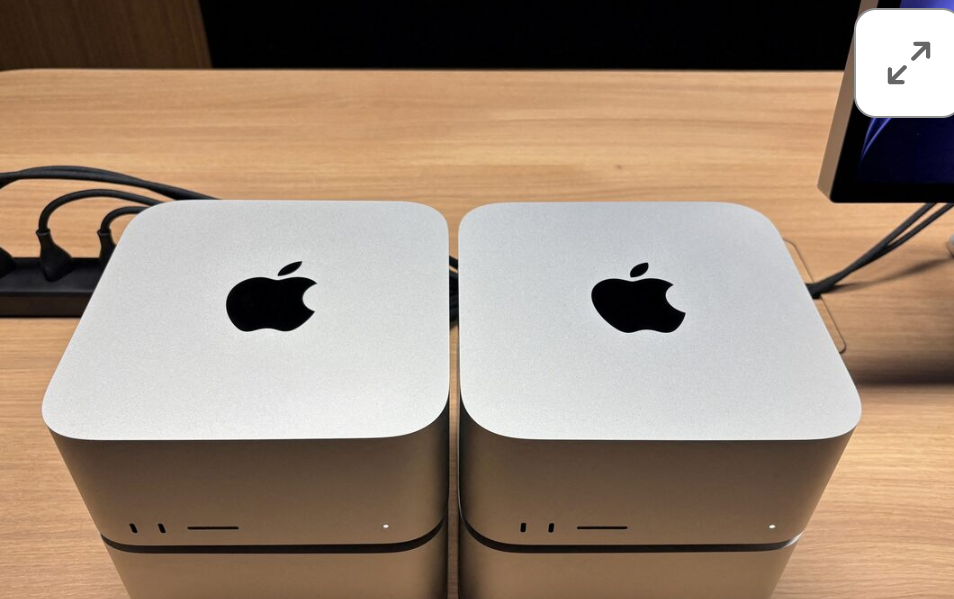
Apple is positioning its upgraded Mac Mini and Mac Studio computers as alternatives to renting cloud computing capacity for Artificial Intelligence (AI) workloads. As the new desktops begin shipping on September 22, 2026, the company is pitching corporate buyers on the potential cost benefits of running AI tasks locally rather than paying cloud providers for usage.
The strategy puts Apple in a more direct contest with Microsoft and Nvidia as technology companies look for ways to make AI computing more affordable. Apple’s latest machines are designed for demanding workloads, including coding and complex business tasks, and can be configured at prices approaching $20,000.
Apple’s enterprise presence remains comparatively small. IDC figures cited by Reuters put Apple’s share of the enterprise desktop and laptop market at 4.6%, compared with 91.3% for Windows. The company is seeking to use its chip architecture and experience building power-efficient devices to expand its role in business computing.
Apple’s New Macs Focus on Local AI Computing
The upgraded Mac Mini and Mac Studio are being promoted for AI tasks that can be performed directly on a user’s computer. Instead of relying entirely on remote data centers, businesses can run compatible AI models on their own hardware.
One potential attraction is the way local computing changes how users pay for AI. Cloud-based AI services commonly charge according to usage, often measured in tokens, while a locally operated computer is purchased upfront and can then be used repeatedly without a separate cloud token charge.
Apple Chief Hardware Officer Johny Srouji said the company believes its machines offer value through performance and cost. He highlighted the absence of a per-token charge when users operate AI workloads on a machine they already own.
However, the upfront purchase price is only one part of the total cost. Businesses would also need to consider electricity, maintenance, software, hardware upgrades and whether a local model can meet their performance and reliability requirements.
Why Apple Believes Its Chip Design Can Help
Apple’s approach builds on its transition to Apple Silicon, which began in 2020. The company brought computing and memory components together in a unified memory architecture, rather than keeping them separate as in many traditional PC designs.
The architecture was developed in part to improve power efficiency and battery life in Apple devices. It has also helped make some Macs suitable for AI workloads, which can require substantial memory capacity and fast movement of data between computing components.
Apple’s longstanding focus on power-efficient hardware has become relevant as businesses look for ways to run AI without relying exclusively on large data centers.
Mac Studio Clusters Demonstrate Apple’s AI Ambitions
Apple has also been adding features aimed at connecting multiple high-performance Macs. Over the past two years, the company has introduced specialised chip-to-chip networking capabilities, including RDMA over Thunderbolt, to support more demanding workloads.
At a launch event this month, Apple demonstrated four Mac Studio computers connected to run an AI model with one trillion parameters. The system was shown identifying and fixing a graphics-coding bug.
Models with very large parameter counts can require substantial computing resources. Apple’s demonstration was intended to show how multiple desktop machines could work together on a task often associated with data-center infrastructure.
According to the Reuters report, the connected Macs operated from a single wall outlet. The demonstration highlights Apple’s effort to make local AI computing more accessible, although the performance and suitability of such a setup will depend on the specific model, software and workload.
Apple’s Enterprise Market Share Remains Small
Despite its hardware capabilities, Apple faces a substantial challenge in corporate computing. IDC’s Linn Huang said Apple holds about 4.6% of the enterprise desktop and laptop market, while Windows accounts for 91.3%.
Windows’ established position gives Microsoft and PC manufacturers access to a broad base of business customers. Companies often have existing software, support arrangements and IT processes built around Windows systems.
Apple’s effort to expand in enterprise AI therefore involves more than offering powerful hardware. Businesses must also assess compatibility with existing applications, security requirements, device management and the skills needed to support a different computing environment.
Microsoft Is Also Pursuing On-Device AI
Microsoft is targeting the same broader opportunity: AI features that can run on a user’s device rather than requiring every task to be processed in the cloud.
Chief Executive Satya Nadella has described the idea as “unmetered intelligence” and has discussed bringing more AI capabilities into Windows, including through a planned “super app” experience.
Microsoft’s position in corporate computing is supported by its ability to work with a wide range of PC manufacturers and chip suppliers. That diversity offers customers hardware choice, but it can also create complexity for developers seeking to optimise AI applications for different processors.
Microsoft said it has been working with chip partners to streamline AI workloads through Windows ML tools. The company also said technologies such as RDMA are an active area of investment.
Nvidia’s Role in the AI Computing Market
Nvidia remains strongly associated with data-center AI computing, where its processors are widely used for demanding workloads. The company is also expanding its presence in PC-related AI hardware.
At the launch of a new PC chip this summer, Nvidia CEO Jensen Huang played down the idea that the company intended to compete directly with Apple. He said Nvidia’s focus was on expanding what Windows PCs can accomplish.
That positioning reflects the different roles the companies occupy in the market. Apple is promoting integrated hardware and software for local AI, Microsoft is developing Windows tools and services for on-device intelligence, and Nvidia supplies computing technology used across data centers and PCs.
Apple’s Cross-Device AI Strategy
Apple is also making the case that AI models developed for its hardware can scale across a range of devices. Srouji said the company’s chips share common principles and designs, allowing customers to choose products based on their needs.
Under this approach, developers and businesses could work with AI models on higher-performance Mac Studio systems and adapt them for less expensive Macs, iPhones or iPads where the model and task permit.
The strategy could make it easier for organisations to build workflows around Apple’s ecosystem. However, the practical ability to move a model between devices depends on memory, processing power, software compatibility and the requirements of the specific AI application.
Can Local AI Reduce Business Computing Costs?
Running AI locally may reduce some cloud usage costs, particularly for workloads that are performed frequently and can run efficiently on desktop hardware. Purchasing a computer also gives organisations more direct control over where certain data is processed.
But local AI is not automatically cheaper for every business. High-end machines can require a substantial upfront investment, and organisations must account for maintenance, power consumption, software support and the possibility that workloads may outgrow the hardware.
Cloud computing can still be useful when companies need to scale resources quickly, access specialised hardware or run models that exceed the capacity of local devices. A hybrid approach, combining local systems with cloud infrastructure, may suit some organisations better than relying entirely on either option.
What Apple’s AI Desktop Push Means for Businesses
Apple’s new Macs signal a broader shift in how technology companies are approaching AI infrastructure. Rather than treating the data center as the only destination for demanding AI workloads, companies are exploring ways to distribute computing between cloud systems and local devices.
For business buyers, the choice will depend on the type of AI work they need to perform, the scale of their operations and their existing technology environment.
Apple is betting that its integrated chip design, power-efficiency experience and growing local-AI capabilities can attract organisations looking to control costs. Microsoft is working to bring on-device AI to the Windows ecosystem, while Nvidia continues to develop computing technology for both data centers and PCs.
The competition is likely to centre on more than hardware specifications. Cost, software compatibility, model performance, security and ease of deployment will all influence how businesses choose to run AI workloads.
Key Takeaways
- Apple’s upgraded Mac Mini and Mac Studio are being promoted for local AI workloads, potentially reducing dependence on usage-based cloud computing.
- Apple’s unified memory architecture and chip-to-chip networking features underpin its pitch for running demanding AI tasks on Macs.
- IDC figures cited by Reuters put Apple at 4.6% of the enterprise desktop and laptop market, compared with 91.3% for Windows.
- Microsoft is developing on-device AI tools for Windows, while Nvidia continues to focus on expanding AI computing capabilities across data centers and PCs.
Frequently Asked Questions
What are Apple’s new Macs designed to do?
The upgraded Mac Mini and Mac Studio are being promoted for demanding local AI tasks, including coding and complex business work.
How could local AI help businesses control costs?
Running compatible AI workloads on purchased hardware may reduce the need to pay cloud providers for every token processed, although ownership and operating costs still apply.
How much can Apple’s high-end Macs cost?
The report says the new Mac Mini and Mac Studio configurations can cost nearly $20,000.
What is Apple’s unified memory architecture?
It is a design that brings computing and memory components together, an approach Apple adopted with its Apple Silicon chips to improve efficiency and that can also benefit some AI workloads.
What did Apple demonstrate with four Mac Studios?
Apple showed four connected Mac Studio computers running a one-trillion-parameter AI model to identify and fix a graphics-coding bug.
What is Apple’s share of the enterprise computer market?
IDC figures cited by Reuters put Apple’s share of the enterprise desktop and laptop market at 4.6%, compared with 91.3% for Windows.
How is Microsoft approaching on-device AI?
Microsoft is working with chip partners and developing Windows ML tools to streamline AI workloads on PCs. Satya Nadella has also discussed expanding Windows AI features.
How does Nvidia fit into the AI computing competition?
Nvidia has a strong position in data-center AI computing and is also developing PC-related AI hardware, while saying its focus is on expanding Windows PC capabilities.
For breaking news and live news updates, like us on Facebook or follow us on Twitter and Instagram. Read more on Latest Business on thefoxdaily.com.






COMMENTS 0