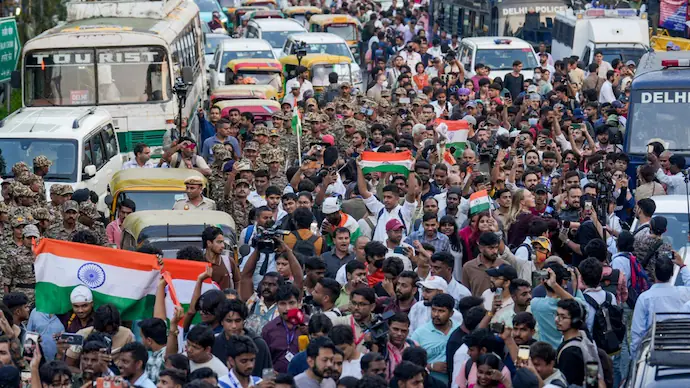
The INDIA bloc rally held in Delhi on November 1 has drawn criticism from the city’s trading community, with the Delhi Vyapar Mahasangh (Regd.) raising concerns over disruptions to business activity, customer movement and the livelihoods of traders and workers.
In a statement issued after the event, the traders’ association said political parties have the democratic right to organise rallies and express their views. However, it argued that the economic consequences of large public gatherings should also be considered, particularly when they affect commercial areas and ordinary citizens.
The association called for better coordination between political organisers, market representatives and government authorities to ensure that public demonstrations do not unnecessarily disrupt trade, employment and the movement of goods and customers.
Delhi Traders Say Rally Affected Business Activity
In its assessment titled What Was Lost, What Was Gained?, the Delhi Vyapar Mahasangh outlined the difficulties faced by businesses during the November 1 rally.
According to the association, the gathering affected business activity and customer footfall on an important trading day. Small traders who travel to Delhi from other states also faced disruptions to their schedules and purchasing plans.
The impact of reduced commercial activity can extend beyond shop owners. Employees, daily-wage labourers, transporters and other workers depend on the regular functioning of markets for their income. When customers cannot easily reach commercial areas or goods movement is interrupted, these groups can also face financial difficulties.
The association highlighted that Delhi’s wholesale markets serve businesses well beyond the national capital. Their operations support a wider network of traders, retailers and distributors across different parts of India.
Wholesale Markets Play an Important Role in India’s Supply Network
Delhi’s wholesale trading centres are important links in the country’s distribution system. Markets such as Sadar Bazar attract buyers from multiple states, including small shopkeepers and traders who depend on the capital for sourcing merchandise.
These buyers often travel to Delhi to purchase goods for resale in their home markets. Disruptions to traffic and access can therefore affect not only businesses located in the capital but also purchasing activity across a wider trading network.
The Delhi Vyapar Mahasangh said interruptions to routine market operations during major political events could be particularly difficult during important trading periods. It specifically pointed to the festive season ahead of Diwali, when market activity and customer movement are important for businesses.
For smaller traders, even a temporary disruption can affect sales opportunities, purchasing schedules and daily earnings. Businesses with limited resources may have less flexibility to absorb the impact of an unexpected interruption.
Association Warns of Impact on Delhi’s Market Reputation
Beyond the immediate disruption, the traders’ body raised concerns about the long-term image of Delhi’s major commercial centres.
It warned that repeated difficulties involving traffic, customer access and market operations could influence where buyers choose to shop. Customers and small traders may increasingly consider online platforms or alternative trading centres if reaching traditional wholesale markets becomes inconvenient.
Such a shift could create additional pressure for physical businesses, particularly smaller shops that rely on regular customer visits and relationships with buyers from outside Delhi.
However, the association’s statement also acknowledged that the rally brought greater public attention to the challenges faced by the capital’s trading community and highlighted the economic importance of its wholesale markets.
Traders Acknowledge Political Right to Hold Peaceful Protests
The Delhi Vyapar Mahasangh clarified that its concerns were not an objection to democratic demonstrations or political expression.
The association said political parties should have the freedom to organise peaceful protests and communicate their positions to the public. Its argument was that these rights should be exercised with consideration for businesses, workers, residents and other people affected by large gatherings.
The statement emphasised that the duration of a political event does not necessarily reflect the length of its economic impact. While a rally may continue for only a few hours, disruptions to business schedules and customer confidence could have consequences beyond the event itself.
This concern is especially relevant for markets that depend on predictable access, transport arrangements and the movement of goods. Traders often coordinate purchases, deliveries and staffing around specific business days, making advance planning important.
Delhi Traders Seek Better Planning for Future Political Events
The association urged political organisers and authorities to take commercial considerations into account when planning future large-scale gatherings in Delhi.
It said decisions about the dates and venues of political events should consider the city’s business calendar, festive seasons, market footfall, goods supply arrangements and public convenience.
Better coordination with market representatives could help organisers identify potential disruptions in advance and make arrangements to reduce their impact. Traffic planning and alternative access routes could also help maintain movement for customers, traders and essential commercial transport.
The traders’ body said a more coordinated approach would allow political activities and commercial operations to continue with fewer conflicts. It also called for greater recognition of the role that small businesses and wholesale markets play in supporting employment and economic activity.
Delhi Vyapar Mahasangh Calls for Balance Between Politics and Trade
Concluding its statement, the association said democratic rights and economic responsibilities should be considered together rather than treated as competing interests.
“Politics has its place, and business and employment have theirs. A balance between the two is the hallmark of a strong, responsible and healthy democratic system,” the association said.
The statement was issued by Delhi Vyapar Mahasangh president Devraj Baweja and senior vice-president Rajendra Kapoor.
The association’s position highlights a broader challenge for cities that host large political gatherings in busy commercial districts: ensuring that democratic participation can take place while limiting disruption to the businesses, workers and residents who depend on those areas every day.
For breaking news and live news updates, like us on Facebook or follow us on Twitter and Instagram. Read more on Latest Business on thefoxdaily.com.



COMMENTS 0