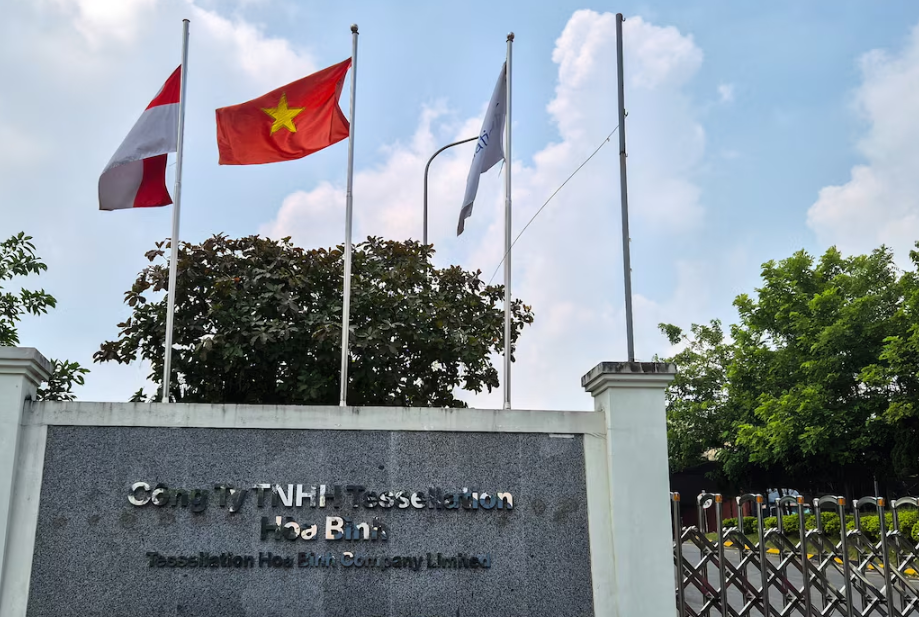
Three Vietnamese garment manufacturers with corporate and historical ties to Chinese textile giant Esquel Group have continued exporting cotton apparel to the United States, despite Esquel being placed on a U.S. forced-labor-related sanctions list in 2024. A Reuters investigation found that the three manufacturers have exported at least $5 million worth of cotton goods to the U.S. since Esquel was sanctioned, while continuing to source substantial quantities of cotton from Esquel.
The investigation raises questions about how corporate restructuring, international supply chains and U.S. customs enforcement interact when companies linked to sanctioned suppliers continue operating through different entities and countries.
Three Vietnamese Garment Makers Remain Connected to Esquel
The three Vietnamese manufacturers identified by Reuters are An Loi Apparel, Tessellation Binh Duong and Tessellation Hoa Binh. Their connections to Esquel go beyond simply purchasing materials from the Chinese textile group.
Before being rebranded in October 2022, all three companies used variations of the name Esquel Garment Manufacturing Vietnam. Corporate filings also listed Edgar Tung, who served as Esquel’s chief executive between 2021 and 2022, as an owner’s representative at the three manufacturers.
Corporate records reviewed by Reuters showed that the manufacturers were owned by the same three offshore firms before and after their name changes.
Former Assistant U.S. Trade Representative Joshua Kagan, who reviewed Reuters’ findings, said the connections could potentially be sufficient for U.S. customs authorities to determine that the manufacturers operate within Esquel’s broader corporate ecosystem.
However, Reuters could not establish that the clothing exported by the Vietnamese companies contained cotton produced by Esquel or cotton originating in China’s Xinjiang region.
Esquel Remains a Major Cotton Supplier
The supply-chain relationship nevertheless remains significant. Customs data reviewed by Reuters showed that Esquel sent approximately 70% of the $34 million in cotton it exported from China between November 2024 and June 2026 to the three Vietnamese garment manufacturers.
The manufacturers also purchase cotton from other suppliers. That distinction is important because the available shipment records do not establish the precise origin of cotton contained in individual finished garments exported to the United States.
Supply-chain experts and U.S. trade lawyers told Reuters that blending cotton from multiple sources is common in the industry. As a result, identifying the ultimate origin of cotton in a particular finished garment can be difficult without detailed supply-chain documentation and testing.
Reuters said Esquel and representatives for the three Vietnamese manufacturers did not respond to requests for comment about their relationship and U.S. exports.
At Least $5 Million in U.S. Apparel Exports
The three Vietnamese manufacturers together have exported at least $5 million worth of cotton goods to the United States since Esquel was sanctioned, according to shipment records reviewed by Reuters.
The findings are significant because Esquel itself was added to the U.S. Uyghur Forced Labor Prevention Act Entity List in November 2024. U.S. Customs and Border Protection says goods produced wholly or partly in China’s Xinjiang Uyghur Autonomous Region, or by entities on the UFLPA Entity List, are subject to a presumption that they were made with forced labor unless the applicable requirements for an exception are met. 0
The U.S. government has accused Esquel of links to forced labor programs involving Uyghurs in Xinjiang. Esquel denies those allegations.
Muji and Rodd & Gunn Sourced From the Manufacturers
The Vietnamese factories have supplied apparel for international brands, including Japanese retailer Muji and New Zealand menswear company Rodd & Gunn.
Both companies confirmed to Reuters that they sourced products from the manufacturers but said they were not aware of the companies’ links to Esquel.
Shipment records showed that Muji USA had sourced apparel from at least one of the manufacturers while it was still operating under an Esquel Garment Manufacturing name.
Muji told Reuters that it plans to audit one of the factories during 2026 and said its suppliers have signed a pledge not to use forced labor. The company did not say whether it would take additional action following Reuters’ findings.
Rodd & Gunn confirmed that it sourced products from two of the manufacturers. The company said its partners are required to source cotton exclusively from the United States, Brazil and Australia and that it collects documentation intended to verify the chain of custody.
Rodd & Gunn also said it was not aware of the relationship with Esquel and did not indicate whether it planned additional action.
How Esquel Became Subject to U.S. Restrictions
Esquel has operated across multiple stages of the textile industry, describing its business model as a “seed to shirt” operation. Its activities have included agricultural research, cotton production, textile manufacturing and apparel production.
The company has a long history of operations in Xinjiang, a major global cotton-producing region. The United States has accused Chinese authorities of serious human-rights abuses against Uyghurs and other predominantly Muslim minority groups in the region, including the use of forced labor.
China has rejected allegations of forced labor and other abuses in Xinjiang as unfounded.
U.S. restrictions on Esquel intensified after one of its Xinjiang mills was blacklisted in 2020 over alleged forced-labor concerns. Esquel challenged the designation, but a federal court in Washington rejected its request for emergency relief, and an appeals court upheld that ruling in July 2022.
Esquel and Tessellation Underwent Corporate Changes
Several corporate changes followed the U.S. actions against Esquel. In 2022, Esquel Group spun off its consumer brands and technology operations into an entity known as Tessellation Group.
Around the same period, the three Vietnamese garment manufacturers removed Esquel-related branding from their names and adopted Tessellation-related names. One of them later became known as An Loi Apparel.
Reuters said it could not determine whether Tessellation Group was ultimately the owner of the three Vietnamese manufacturers that also carried Tessellation names.
Tessellation Group did not respond to Reuters’ questions about its relationship with Esquel and the Vietnamese garment companies.
Edgar Tung, the former Esquel chief executive, became Tessellation Group’s CEO in January 2023. He also did not respond to Reuters’ questions.
Workers Reported No Major Change After Rebranding
Reuters visited the Tessellation Hoa Binh factory in Vietnam as part of its investigation. Six workers who said they had been employed at the plant before its rebranding told Reuters that they had not observed changes in management or working practices following the name change.
Their accounts do not by themselves establish ownership or determine the origin of cotton used in exported products. However, they provide additional context for Reuters’ findings about continuity before and after the corporate rebranding.
The continued commercial relationship with Esquel is also reflected in customs data showing that Esquel remained the dominant supplier of cotton to the three manufacturers during the period examined.
U.S. Forced Labor Enforcement Creates a Supply-Chain Test
The case highlights a broader challenge for U.S. authorities: enforcement of forced-labor restrictions can become complicated when manufacturing takes place across multiple jurisdictions and companies operate through related corporate structures.
The Uyghur Forced Labor Prevention Act was signed into law in 2021. It established a broad presumption against imports connected to Xinjiang and created an Entity List identifying companies subject to additional scrutiny.
Esquel Group was added to that Entity List in November 2024. CBP documents show that the addition included Esquel Group, Guangdong Esquel Textile Co. and Turpan Esquel Textile Co. 1
For importers, compliance therefore depends not only on identifying their immediate supplier but also on establishing the origin and chain of custody of materials used in finished goods.
Why Vietnam Matters in the U.S. Apparel Supply Chain
Vietnam is a major manufacturing base for clothing sold in the United States. That makes the country’s garment industry an important part of enforcement efforts surrounding the UFLPA.
Reuters reported that approximately $28 billion of apparel was shipped from Vietnam to the United States between November 2024 and June 2026.
During that period, CBP detained about $2.6 million of apparel from Vietnam for inspection under the U.S. forced-labor law. More than half of the detained goods, measured by value, were subsequently released, according to the Reuters investigation.
The figures illustrate the scale of the enforcement challenge: the value of apparel shipped from Vietnam to the United States is vastly larger than the amount detained for forced-labor inspection.
Why Customs Inspections Are Important
CBP is responsible for enforcing U.S. restrictions on goods connected to forced labor. The agency has said that companies should remove suppliers using forced labor or require them to change their practices.
CBP’s enforcement system includes tools such as Withhold Release Orders and UFLPA-related admissibility reviews. Under U.S. law, merchandise produced wholly or partly with forced labor is prohibited from entering the country. 2
However, customs authorities cannot physically inspect every shipment entering the United States. That makes documentation, supply-chain tracing and risk-based enforcement important components of the system.
The Reuters findings therefore raise a broader question about whether importers can reliably identify indirect relationships between sanctioned entities and manufacturers operating in third countries.
Lawmakers Have Raised Concerns About Enforcement
The level of inspections has attracted scrutiny from U.S. lawmakers. In a December 2025 letter to CBP leaders, Democratic lawmakers argued that inspections had fallen sharply despite what they described as no evidence that shipments covered by the law had declined.
CBP has said that it continues to prioritize forced-labor enforcement while also implementing tariff measures.
The agency has faced a significant increase in responsibilities as the United States has expanded tariffs and trade enforcement involving numerous countries.
Washington-based attorney Jessica Rivkin, who specializes in the UFLPA, told Reuters that CBP has faced substantial pressure from the tariff measures introduced by the Trump administration.
Corporate Links Do Not Automatically Establish Cotton Origin
One of the most important distinctions in the investigation is between corporate relationships and proof of the origin of specific cotton.
Reuters identified extensive connections between Esquel and the three Vietnamese manufacturers. It also found that Esquel supplied a large share of their cotton during the period examined.
But Reuters said it could not determine whether the cotton in the garments shipped to the United States originated from Esquel or Xinjiang.
This distinction matters because a company’s relationship with a sanctioned entity does not, by itself, establish that every product manufactured by that company contains prohibited material. Customs enforcement requires evidence concerning the relevant goods and Supply Chain.
At the same time, the blending of cotton from different suppliers can make that determination more difficult, increasing the importance of detailed traceability records.
What the Investigation Means for Clothing Brands
The case demonstrates why apparel companies face increasing pressure to understand suppliers beyond the factory that directly produces their clothing.
A brand may purchase finished garments from a Vietnamese factory while sourcing cotton through another company. If raw materials pass through multiple traders, mills and manufacturers, establishing the complete chain of custody becomes more complicated.
Companies therefore increasingly rely on supplier certifications, documentation, audits and other forms of due diligence to establish where materials originated.
Muji and Rodd & Gunn both told Reuters that they had requirements concerning forced labor or cotton sourcing. Their responses also demonstrate that companies can learn new information about supply-chain relationships after products have already entered the market.
The Bigger Issue: Supply-Chain Transparency
The Esquel-linked manufacturers illustrate the difficulty of separating corporate identity from physical supply chains.
A factory can change its name while continuing to use the same facilities, maintain commercial relationships and retain connections with individuals or ownership structures associated with its previous identity. At the same time, the factory can source materials from multiple suppliers, making the origin of individual inputs difficult to establish.
For U.S. regulators, that creates a challenge between broad sanctions and shipment-level evidence. For apparel brands, it increases the importance of mapping suppliers several levels deep rather than focusing only on direct manufacturing partners.
What Happens Next
The Reuters investigation does not establish that the cotton apparel exported by the three Vietnamese manufacturers contained Xinjiang cotton or cotton produced by Esquel. It does establish that the manufacturers maintained significant commercial and corporate links to Esquel and exported at least $5 million in cotton goods to the United States after Esquel’s 2024 designation.
The case is likely to keep attention focused on how U.S. authorities identify indirect supply-chain connections and how apparel companies verify the origin of cotton used in their products.
For importers and retailers, the central issue is increasingly traceability: knowing not just where a garment was sewn, but where its raw materials originated and which companies were involved at each stage of production.
As U.S. enforcement of forced-labor restrictions develops, corporate restructuring, third-country manufacturing and blended raw materials will remain important factors in determining how effectively the rules can be applied across complex global apparel supply chains.
FAQs
What is the Esquel Group?
Esquel Group is a Hong Kong-based textile and apparel company with operations spanning cotton-related activities, textile manufacturing and garment production. It has faced U.S. restrictions over alleged links to forced labor in Xinjiang, allegations the company denies.
Why was Esquel placed on a U.S. sanctions-related list?
The U.S. government added Esquel Group and related entities to the UFLPA Entity List in November 2024 over forced-labor concerns. Esquel has denied the allegations.
Which Vietnamese garment manufacturers are linked to Esquel?
Reuters identified An Loi Apparel, Tessellation Binh Duong and Tessellation Hoa Binh. The companies previously operated under variations of the Esquel Garment Manufacturing Vietnam name.
Did Reuters establish that the U.S.-bound clothes contained Xinjiang cotton?
No. Reuters said it could not establish whether the products exported by the Vietnamese manufacturers contained cotton produced by Esquel or cotton originating in Xinjiang.
Which brands sourced clothing from the Vietnamese manufacturers?
Reuters reported that Muji USA and Rodd & Gunn confirmed sourcing apparel from the manufacturers. Both companies said they were not aware of the manufacturers’ links to Esquel.
What is the Uyghur Forced Labor Prevention Act?
The UFLPA is a U.S. law designed to prevent imports connected to forced labor in China’s Xinjiang region. Goods covered by the law are subject to a presumption against entry unless the relevant legal requirements are satisfied. 3
Why can cotton supply chains be difficult to trace?
Cotton can pass through multiple suppliers, mills and manufacturers, and industry participants told Reuters that blending cotton from different sources is common. This can make the origin of cotton in a finished garment difficult to establish without detailed records and verification.
What is the main issue raised by the Reuters investigation?
The investigation highlights the challenge of enforcing forced-labor import restrictions when companies operate through complex international supply chains, corporate rebranding and manufacturing relationships spanning multiple countries.
For breaking news and live news updates, like us on Facebook or follow us on Twitter and Instagram. Read more on Latest Business on thefoxdaily.com.






COMMENTS 0