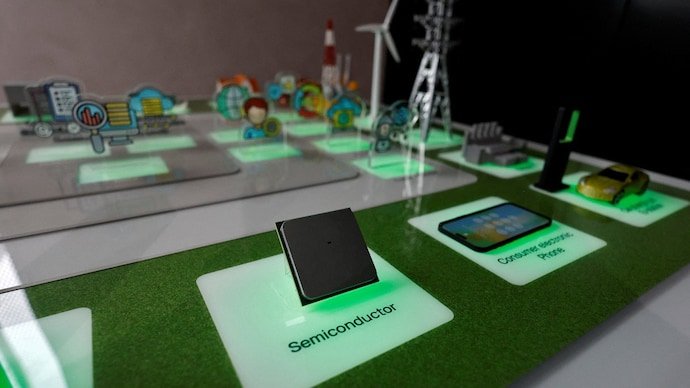
India’s next industrial boom could be built around six emerging sectors rather than traditional factory-led manufacturing alone. Semiconductors, private space, data centres, electronics components, solar equipment and aerospace are increasingly developing into broader industrial ecosystems, bringing together capital, technology, skilled labour, Infrastructure and domestic demand.
That is the central argument in a recent Jefferies strategy assessment, which sees India entering a potentially important new phase of industrial expansion. The brokerage’s thesis is built around three structural advantages: an established manufacturing base, a large domestic market and the global drive among companies to diversify supply chains beyond China.
The opportunity is also being reinforced by government policy. Incentives for semiconductors and electronics, support for domestic solar manufacturing and the opening of the space sector to private companies have created conditions for industries that were either small or predominantly state-controlled only a decade ago.
The bigger story is not simply how much each sector could be worth. It is whether India can build the supporting ecosystems that allow these industries to compete globally. That means moving beyond assembly and basic manufacturing toward design, components, engineering, infrastructure and specialised services.
Why India’s next industrial cycle could be different
India has spent decades developing conventional manufacturing capabilities across automobiles, chemicals, pharmaceuticals, steel, engineering and other industries. The new opportunity is to use that base to build industries linked to some of the fastest-growing parts of the global Economy.
The common thread across the six sectors is industrial localisation. Instead of importing most of the technology, components or finished products, India is attempting to move more of the value chain into the country.
That shift matters because a factory on its own creates less economic depth than a complete ecosystem. A semiconductor industry needs chip designers, packaging companies, equipment suppliers, chemical producers and specialised logistics. Aerospace requires precision engineering, component manufacturers and globally certified suppliers. Data centres need power, cooling, construction, fibre networks and land.
That ecosystem effect is what could make the next phase of Indian industrialisation broader than simply increasing factory output.
1. Space sector: India’s government-led industry becomes commercial
India’s space sector is moving from a predominantly government-led model toward a broader commercial ecosystem.
The policy change began in earnest when India opened space activities to private companies in 2020. Since then, startups have entered areas ranging from launch vehicles and satellite manufacturing to Earth observation, space intelligence and data services.
Companies such as Skyroot Aerospace, Pixxel, Agnikul Cosmos and Digantara represent different parts of this emerging private ecosystem. Their presence indicates that India’s space opportunity is no longer limited to the traditional government space programme.
Jefferies estimates that India’s space economy could expand from roughly $8.4 billion in 2023 to around $40–45 billion by 2030, implying an increase of almost five times.
The significance of that forecast extends well beyond the headline market size. A commercial space economy requires launch infrastructure, propulsion systems, satellite components, software, ground stations, tracking capabilities and specialist engineering.
As these activities scale, more Indian suppliers can potentially become part of a global space supply chain rather than serving only domestic government programmes.
Why private space could have an outsized impact
Space technology has spillover effects across telecommunications, navigation, agriculture, weather forecasting, defence and disaster management. A larger private ecosystem can therefore create value beyond rocket launches and satellite sales.
The sector also gives India an opportunity to compete where engineering capability and cost efficiency can be advantages, particularly in commercial satellite services and launch-related activities.
2. Semiconductors: India moves from importing chips to building an ecosystem
Semiconductors may be the most strategically important industry in India’s new industrial push.
Modern economies depend on chips for automobiles, Smartphones, telecom equipment, computers, industrial machinery, defence systems and artificial intelligence infrastructure. India has traditionally depended heavily on imports for semiconductors, leaving manufacturers exposed to global shortages and supply-chain disruptions.
That is beginning to change.
Jefferies estimates that roughly $20 billion of semiconductor investment is already in the pipeline, including a fabrication facility and several outsourced semiconductor assembly and testing, or OSAT, projects moving toward production.
Recent government updates indicate that India’s approved semiconductor ecosystem has expanded significantly, with 12 units representing about $20 billion of investment and several facilities already moving into production. The developments suggest that the country’s chip strategy is shifting from policy announcements toward physical manufacturing capacity.
A new incentive programme worth around $13 billion, according to the Jefferies analysis cited in the source material, could further support the ecosystem and encourage higher-value activities such as chip design.
The semiconductor challenge is bigger than building a fab
India cannot become a competitive semiconductor hub simply by constructing fabrication plants. The industry requires specialised workers, extremely reliable power and water, sophisticated equipment, high-purity materials and internationally competitive supply chains.
It also faces competition from established semiconductor manufacturing centres across East Asia, the United States and Europe.
That makes ecosystem depth crucial. India’s long-term objective is not merely to produce a limited number of chips domestically but to create an industry in which design, manufacturing, packaging and supporting services reinforce each other.
3. Data centres: the infrastructure behind India’s digital economy
India’s third major opportunity sits underneath the digital economy rather than on a factory floor.
Data centres are becoming critical national infrastructure as cloud computing, digital payments, artificial intelligence, enterprise software and online services increase demand for computing capacity.
Jefferies estimates that India’s colocation data-centre capacity has grown roughly fivefold over the past five years to around 2GW. The brokerage expects another fivefold expansion over the next five years, potentially taking capacity to around 10GW.
That expansion alone could create a significant opportunity for data-centre operators. But the wider economic impact is potentially much larger.
Jefferies estimates that the expansion could generate around $45 billion of investment across supporting infrastructure such as Electricity, cooling systems, construction and networking.
The hidden industrial opportunity in data centres
A data centre is often imagined as a building filled with servers. In industrial terms, however, it is a complex infrastructure project.
It requires reliable electricity, backup generation, transformers, switchgear, cooling equipment, fibre connectivity, construction materials, security systems and specialised engineering.
That means the data-centre boom could benefit companies far outside the technology sector.
The rapid growth of artificial intelligence is adding another layer to the opportunity because AI workloads require much greater computing capacity and electricity than many traditional applications.
India’s ability to expand data-centre capacity could therefore influence not only its technology sector but also power generation, transmission, construction and industrial equipment demand.
4. Electronics: the next step is components, not just assembly
India has already emerged as a major electronics assembly location, particularly for smartphones. The next challenge is to capture a larger share of the value inside those products.
That means manufacturing more components locally.
For years, the criticism of India’s electronics success was that an increasing number of finished devices were being assembled domestically while many critical components continued to be imported.
The government’s Electronics Components Manufacturing Scheme, or ECMS, is designed to address that gap by encouraging investment in components and deeper manufacturing capabilities.
Jefferies expects the scheme eventually to cover around 50 per cent of the mobile component value chain over the next six to seven years.
That could significantly change the structure of India’s electronics industry.
From “assembled in India” to “made in India”
The distinction matters because components generally carry more technological know-how and can create stronger supplier networks than final assembly alone.
Greater domestic production of printed circuit boards, display-related components and other electronics inputs can reduce import dependence while creating opportunities for Indian companies to become suppliers to global manufacturers.
The combination of semiconductor policies, component incentives and electronics manufacturing support could therefore create a more integrated technology ecosystem.
The ultimate goal is not simply to increase the number of smartphones made in India. It is to increase the amount of each smartphone’s value that is created inside India.
5. Solar manufacturing: capturing more of the clean-energy supply chain
Solar manufacturing is another area where India is trying to move from scale to deeper localisation.
According to Jefferies, India has become the world’s second-largest solar photovoltaic manufacturing base, with roughly 35GW of solar-cell capacity operational and another approximately 100GW under construction.
The next challenge is to localise more of the supply chain, including wafers and ingots that sit further upstream in the manufacturing process.
Government measures such as domestic-content requirements, the Approved List of Models and Manufacturers and production-linked incentives are intended to support that transition.
Jefferies expects roughly 90 per cent of the solar manufacturing value chain to be localised by 2030.
Why solar localisation matters
The solar opportunity is closely connected to India’s energy security.
Increasing domestic manufacturing can reduce dependence on imported equipment while creating a domestic industrial base around one of the world’s fastest-growing energy technologies.
It can also create demand for machinery, speciality materials, engineering services and logistics.
For Indian manufacturers, the opportunity extends beyond the domestic market. As global solar deployment continues, companies that become competitive at scale could eventually supply international markets.
6. Aerospace: moving higher up the global supply chain
Aerospace could become one of India’s most promising high-value manufacturing opportunities.
India already possesses a large pool of engineering talent and a relatively cost-competitive manufacturing Environment. The country has also developed a growing supplier relationship with global aircraft manufacturers.
Jefferies estimates Indian aerospace exports to Boeing and Airbus at roughly $1.4–1.6 billion annually, indicating that Indian companies are already becoming part of the global aircraft supply network.
Companies including BHFL, Dynamic Technologies, Rane, Motherson and Sansera are expanding their participation as suppliers to global original equipment manufacturers and Tier-1 aerospace companies.
The opportunity is not necessarily for India to begin producing complete passenger aircraft in the near term. A more realistic pathway is to steadily move into higher-value components, systems, precision engineering and specialised manufacturing.
Why aerospace can create durable industrial capabilities
Aerospace manufacturing requires extremely high levels of quality control and precision. Companies that develop those capabilities can potentially apply them to other advanced manufacturing industries as well.
That creates an ecosystem effect similar to semiconductors: once supplier capabilities deepen, the benefits can spread beyond the original industry.
India’s challenge will be maintaining consistent quality, meeting international certification requirements and scaling production enough to become indispensable to global manufacturers.
The six sectors are connected more than they appear
The most important part of Jefferies’ industrial thesis may not be the six sectors individually but the connections between them.
Semiconductor manufacturing requires specialised industrial infrastructure and power. Data centres require chips, cooling systems and enormous amounts of electricity. Solar manufacturing supports the energy system that can power digital and industrial growth. Aerospace and space depend on advanced electronics and precision engineering.
This means growth in one industry can create demand in several others.
| Sector | Core opportunity | Wider ecosystem |
|---|---|---|
| Space | Launches, satellites, Earth observation and space intelligence | Propulsion, components, software, tracking and ground infrastructure |
| Semiconductors | Chip fabrication, packaging and design | Equipment, materials, engineering, chemicals and logistics |
| Data centres | Cloud, AI and digital infrastructure capacity | Power, cooling, construction, networking and electrical equipment |
| Electronics | Components and deeper manufacturing | PCBs, displays, chips, suppliers and precision manufacturing |
| Solar | Cells, wafers and upstream manufacturing | Machinery, materials, engineering and energy infrastructure |
| Aerospace | Aircraft components and precision manufacturing | Engineering, certification, advanced materials and global suppliers |
Policy support is helping industries reach scale
Government policy has played an unusually important role in several of these sectors.
Production-linked incentives have attempted to encourage companies to manufacture domestically at larger scales. Semiconductor programmes are supporting fabrication and packaging. Electronics policies are pushing component localisation. Solar measures are designed to increase domestic manufacturing, while space-sector reforms have opened opportunities for private enterprises.
These policies do not guarantee success. Incentives can create capacity, but companies still need competitive costs, reliable infrastructure, skilled employees and global customers.
The important change is that policy is increasingly focused on building ecosystems rather than merely attracting individual factories.
Supply-chain diversification is giving India another opportunity
India’s industrial push is also being strengthened by a major change in global corporate strategy.
Companies are increasingly seeking manufacturing and sourcing options outside China to reduce concentration risk and make supply chains more resilient.
India cannot capture all of that activity. Competing locations across Southeast Asia, Mexico, Eastern Europe and elsewhere are also trying to attract investment.
But India’s combination of market size, engineering talent, existing industrial capabilities and policy support gives it a strong starting position.
The biggest opportunity may come when domestic demand and export demand reinforce each other. A large Indian market can help companies reach scale, while global exports can push them toward international quality and cost standards.
Domestic demand gives India an unusual advantage
One of India’s biggest advantages is something that cannot easily be replicated by a policy incentive: its enormous domestic market.
A new semiconductor product, digital service, solar technology or electronics component can potentially find customers inside India before expanding internationally.
That creates a pathway that smaller manufacturing economies often lack. Companies can use domestic demand to build production volumes, improve efficiency and accumulate technological expertise before competing globally.
For sectors such as data centres and electronics, domestic demand is already a major growth engine. In space and aerospace, the domestic market can provide an anchor while companies pursue international customers.
The bigger opportunity could be outside the six headline industries
There is an important second-order effect in Jefferies’ argument.
The companies most likely to benefit from this industrial cycle may not always be the household names operating directly in the six sectors.
Consider a semiconductor fabrication plant. It needs industrial gases, chemicals, power equipment, water-treatment systems, clean-room infrastructure and specialised engineering.
A new data centre needs electricity transmission, transformers, cooling equipment, buildings and fibre networks.
Solar factories require machinery, glass, chemicals, metals and logistics.
Aerospace manufacturers need high-precision machining, electronics, materials and testing services.
As these ecosystems expand, the industrial multiplier can spread through hundreds of supplier companies.
What could prevent the industrial boom?
The opportunity is substantial, but India’s industrial transformation is not guaranteed.
Semiconductors face technological and talent constraints. Space companies need access to capital and reliable commercial demand. Data centres require huge amounts of electricity and adequate grid infrastructure. Electronics must overcome continued dependence on imported components. Solar manufacturers face intense global competition and changing technology. Aerospace requires stringent quality standards and long qualification cycles.
There is also the broader question of cost competitiveness. Government incentives can reduce the initial disadvantage, but global manufacturers ultimately need products that are reliable and competitively priced.
India therefore needs to turn policy support into productivity gains rather than permanent dependence on incentives.
Why “ecosystem depth” could decide India’s success
The next stage of India’s manufacturing story will be determined less by the number of factories announced and more by what surrounds those factories.
A truly competitive industry needs local suppliers, skilled workers, research capabilities, financing, infrastructure and customers.
That is why the six sectors are strategically important. They are large enough, technologically significant enough and interconnected enough to potentially create entire industrial clusters.
If India succeeds in building those clusters, the country could move from being primarily a market for imported technology to becoming an increasingly important producer of that technology.
From “Make in India” to deeper industrial value
The evolution across these six industries can be viewed as a progression.
The first stage is importing finished products. The next is assembling them domestically. The more difficult stage is producing components. The most valuable stage is controlling design, technology, manufacturing and supply chains.
India’s emerging sectors are now trying to move through that progression at the same time.
Electronics is moving from assembly toward components. Semiconductors are moving toward fabrication and packaging. Solar is moving upstream into wafers and ingots. Aerospace is moving toward higher-value supplier roles. Space is developing a private ecosystem around launches and satellite technologies. Data centres are creating a domestic infrastructure layer for the digital economy.
That makes the current industrial cycle fundamentally different from simply adding more manufacturing capacity.
What this could mean for India’s economy by 2030
By the end of this decade, India’s industrial landscape could look significantly different if these investments translate into successful commercial operations.
The country could have a much larger private space economy, a functioning semiconductor manufacturing base, dramatically more data-centre capacity, deeper electronics supply chains, a highly localised solar industry and a stronger position in global aerospace manufacturing.
The common outcome would be greater domestic value addition.
That could improve India’s ability to retain more of the economic value generated by its own consumption while also creating new export opportunities.
The real test is whether India can scale
India has already demonstrated that it can build large-scale manufacturing capacity in selected industries. The more difficult challenge is achieving the consistency, speed and productivity required to become a major global supplier in technologically demanding sectors.
Scale will matter particularly for semiconductors, electronics and solar, where international competition is intense and margins can be tightly linked to production volumes.
It will also matter for aerospace and space, where global customers demand reliability over many years.
The ability to move from successful individual projects to dense, competitive industrial ecosystems will ultimately determine whether this becomes a genuine industrial transformation.
India’s next industrial revolution may be ecosystem-driven
Jefferies’ six-sector thesis points to a broader change in the way India’s industrial future is being built. The opportunity is no longer limited to factories producing conventional goods. It increasingly includes chips, rockets, satellites, AI infrastructure, advanced electronics, solar equipment and aircraft components.
These industries are being supported by domestic demand, government policy and a global desire to diversify supply chains. More importantly, they can reinforce one another by creating demand for power, engineering, components, logistics and advanced manufacturing.
The outcome will depend on execution. India will need to develop specialised talent, reliable infrastructure, competitive costs and deeper supplier networks while ensuring that policy support translates into durable commercial capability.
If those pieces fall into place, the country’s next manufacturing cycle could be much broader than the factory expansion of previous decades. It could mark a transition from assembling global products to building the industrial ecosystems behind them from chips and satellites to data centres, solar technology and aerospace.
For breaking news and live news updates, like us on Facebook or follow us on Twitter and Instagram. Read more on Latest Business on thefoxdaily.com.






COMMENTS 0