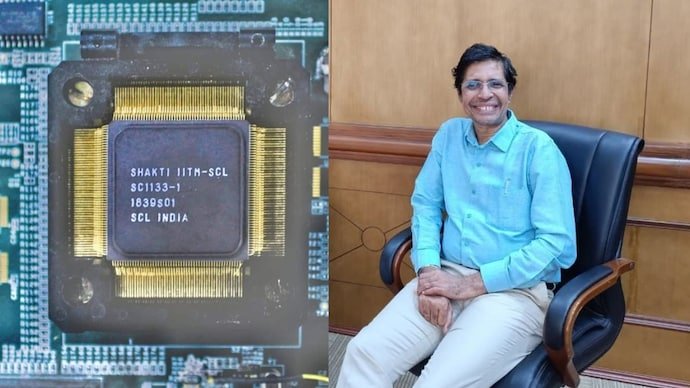
India’s ambition to build its own microprocessor was never just a story about chip design, silicon and engineering. According to V. Kamakoti, Director of IIT Madras, the more difficult challenge was convincing researchers, funders, industry and potential users that an Indian-designed processor could actually work.
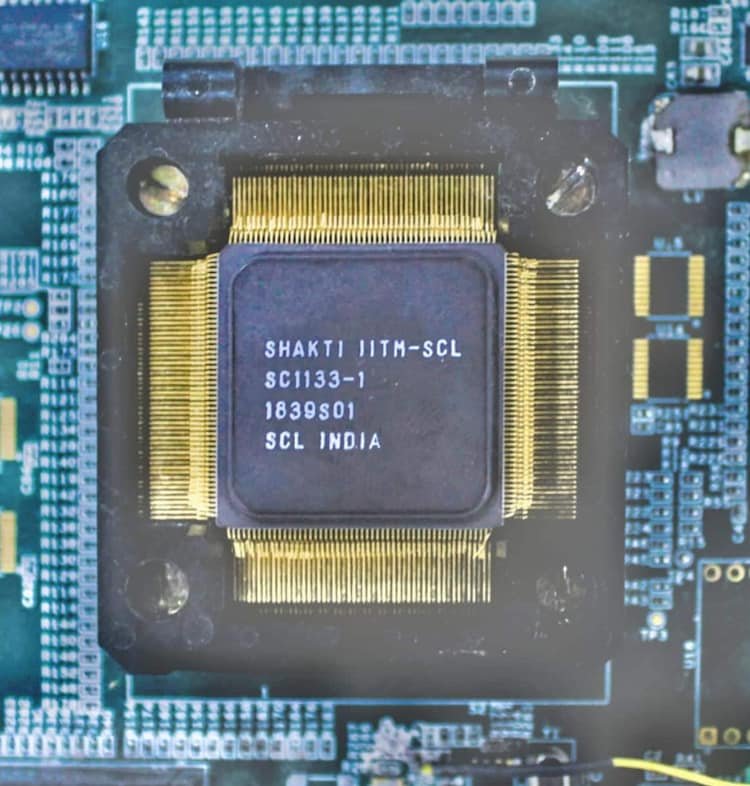
That challenge sits at the heart of Shakti, a family of microprocessors developed at IIT Madras and based on the open RISC-V instruction set architecture. For Kamakoti, the journey from a research project to a technology that India could realistically use required something that cannot be measured in transistor counts or processor speeds: trust.
“To build trust is the challenge,” Kamakoti told India Today Digital in an interview at the IIT Madras campus, describing the experience of developing Shakti and trying to move it beyond the laboratory.
His account offers a different perspective on India’s semiconductor ambitions. While government Investment, fabrication facilities and advanced equipment are essential to building a domestic chip ecosystem, the experience of Shakti suggests that technological self-reliance begins much earlier with the willingness to believe that a locally developed technology can succeed.
What is the Shakti microprocessor?
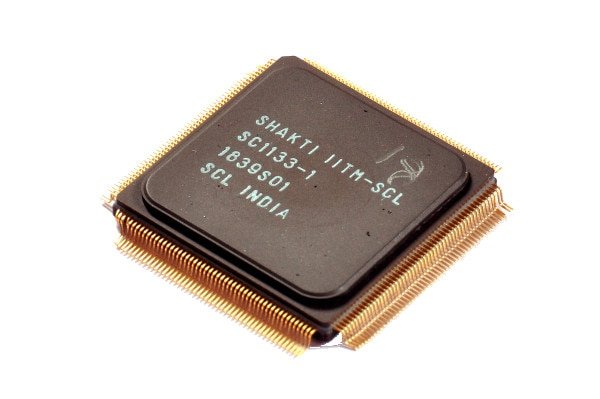
A microprocessor is one of the fundamental components inside a computing system. It executes instructions and performs the calculations that allow devices to operate, effectively acting as the computational engine inside everything from computers and embedded systems to specialised machines.
For decades, India has depended heavily on processor architectures and chip designs developed outside the country. That dependence becomes strategically significant when processors are used in critical Infrastructure, defence systems, communications equipment and other sensitive applications.
Shakti was developed as an Indian response to that dependence.
The processor family was designed at IIT Madras using RISC-V, an open instruction set architecture. RISC-V provides the basic set of instructions that processors understand and execute. Those instructions form the underlying vocabulary through which software communicates with processor hardware.
The open nature of RISC-V is particularly important. Unlike proprietary instruction set architectures that require companies to operate within licensing arrangements, RISC-V is publicly available for designers to use and build upon.
That openness allowed Indian researchers to develop processor designs without first having to obtain permission to use a proprietary foreign instruction set.
RISC-V originated as an academic project at the University of California, Berkeley, before developing into an internationally adopted architecture. Its open model has since attracted researchers, companies and governments interested in developing their own processor technologies.
Why trust became the biggest challenge
From the outside, developing a processor can appear to be primarily an engineering problem. Researchers need to design the architecture, create the hardware, test it, manufacture or fabricate the chip and verify that it performs as expected.
But Kamakoti says the most difficult part of the Shakti journey came before the technology had established itself.
“The biggest hurdle, not just for IITs, but for any entrepreneur or researcher starting something new, is building trust,” he said.
The challenge was not that the world had never built microprocessors. It was that an Indian research team was asking others to believe that it could successfully develop one.
That distinction is crucial.
A technology can be technically possible while still being difficult to commercialise or deploy because potential supporters do not yet know whether a particular team, institution or company can deliver it.
For Shakti, that meant researchers themselves had to believe that the project could ultimately become a functioning technology. At the same time, people providing financial or institutional support had to reach the same conclusion.
Kamakoti described these as two interconnected forms of confidence.
“First, you should start trusting your project, that it will finally see the light of day,” he said. “Secondly, people who are going to fund or support you must also start believing in it.”
Only when both forms of trust existed could the project move forward with greater confidence.
The years spent convincing people
Shakti’s development highlights an often-overlooked stage in technological innovation: the period between announcing an ambitious project and demonstrating that it can actually deliver.
During that period, a research team can have talented engineers, a strong technical concept and access to laboratories, yet still struggle to persuade others to commit resources.
Kamakoti said Shakti faced exactly that problem.
“We took a lot more time to convince people that this is indeed something that will work,” he said.
That observation changes the way the project can be understood. The obstacle was not necessarily a missing engineering breakthrough. Instead, the team had to establish credibility around a technology that did not yet have a long history of successful deployment behind it.
Once that confidence was established, however, the process became easier.
“Building trust is the real challenge. Once the trust is built, things move,” Kamakoti said.
For emerging technology ecosystems, that cycle can be especially important. The first successful project creates confidence that makes the next project easier to finance, develop and adopt.
IIT Madras reputation became a form of collateral
One of the factors that helped Shakti build credibility was the institutional reputation of IIT Madras.
Kamakoti attributed that confidence partly to the expertise of the researchers and partly to what he described as the “brand value” developed by the institution over many years.
That reputation does not automatically prove that a new technology will succeed. But for funders and partners considering an unfamiliar project, an institution with a history of research achievements can reduce some of the uncertainty involved in taking a risk.
“These are IIT Madras people,” Kamakoti said, explaining how potential supporters may view projects emerging from the institute. “They are known for taking risks and succeeding.”
In that sense, institutional reputation can become a form of collateral for innovation.
Every successful project strengthens confidence in the next one. Over time, that accumulated credibility can make it easier for researchers to secure support for ambitious technologies that would otherwise appear too uncertain.
For Shakti, the processor therefore benefited not only from engineering expertise but also from years of institutional credibility.
The research ecosystem behind Shakti
Technology does not stop at the point where a research prototype works. For a processor to have an impact, it needs companies capable of developing products around it, entrepreneurs willing to commercialise related technologies and customers willing to adopt them.
IIT Madras has built an incubation ecosystem designed to help bridge that gap.
At the centre of that ecosystem is the IIT Madras Research Park, where startups can operate while maintaining a connection with the institute and its research environment.
Kamakoti said startups are mentored for roughly one and a half to two years before graduating to the next stage.
According to him, more than 590 companies have been incubated and nurtured through the ecosystem, with their combined valuation reaching around Rs 83,000 crore.
The scale is significant because it illustrates the broader infrastructure required to convert research into commercial activity. A university laboratory can create a technical breakthrough, but businesses are often needed to manufacture, distribute, support and continuously improve products built around that breakthrough.
The technology is not always the biggest problem for startups
Kamakoti’s observations about IIT Madras’s startup ecosystem also reveal another aspect of the trust problem.
Young technology founders often have strong technical skills. The challenge can emerge when they have to move beyond engineering and convince customers, investors and partners that their technology solves a problem worth paying for.
“They are technically super brilliant,” Kamakoti said when discussing young founders.
That is why mentorship, in his view, is not necessarily about teaching founders how to build the technology. It is about helping them navigate the difficult transition between technical capability and real-world adoption.
A functioning prototype is only the beginning. A company still has to understand its market, identify customers, build a sustainable Business model, raise capital and establish confidence among people who may be unfamiliar with the technology.
The same principle applies to national technology programmes.
A country can invest heavily in research and infrastructure, but the resulting technologies still need people and institutions willing to trust them enough to use them.
Why Shakti matters to India’s semiconductor ambitions
India is making a major push to expand its semiconductor ecosystem, including efforts to develop domestic manufacturing capabilities.
Semiconductor manufacturing, however, is only one part of technological self-reliance.
A chip fabrication plant can manufacture silicon, but the country also needs processor architectures, chip designs, software ecosystems, testing capabilities, packaging expertise and companies capable of turning those components into usable products.
Shakti sits within that broader effort because it represents an Indian-designed processor architecture built around an open international standard.
The significance is not necessarily that one processor can replace every foreign processor used in India. Instead, an indigenous processor programme gives researchers and companies experience in one of the most technically demanding areas of computing.
It also provides a foundation on which future processor designs and specialised applications can potentially be developed.
Open architecture reduces one major barrier
RISC-V has played an important role in making this kind of development more accessible.
At the heart of any processor is its instruction set architecture the fundamental collection of commands that the processor is designed to understand. Software ultimately relies on this interface to communicate with the hardware.
Because RISC-V is open, designers can build processors around the architecture without depending on a proprietary instruction set controlled by a single commercial company.
That does not make chip development easy. Designing a competitive processor still requires advanced engineering, verification, software support, manufacturing access and extensive testing.
But the open architecture removes one potential barrier and allows researchers to focus on building their own implementations.
For a country seeking greater control over critical computing technologies, that distinction can be strategically important.
Technology sovereignty is about more than factories
India’s semiconductor ambitions are often discussed in terms of fabrication plants, investment commitments and manufacturing capacity. Those elements are essential because modern chip production requires enormous capital and highly specialised infrastructure.
But Kamakoti’s experience with Shakti points to another requirement: the ability to develop confidence around domestic technologies.
Before an Indian-designed processor can be manufactured at scale, potential users and manufacturers need to believe that it is reliable enough to justify the investment.
That confidence cannot be created simply by building a factory.
It has to come from demonstrated performance, credible research, institutional experience, testing, partnerships and successful deployments.
In that sense, Shakti’s story is not only about creating a processor. It is also about creating the ecosystem required for Indian-designed hardware to be taken seriously.
‘Solve a problem for Bharat, and you have solved it everywhere’
Kamakoti also emphasises a broader philosophy behind IIT Madras’s innovation efforts: technologies should address real problems faced by India.
His argument is that solving a problem for India’s diverse and demanding environment can create technology with relevance beyond the country.
That approach shifts the focus away from developing technology simply for the sake of technological achievement. Instead, research is connected to practical needs and potential users.
The logic became particularly visible during the COVID-19 Pandemic, when technologies and medical solutions developed for India’s large population demonstrated potential relevance elsewhere.
For processor technology, the same principle can apply. A system designed around India’s requirements can potentially become useful in other markets facing similar needs, provided it meets the required technical and commercial standards.
The real lesson from Shakti
The story of Shakti ultimately reveals a less visible side of technological independence.
Engineering is indispensable. Without skilled researchers, processor architecture, verification and hardware development, an indigenous chip would not exist.
But engineering alone does not guarantee adoption.
A new technology has to cross a gap between the laboratory and the real world. During that transition, researchers need to convince funders, companies, institutions and users that their work is reliable and worth supporting.
That is where trust becomes an engineering multiplier of its own.
Once people believe a technology can work, funding becomes easier to secure, partnerships become more realistic and companies become more willing to build around it. Successful deployments then create additional evidence, reinforcing confidence in the next generation.
For India, this may be one of the most important lessons from Shakti as the country expands its semiconductor ambitions.
The challenge is not simply to manufacture more chips. It is to build the research institutions, companies, software ecosystems, manufacturing capabilities and public confidence necessary for Indian-designed technology to become part of everyday computing and critical systems.
Shakti demonstrates that the first breakthrough in technological self-reliance may not always be a new piece of silicon. Sometimes it is the moment when enough people become convinced that the silicon being designed at home can actually work.
For breaking news and live news updates, like us on Facebook or follow us on Twitter and Instagram. Read more on Latest India on thefoxdaily.com.





COMMENTS 0