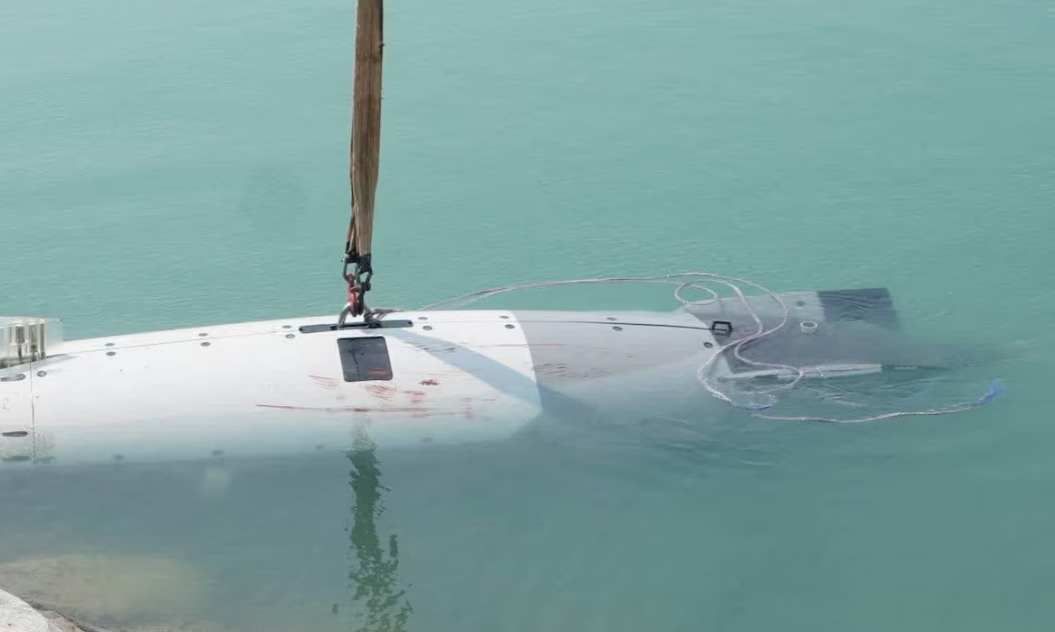
Iran’s Islamic Revolutionary Guard Corps (IRGC) says it has captured an unmanned U.S. submarine near the entrance to the Strait of Hormuz, highlighting the growing role of autonomous underwater systems in the conflict and raising fresh questions about U.S. surveillance operations in one of the world’s most strategically important waterways.
Iranian state media identified the captured vessel as a Dive-LD, a large autonomous underwater vehicle developed by California-based defense company Anduril. The United States, however, gave a different account of the incident, saying an underwater drone had malfunctioned more than a day earlier while surveying regional waters.
The Pentagon said the defective vehicle was an older model and did not carry sensitive data or classified sonar or radar equipment. Anduril confirmed that one of its vessels had been lost but described the Dive-LD as an “attritable” autonomous system designed to operate in dangerous environments where losing the vehicle is considered an acceptable possibility.
Iran Says It Captured a U.S. Underwater Drone
Iran’s Revolutionary Guards Navy said the unmanned submarine was captured at the entrance to the Strait of Hormuz. Iranian state media portrayed the incident as the seizure of a highly advanced American military system.
The claim provides a rare public glimpse into the use of autonomous underwater vehicles during military operations. Unlike conventional submarines, these systems can conduct missions without a crew onboard, potentially allowing militaries to gather information or perform dangerous underwater tasks without directly exposing sailors to hostile environments.
The exact circumstances surrounding the seizure remain disputed. Iran says it captured the vehicle, while the Pentagon says the underwater drone had malfunctioned more than a day earlier.
That difference is significant because a malfunctioning autonomous vehicle that is subsequently recovered is very different from a functioning military platform being intercepted during an active mission.
What Is the Dive-LD?
The vessel identified by Iranian media is the Dive-LD, an autonomous underwater vehicle developed by Anduril.
The 19-foot, or approximately 5.8-metre, submersible is designed for a range of underwater missions. According to information provided by the company, those missions can include mine countermeasures, seabed mapping, intelligence gathering and inspection of underwater infrastructure.
That makes the platform useful beyond traditional combat. An autonomous underwater vehicle can potentially survey large areas, examine the seabed and monitor infrastructure such as underwater cables and pipelines without placing a human crew inside a submarine.
Anduril says the Dive-LD can operate for up to 10 days without returning to base and can dive to depths of up to 6,000 metres, or approximately 19,700 feet.
Why the U.S. Navy Is Investing in Unmanned Systems
The incident comes as the U.S. military is investing heavily in unmanned naval technology. The strategic attraction is straightforward: autonomous vessels can potentially cover large areas at a lower cost and with less risk to personnel than crewed platforms.
Underwater systems are particularly useful for missions that require persistent monitoring. Oceans are enormous, and monitoring every potentially important area with conventional ships and submarines can be expensive and resource-intensive.
Autonomous systems offer another option. They can be deployed for surveillance, mapping and infrastructure inspection while keeping sailors away from some of the most dangerous operating environments.
This does not mean unmanned vehicles are replacing conventional submarines. Rather, they can complement crewed platforms by performing missions that do not necessarily require a human crew onboard.
What the Pentagon Says Happened
The Pentagon disputed the implication that Iran had successfully intercepted an operational U.S. submarine during an active mission.
A Pentagon spokesperson said an underwater drone had malfunctioned more than a day before Iran’s announcement. According to the Pentagon, the vehicle had been surveying regional waters in support of ongoing operations.
The Pentagon also described the vehicle as an older model and said it did not collect sensitive data or carry classified sonar or radar equipment.
If accurate, those details would significantly reduce the intelligence value of the captured platform. However, the incident could still provide Iran with useful information about the design, construction and capabilities of a U.S.-linked autonomous underwater system.
Anduril Confirms Loss of One Vessel
Anduril confirmed that one of its vessels had been lost but emphasized that the Dive-LD was designed with the possibility of loss in mind.
The company describes the platform as an attritable autonomous system. In military terminology, attritable generally refers to equipment that is valuable and useful but designed to be deployed in situations where some losses can be accepted as part of the mission.
This approach is different from the traditional model in which an extremely expensive platform must be protected because losing it could represent a major strategic and financial setback.
The concept reflects a broader shift in military technology: instead of relying only on a small number of highly sophisticated and expensive platforms, militaries can increasingly consider networks of smaller or autonomous systems that can perform specific tasks.
Why the Strait of Hormuz Matters
The location of the reported incident is particularly important. The Strait of Hormuz is a narrow waterway connecting the Persian Gulf with the Gulf of Oman and the wider Arabian Sea.
It is one of the world’s most strategically important maritime chokepoints because large volumes of energy supplies move through the region.
Any military activity around the strait therefore has implications beyond the immediate confrontation between Iran and the United States. Shipping companies, energy markets, regional governments and militaries around the world closely monitor developments in the waterway.
The use of underwater drones adds another layer to that security environment. Unlike surface ships, underwater vehicles can conduct missions below the waterline, making them potentially difficult to detect and track.
Why Underwater Drones Are Becoming More Important
Autonomous underwater vehicles have several characteristics that make them attractive for modern military operations.
- Reduced risk to personnel: No crew needs to remain inside the vehicle during its mission.
- Persistent operations: Some systems can remain underwater for extended periods.
- Surveillance: They can collect information about maritime environments and underwater areas.
- Seabed mapping: They can examine underwater terrain and infrastructure.
- Mine-related missions: Specialized vehicles can support mine countermeasure operations.
- Infrastructure inspection: Autonomous systems can examine underwater cables, pipelines and other structures.
These capabilities make underwater drones useful for both military and potentially civilian applications. Their value comes not simply from carrying weapons but from their ability to operate where conventional systems may be expensive, risky or difficult to deploy.
The Intelligence Question Is More Important Than the Vehicle’s Price
Reports cited by U.S. military news outlet DefenseScoop in 2024 put the cost of individual Dive-LD units at about $2.5 million. That is substantial, but it is relatively small compared with the cost of many conventional military platforms.
For that reason, the financial loss of one vehicle may not be the most important issue.
The bigger question is what information could potentially be recovered from the vehicle.
A captured autonomous system could theoretically reveal aspects of its construction, sensors, communications architecture, navigation technology or operational design. The Pentagon’s statement that this particular vehicle did not carry sensitive information is therefore an important part of the U.S. response.
However, even an older or less-sensitive platform can provide an adversary with an opportunity to study technology and understand how autonomous systems are designed and deployed.
Iran’s Claim and the U.S. Response Tell Different Stories
The two sides’ descriptions of the incident illustrate how military encounters can be framed very differently.
Iran described the event as the capture of a highly sophisticated American unmanned submarine. That framing presents the IRGC as capable of detecting and securing an advanced U.S. military system in waters close to Iran.
The Pentagon presented a much less dramatic version, saying the drone had already malfunctioned and was an older platform without sensitive equipment.
Both narratives serve strategic purposes. Iran has an incentive to demonstrate its ability to monitor and challenge U.S. activity near its territory, while the United States has an incentive to prevent the incident from being interpreted as a major intelligence or operational failure.
The available information does not independently establish every detail of how the vehicle was lost or recovered.
What the Incident Says About Future Naval Warfare
The reported capture is part of a broader transformation in naval warfare. Autonomous technology is increasingly moving from experimental programs toward operational use.
Future naval operations are likely to involve combinations of crewed ships, submarines, aircraft, surface drones and underwater autonomous vehicles. These systems can potentially share information and perform different parts of a larger mission.
The strategic advantage may therefore come not from one extraordinary autonomous vehicle but from how effectively multiple systems work together.
For countries operating in contested waters, this could make surveillance more persistent and make it harder for adversaries to know exactly what is being monitored.
Strait of Hormuz Becomes Even More Sensitive
The incident also underscores how technologically complicated the security environment around the Strait of Hormuz has become.
Naval forces operating in the area must consider not only conventional ships and submarines but also unmanned systems, underwater infrastructure and electronic surveillance.
For Iran, detecting or recovering an American autonomous vehicle could offer valuable insight into the kinds of technology being deployed around its waters. For the United States, the loss demonstrates one of the risks associated with operating unmanned systems in contested environments.
At the same time, the very concept of attritable systems means that some losses are expected. The U.S. military’s calculation is not necessarily that every drone must survive, but that the operational information or capability gained from deploying such systems can justify the risk.
Key Facts About the Reported Drone Incident
| Detail | Reported Information |
|---|---|
| Location | Entrance to the Strait of Hormuz |
| Iran’s claim | IRGC says it captured a U.S. unmanned submarine |
| Identified platform | Anduril Dive-LD |
| Length | About 19 feet (5.8 metres) |
| Maximum reported operating depth | Up to 6,000 metres |
| Maximum reported endurance | Up to 10 days |
| Potential missions | Seabed mapping, intelligence gathering, mine countermeasures and infrastructure inspection |
| Pentagon’s account | Vehicle malfunctioned more than a day before the announcement |
| Company response | Anduril confirmed the loss and described Dive-LD as an attritable autonomous system |
| Reported unit cost | About $2.5 million, according to DefenseScoop in 2024 |
What Happens Next?
The immediate question will be whether additional details emerge about how the vehicle was lost and how Iranian forces obtained it.
Another important question is whether the United States changes its use of underwater autonomous systems in the region. If the vehicle was recovered after a malfunction, operators may review how autonomous platforms are monitored, controlled and protected during missions.
Iran may also study the captured system for technical information, although the potential intelligence value would depend heavily on the vehicle’s configuration and what equipment was actually onboard.
More broadly, the incident could encourage both countries to improve their ability to detect, track and recover unmanned underwater vehicles.
Conclusion
Iran says it captured a U.S. submarine drone near the entrance to the Strait of Hormuz, while the Pentagon says an underwater drone had malfunctioned more than a day earlier during a regional surveillance mission. Anduril has confirmed the loss of one of its vessels and described the Dive-LD as an attritable autonomous system designed for operations where losing the platform is an accepted risk.
The incident is significant because it highlights how underwater drones are becoming part of modern military operations. These systems can conduct surveillance, mapping, mine-related missions and infrastructure inspections without placing sailors inside the vehicle.
Whether the reported capture represents a major U.S. operational setback or primarily the loss of an expendable autonomous platform will depend on the circumstances surrounding the incident and the information Iran can obtain from the vehicle.
Either way, the episode demonstrates that the waters around the Strait of Hormuz are becoming an increasingly important testing ground for autonomous naval technology and the future of maritime surveillance.
For breaking news and live news updates, like us on Facebook or follow us on Twitter and Instagram. Read more on Latest Business on thefoxdaily.com.





COMMENTS 0