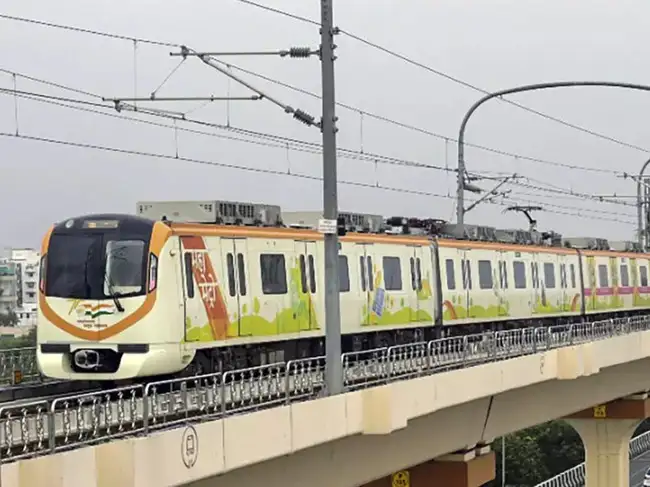
Nagpur Metro is constructing a 257-metre-long elevated bridge nearly 80 feet above railway tracks at Uppalwadi as part of its Phase-II expansion. The structure is designed to cross three railway lines and is being built using the balanced cantilever technique, a construction method that eliminates the need for conventional scaffolding beneath the bridge.
The bridge forms part of the 6.92-kilometre Reach-2A corridor towards Kamptee. Its construction presents a significant Engineering challenge because work is taking place above operational railway Infrastructure, where the use of conventional ground-supported scaffolding could interfere with train movement.
Nagpur Metro Bridge to Cross Three Major Railway Lines
The 257-metre bridge at Uppalwadi is being constructed approximately 80 feet above the railway tracks. Once completed, it will carry the metro corridor across three railway lines, providing an elevated connection along the Reach-2A route.
Building a structure over active railway lines requires careful planning. Construction activities must account for train operations, worker safety and the movement of heavy machinery. Traditional scaffolding installed beneath a bridge could obstruct the railway corridor and create additional operational challenges.
To address these constraints, the project is using a construction approach that allows the bridge to extend progressively from its supporting piers without requiring extensive temporary structures underneath.
How Is Nagpur Metro Building the Bridge Without Scaffolding?
The bridge is being constructed using the balanced cantilever technique. This method involves building sections of a bridge outward from supporting piers, with corresponding segments constructed on either side to maintain structural balance during the process.
Instead of supporting the entire bridge from the ground, engineers use the completed portions of the structure and specialised equipment to construct additional segments. As work progresses, the sections extend towards each other until the bridge span is completed.
One of the main advantages of this technique is that it reduces the need for scaffolding or temporary supports beneath the structure. This makes it particularly useful when bridges must cross railway tracks, roads, rivers or other areas where ground-level construction support is difficult to install.
At Uppalwadi, avoiding scaffolding beneath the bridge is especially important because three railway lines pass below the construction area. The method allows work to proceed overhead while reducing interference with the railway corridor.
Specialised 40-Tonne Machine to Construct Bridge Sections
The construction process involves specialised equipment to position and assemble the bridge segments. A machine weighing approximately 40 tonnes is being used as part of the operation to support the construction of individual sections.
Such equipment plays an important role in balanced cantilever construction. It helps engineers handle heavy structural components and extend the bridge progressively from its supporting points.
Working at a height of nearly 80 feet also requires precise coordination between engineering teams, equipment operators and construction workers. Each section must be positioned carefully to maintain alignment and structural stability as the bridge advances.
The use of specialised machinery, combined with the balanced cantilever method, allows the project to address the restrictions created by the railway lines below.
Nagpur Metro Phase-II Construction Progresses in Day and Night Shifts
The bridge is part of Nagpur Metro’s Phase-II development, which aims to extend the city’s metro network and improve connectivity towards areas including Kamptee. The 6.92-kilometre Reach-2A corridor is one component of this expansion.
Construction work is progressing through day and night shifts. Working across different shifts can help maintain construction momentum and coordinate activities around site conditions and operational requirements.
However, round-the-clock construction in a location above railway infrastructure requires strict safety arrangements. Teams must coordinate equipment movement, material handling and work schedules while accounting for the railway operations beneath the elevated structure.
Why the Balanced Cantilever Technique Matters
The balanced cantilever technique is particularly useful for bridge construction in locations where conventional scaffolding is impractical. By allowing a structure to be built outward from its supports, the method reduces dependence on ground-level temporary structures.
For railway crossings, this can help minimise disruption to train operations. It also provides a practical solution when the area beneath a proposed bridge is difficult to access or cannot be blocked for construction activities.
The method requires careful engineering calculations and accurate execution. Engineers must ensure that the sections remain balanced during construction and that the completed structure meets the required structural and safety standards.
What the Bridge Means for Nagpur Metro’s Expansion
The 257-metre bridge at Uppalwadi represents an important construction component of Nagpur Metro’s Phase-II expansion. Its location above three railway lines makes the choice of construction technique central to completing the crossing without relying on conventional scaffolding underneath.
As work continues on the Reach-2A corridor towards Kamptee, the bridge will form part of the infrastructure needed to extend metro connectivity. Its construction also demonstrates how specialised engineering methods can help metro projects overcome challenges posed by busy railway corridors and restricted construction spaces.
For breaking news and live news updates, like us on Facebook or follow us on Twitter and Instagram. Read more on Latest Business on thefoxdaily.com.






COMMENTS 0