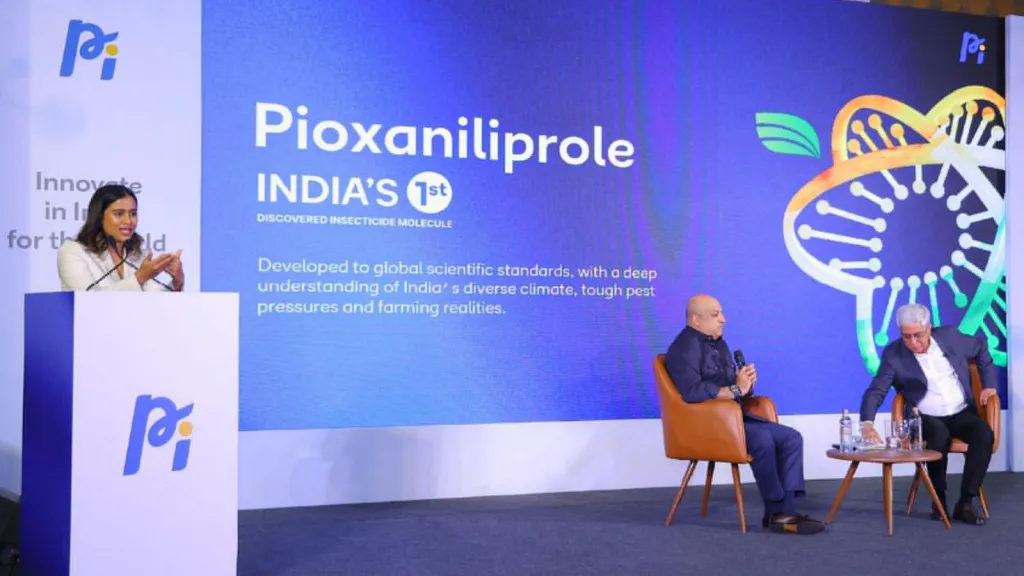
India is set to introduce its first indigenously discovered insecticide molecule, Pioxaniliprole, with PI Industries Ltd planning to launch the product under the trade name Pioxazon during the upcoming rabi crop season. The insecticide has received regulatory approval for use on rice, chilli, tomato and chickpea crops, offering farmers another crop protection option against several damaging insect pests.
The launch marks a significant development for India’s agricultural chemicals industry, reflecting more than a decade of research and substantial investment in developing a new crop protection molecule. The product is expected to target caterpillar pests that can damage crops, reduce yields and affect farm incomes.
According to the company, Pioxaniliprole has completed regulatory evaluation and multilocation field trials before receiving approval from the Central Insecticides Board and Registration Committee. PI Industries plans to begin bringing the product to farmers from the following month.
Pioxaniliprole Receives Approval for Four Crops
Pioxaniliprole belongs to the anthranilic diamide class of insecticides and has been approved as a 20% weight-by-volume suspension concentrate formulation. Its approved uses cover rice, chilli, tomato and chana, also known as chickpea.
The insecticide is intended to control several economically significant insect pests, including yellow stem borer, leaf folder, fall armyworm, tobacco cutworm, fruit borer and pod borer. These pests can damage different parts of crops, including leaves, stems, fruits and pods, potentially affecting both crop quality and agricultural productivity.
In rice cultivation, yellow stem borer and leaf folder can cause substantial damage when infestations are not managed effectively. In chilli and tomato farming, fruit-boring insects can damage produce and reduce its marketability. Chickpea farmers also face losses from pod-boring pests that feed on developing seeds.
The approval gives farmers access to a new insecticide option for the specified crops and target pests. However, its effectiveness in the field will depend on factors such as pest pressure, application timing, crop conditions and compliance with approved product directions.
PI Industries Plans Commercial Launch of Pioxazon
PI Industries Ltd plans to commercialise Pioxaniliprole under the brand name Pioxazon during the upcoming rabi season. The company’s managing director, Mayank Singhal, described the product as India’s first insecticide molecule discovered domestically.
Singhal said the molecule received approval from the Central Insecticides Board and Registration Committee after extensive regulatory studies and field trials across multiple locations.
“We are now ready to take it to farmers’ fields from next month,” Singhal said, highlighting the company’s plans to move from research and regulatory evaluation to commercial distribution.
The launch will be an important milestone for PI Industries, which operates in the agricultural chemicals sector and develops crop protection products. Bringing a new active ingredient to market can help a company expand its product portfolio while creating opportunities to serve farmers dealing with persistent pest-related challenges.
The commercial rollout will also provide an opportunity to assess how the new molecule performs under different agricultural conditions. Farmers and agricultural experts will be able to evaluate its practical value as part of crop protection programmes, subject to the approved uses and application instructions.
More Than a Decade of Research and Development
Developing a new insecticide molecule requires significant financial resources, scientific expertise and regulatory testing. PI Industries said it invested approximately Rs 2,000 crore and spent more than a decade developing Pioxaniliprole.
Singhal said developing a new crop protection active ingredient costs around $300 million globally. The company’s investment reflects the complexity of discovering and developing a molecule that can be evaluated for safety, effectiveness and suitability for agricultural use.
The development process typically involves laboratory research, formulation work, field evaluations and regulatory studies. Researchers must establish whether a candidate molecule can control target pests while meeting applicable requirements for use on crops.
Multilocation field trials are particularly important because pest populations, weather conditions, farming practices and crop characteristics can vary across agricultural regions. Testing a product in different environments helps generate evidence about its performance under practical conditions.
For India, the development of an indigenously discovered insecticide could strengthen domestic research capabilities in agricultural chemicals. It also demonstrates the potential for Indian companies to invest in original crop protection research rather than relying exclusively on molecules developed elsewhere.
How Pioxaniliprole Works Against Caterpillar Pests
Pioxaniliprole belongs to the anthranilic diamide group, a class of insecticides that acts on ryanodine receptors in insects. These receptors function as calcium-release channels involved in muscle activity.
When the insecticide interacts with these receptors, it disrupts the normal regulation of calcium within insect muscle cells. The resulting uncontrolled release of calcium interferes with muscle function and can cause affected insects to stop feeding, become paralysed and eventually die.
This mode of action distinguishes diamide insecticides from products that target other biological processes in insect pests. It can make the chemical group useful in crop protection programmes when selected and applied appropriately.
However, repeated reliance on insecticides with the same mode of action can contribute to the development of resistance in pest populations. Resistance occurs when insects become less susceptible to a treatment that previously controlled them effectively.
For this reason, agricultural experts generally recommend integrating chemical control with other appropriate pest management practices. These may include monitoring pest populations, using suitable application timings, following recommended doses and rotating insecticides with different modes of action where permitted.
Farmers should follow the product label and advice from qualified agricultural professionals, including restrictions relating to crop use, target pests, application rates, protective equipment and pre-harvest intervals.
Why the New Molecule Matters for Indian Agriculture
Insect pests remain a major challenge for crop production because infestations can reduce yields, damage the quality of harvested produce and increase the cost of cultivation. Effective pest management is particularly important for farmers growing crops such as rice, chilli, tomato and chickpea, where particular insect pests can cause significant losses.
The introduction of a new active ingredient could expand the range of available crop protection tools. A product with a different mode of action may also provide additional options for managing pests that have developed resistance to other insecticides, although its suitability for resistance management depends on the pest involved and the existing control programme.
The product’s commercial success will depend on several factors, including field performance, affordability, availability and farmers’ confidence in its effectiveness. Agricultural extension services and product guidance will also be important in helping growers understand its approved uses and safe application practices.
Because Pioxaniliprole has been approved for specific crops and target pests, its use should remain within those authorised conditions. Approval for one crop or pest does not automatically establish that the product is suitable for other agricultural uses.
What Farmers Should Know Before Using Pioxazon
Farmers considering Pioxazon should check the approved product label and seek guidance from qualified agricultural experts before applying it. The correct timing and method of application can influence pest control outcomes, while excessive or inappropriate use may increase costs and contribute to resistance.
Integrated pest management can help reduce dependence on repeated chemical applications by combining pest monitoring with suitable cultural, biological and chemical control measures. Such approaches can support more sustainable crop protection while helping preserve the effectiveness of available insecticides.
Farmers should also follow safety precautions during mixing, handling and spraying, including using the protective equipment specified on the label and preventing contamination of water sources and nearby non-target habitats.
The product’s approval represents a regulatory milestone, but farmers’ experience during commercial use will help establish its practical value across different growing conditions. Its performance, cost and compatibility with existing pest management programmes will be important considerations during the rollout.
Indigenous Research Could Expand India’s Crop Protection Capabilities
PI Industries’ investment in Pioxaniliprole highlights the role of research and development in creating new solutions for agricultural challenges. Developing an original active ingredient requires long-term investment, specialised scientific capabilities and extensive regulatory evaluation.
The molecule’s planned launch could strengthen India’s position in agricultural chemical innovation by demonstrating that domestic companies can develop new crop protection ingredients. It may also encourage further investment in research aimed at improving crop productivity and addressing evolving pest pressures.
At the same time, the long-term significance of the launch will depend on the product’s real-world performance, responsible use and commercial adoption. Regulatory approval establishes the authorised conditions for use, while continued field experience will help determine how effectively the insecticide meets farmers’ needs.
With commercialisation planned for the upcoming rabi season, Pioxaniliprole is set to move from a decade-long development process into agricultural use. Its introduction offers Indian farmers an additional option against selected insect pests while highlighting the growing importance of indigenous innovation in crop protection.
For breaking news and live news updates, like us on Facebook or follow us on Twitter and Instagram. Read more on Latest Business on thefoxdaily.com.






COMMENTS 0