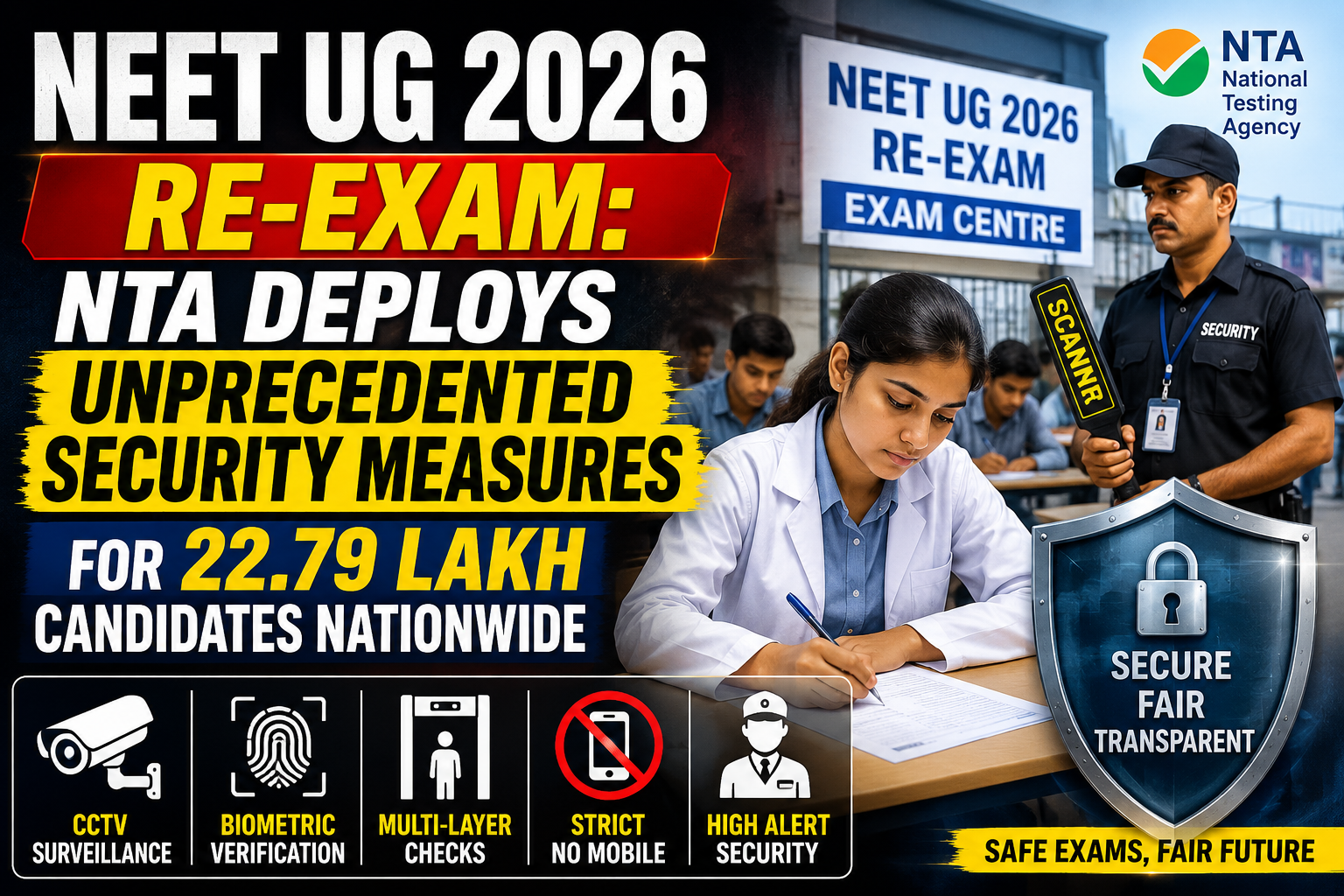
The National Eligibility cum Entrance Test (NEET-UG) remains India’s most significant medical entrance examination, serving as the gateway to undergraduate medical and dental Education for millions of aspiring doctors. As the National Testing Agency (NTA) prepares to conduct the NEET UG 2026 re-examination on June 21, authorities have implemented one of the most comprehensive security and monitoring frameworks ever seen in the history of the exam.
With approximately 22.79 lakh candidates expected to participate across 551 cities in India and 14 international locations, the re-exam represents not only a logistical challenge but also a critical test of the NTA’s ability to restore public confidence in the examination system.
Why the NEET UG 2026 Re-Exam Matters
NEET UG is more than just an entrance examination. Every year, it determines admission opportunities for students seeking seats in MBBS, BDS, AYUSH, veterinary, and several allied healthcare programs across India.
The 2026 re-examination has attracted nationwide attention because maintaining transparency and fairness has become a top priority for educational authorities. Given the scale of participation and the high stakes involved, even minor operational issues can affect thousands of candidates.
The NTA’s latest preparations demonstrate a significant shift toward stronger accountability, technological monitoring, and real-time oversight mechanisms.
NEET UG 2026 Re-Exam Schedule and Key Details
The examination will be conducted on June 21 from 2:00 PM to 5:15 PM. Candidates eligible for compensatory time under disability guidelines will receive additional time according to prescribed norms.
| Particulars | Details |
|---|---|
| Exam Name | NEET UG 2026 Re-Examination |
| Exam Date | June 21, 2026 |
| Exam Timing | 2:00 PM – 5:15 PM |
| Total Candidates | 22.79 Lakh |
| Indian Cities | 551 |
| International Cities | 14 |
| Reporting Window | 11:00 AM – 1:30 PM |
The sheer scale of the examination highlights why authorities are focusing heavily on coordination, security, and candidate management.
Nationwide Mock Drill: A New Layer of Exam Preparedness
One of the most notable aspects of this year’s preparation is the nationwide mock drill scheduled before the examination. Unlike traditional administrative reviews, this exercise is designed to simulate real examination-day conditions across the country.
The drill will assess:
- Security readiness at examination centres
- Communication channels between authorities
- Response mechanisms during emergencies
- Monitoring system effectiveness
- Coordination among local agencies
- Transportation security for confidential materials
More than 2.5 lakh security personnel are expected to participate in the exercise, making it one of the largest examination-related security operations in India.
This proactive approach reflects a growing trend among major examination bodies worldwide, where risk assessment and contingency planning are becoming essential components of exam administration.
Multi-Layer Security Framework Introduced by NTA
To strengthen trust in the examination process, the NTA has implemented a multi-layer security architecture covering every stage of the examination cycle.
1. Large-Scale Human Monitoring Network
A total of 674 city coordinators and 6,669 observers have been deployed to oversee examination operations.
Their responsibilities include:
- Monitoring centre-level compliance
- Reporting irregularities
- Ensuring standardized procedures
- Providing immediate escalation of concerns
2. CCTV Surveillance and Live Monitoring
Every examination centre will operate under continuous CCTV surveillance.
Live monitoring systems connected to centralized control rooms will enable authorities to observe examination activities in real time, significantly reducing opportunities for malpractice.
This system also creates digital records that can be reviewed if complaints or disputes arise after the examination.
3. GPS Tracking of Question Papers
The transportation of confidential examination materials has historically been considered a vulnerable stage in large-scale examinations.
To address this challenge, vehicles transporting question papers and sensitive materials will:
- Remain sealed throughout transit
- Carry GPS tracking systems
- Be accompanied by police escorts
- Follow monitored routes
These measures aim to maintain the integrity of examination materials from printing facilities to examination centres.
4. Strict Entry Screening
Candidates will undergo detailed frisking procedures before entering examination venues.
The objective is to prevent unauthorized materials, communication devices, or technological tools from entering examination halls.
Items prohibited include:
- Mobile phones
- Smartwatches
- Bluetooth devices
- Calculators
- Electronic gadgets
- Jewellery and metallic accessories
Aadhaar-Based Biometric Verification: Balancing Security and Accessibility
Biometric verification has become a central component of modern examination security. The NTA plans to use Aadhaar-based biometric authentication to verify candidate identities and reduce the risk of impersonation.
However, recognizing the possibility of technical failures, authorities have clarified that genuine candidates will not be denied entry solely because biometric verification fails.
Common reasons for verification issues may include:
- Weak fingerprints
- Technical system errors
- Network connectivity disruptions
- UIDAI server-related issues
- Physical conditions affecting fingerprint scans
In such situations, manual verification procedures will be followed, including document checks and written declarations.
This balanced approach is particularly important because exam security must not come at the cost of excluding legitimate candidates.
Social Media Monitoring and Misinformation Control
In recent years, social media has become a major source of examination-related rumours, misinformation, and anxiety among students.
To address this challenge, authorities are actively monitoring online platforms for:
- Fake question paper leak claims
- Fraudulent messages
- Impersonation attempts
- Misinformation campaigns
- Suspicious activities targeting candidates
Educational experts often note that false information spreads rapidly during high-stakes examinations, creating unnecessary panic among students. Therefore, monitoring digital platforms has become as important as securing physical examination centres.
Special Measures to Protect Students from Extreme Summer Conditions
Conducting an examination involving nearly 23 lakh candidates during the summer season requires significant attention to health and safety.
The NTA has introduced several heat-relief measures aimed at improving candidate comfort and reducing health risks.
Facilities available at centres include:
- Power backup through generators
- Adequate fans and ventilation systems
- Continuous lighting support
- Drinking water availability
- Medical assistance teams
- Additional support staff
Candidates will also be allowed to carry transparent water bottles, helping them remain hydrated during the examination process.
Special Considerations for Candidates with Medical Conditions
The NTA has emphasized inclusivity by providing accommodations for candidates with specific medical requirements.
For example, students with diabetes may carry approved items such as:
- Fruits
- Sugar tablets
- Other permitted medical necessities under official guidelines
Such measures ensure that health concerns do not become barriers to fair participation.
Important Reporting Guidelines Candidates Must Follow
Candidates should carefully adhere to the official reporting schedule to avoid last-minute complications.
Entry to examination centres will be permitted between 11:00 AM and 1:30 PM. No candidate will be allowed to enter after the closing time.
Students are advised to:
- Reach the centre well before reporting deadlines
- Carry required documents
- Follow dress code instructions if applicable
- Avoid bringing prohibited items
- Verify centre details in advance
- Rely only on official NTA communications
What Makes This Security Framework Different?
The most significant difference compared to previous years is the integration of multiple security layers working simultaneously.
Rather than depending on a single monitoring mechanism, the NTA is combining:
- Human supervision
- Technology-based verification
- GPS tracking
- CCTV surveillance
- Social media monitoring
- Large-scale security deployment
- Mock drill preparedness exercises
This integrated approach reflects global best practices increasingly adopted for high-stakes examinations.
Expert Insight: Why Exam Security Is Becoming More Complex
The growing digitization of communication has transformed examination security worldwide. While technology improves monitoring capabilities, it also creates new challenges involving misinformation, identity fraud, and coordinated malpractice attempts.
As a result, examination agencies are shifting from reactive responses to preventive security strategies. The extensive preparations for NEET UG 2026 illustrate how exam administration is evolving into a sophisticated operation involving education authorities, technology experts, law enforcement agencies, and local administrations.
Future Outlook: A Critical Test for Examination Governance
The successful conduct of the NEET UG 2026 re-examination will likely influence future examination policies across India. If the multi-layer security framework proves effective, similar systems could become standard practice for other large-scale national entrance examinations.
The examination also serves as a reminder that public trust is one of the most valuable assets in any assessment system. Transparency, fairness, and operational excellence are no longer optional—they are essential expectations from students, parents, and educational institutions.
Conclusion
With 22.79 lakh candidates set to appear, the NEET UG 2026 re-examination represents one of the largest and most closely monitored academic events in the country. From nationwide mock drills and biometric verification to CCTV surveillance and GPS-tracked transportation of question papers, the National Testing Agency has introduced an extensive framework designed to ensure fairness and security.
As candidates prepare for one of the most important examinations of their academic journey, the focus now shifts from preparation by authorities to performance by students. The NTA’s message remains clear: trust the process, follow official guidelines, avoid misinformation, and approach the examination with confidence.
For breaking news and live news updates, like us on Facebook or follow us on Twitter and Instagram. Read more on Latest Careers on thefoxdaily.com.






COMMENTS 0