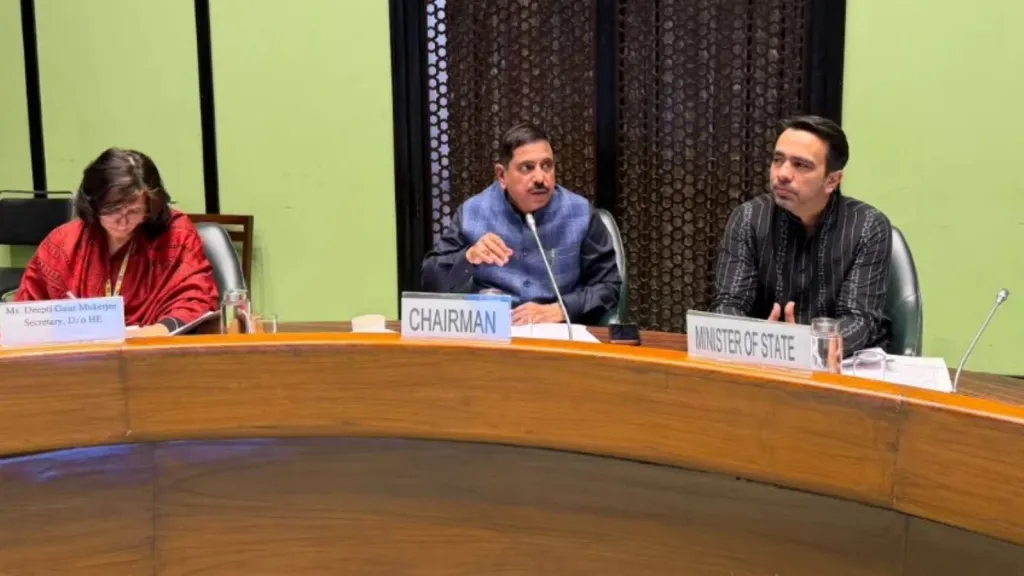
Internationalising India’s education system and strengthening its position as a global destination for higher learning were central themes at the first meeting of the Parliamentary Consultative Committee on Education for 2026, chaired by Union Education Minister Pralhad Joshi on Wednesday. The discussions focused on expanding the international reach of Indian universities, encouraging foreign institutions to establish campuses in India, attracting International Students and building stronger research partnerships with universities around the world.
The meeting also examined how India could make its school education system more internationally connected through curriculum reforms, multilingual learning, teacher mobility and greater cross-cultural exposure. The discussions reflect the government’s broader ambition to transform India from a country that sends large numbers of students overseas for Higher Education into a global education hub capable of attracting learners, researchers and academic institutions from other countries.
Sharing details of the meeting on X, Joshi said members discussed expanding Indian universities globally, facilitating foreign university campuses in India, strengthening international research partnerships, promoting student and faculty exchanges and attracting international students.
The agenda places internationalisation at the centre of India’s long-term education reforms, particularly as the country seeks to implement the National Education Policy (NEP) 2020 and advance the vision of Viksit Bharat 2047.
Why India Wants Its Universities to Expand Globally
India has one of the world’s largest higher education systems, with universities, colleges and specialised institutions serving millions of students. However, its international presence remains smaller than that of established education destinations such as the United States, the United Kingdom, Australia and Canada.
Expanding Indian universities beyond national borders could help change that position. International campuses and academic partnerships can give Indian institutions access to new student populations, research networks and funding opportunities. They can also strengthen the global recognition of Indian qualifications and create pathways for graduates to work or pursue further studies internationally.
For Indian universities, international expansion does not necessarily mean establishing complete campuses overseas immediately. Institutions can build their global presence through joint degree programmes, research centres, academic collaborations, exchange arrangements and partnerships with foreign universities. These models can help institutions develop international networks before committing to the financial and administrative requirements of operating abroad.
The government’s interest in taking Indian universities global also reflects growing competition among countries to attract international students. Universities increasingly operate in an international education market where students compare academic quality, research opportunities, affordability, employment prospects and the value of qualifications before choosing where to study.
India’s potential advantages include its large pool of academic talent, established institutions in science and technology, comparatively broad range of educational costs and growing digital infrastructure. Turning these advantages into a stronger international reputation will require consistent academic standards, internationally recognised qualifications and reliable support for overseas students.
Foreign University Campuses in India Remain a Major Priority
One of the key subjects discussed by the parliamentary committee was facilitating foreign university campuses in India. The proposal is significant because it could allow students to access international academic programmes without having to travel abroad for an entire degree.
For many Indian families, overseas education involves substantial expenses, including tuition fees, accommodation, travel, insurance and living costs. Studying at a foreign university’s Indian campus could provide access to an international institution’s academic environment while reducing some of the financial and logistical challenges associated with relocating to another country.
Foreign campuses could also increase competition within India’s higher education sector. Domestic universities may face greater pressure to improve teaching standards, research facilities, student services and international academic engagement as overseas institutions establish a presence in the country.
The regulatory framework for foreign university campuses has developed under the National Education Policy 2020. The University Grants Commission introduced regulations in 2023 governing the establishment and operation of campuses of foreign higher educational institutions in India.
Under the framework, eligible foreign universities can establish campuses subject to regulatory approval and prescribed conditions. The rules are intended to provide institutions with greater academic and administrative flexibility while maintaining oversight of their operations in India.
However, attracting foreign universities will depend on more than regulatory permission. Institutions will assess the availability of suitable locations, infrastructure, research facilities, faculty, financial viability and the ability to offer programmes that meet their academic standards.
India will also need to ensure that foreign campuses complement rather than weaken the domestic higher education ecosystem. The long-term objective is to encourage academic competition, collaboration and knowledge transfer while protecting educational quality and accessibility.
Attracting International Students to Indian Universities
Attracting foreign students was another major priority highlighted by Joshi. India has historically been a destination for students from neighbouring countries and parts of Africa, Asia and the Middle East. However, it has considerable scope to expand its international student population and compete more effectively with established education destinations.
A stronger international student presence could benefit Indian universities financially and academically. Tuition and other student-related spending can contribute to institutional resources and local economies, while interactions among students from different countries can create more diverse learning environments.
International students can also strengthen India’s diplomatic and cultural relationships. Graduates who study in India may maintain professional, academic and personal connections with the country throughout their careers. Such networks can support research collaboration, business relationships and cooperation between institutions across national borders.
But attracting students requires a complete international education experience. Universities need transparent admission procedures, internationally understandable course information, reliable accommodation, accessible student support and clear guidance on visas and other administrative requirements.
Recognition of qualifications is equally important. Students and their families need confidence that degrees earned in India will be accepted by employers, professional bodies and universities in their home countries or elsewhere.
Academic quality will ultimately determine whether international recruitment efforts are sustainable. Promotional campaigns can increase awareness, but students are more likely to choose institutions that offer strong teaching, research opportunities, practical training and credible career pathways.
International Research Partnerships and Faculty Exchanges
The committee’s discussions also covered international research partnerships and student and faculty exchange programmes. These initiatives are important because internationalisation is not limited to recruiting students or opening university campuses overseas. It also involves connecting Indian researchers and academics with global knowledge networks.
Research partnerships can allow universities to combine expertise, infrastructure and funding to address scientific and social challenges that cross national boundaries. Areas such as artificial intelligence, biotechnology, climate change, public health, clean energy, agriculture and advanced manufacturing can benefit from collaboration between institutions in different countries.
Joint research projects can also give Indian researchers access to specialised laboratories, international datasets and academic networks that may not be available within a single institution. At the same time, foreign researchers can benefit from India’s scientific talent, research infrastructure and experience in addressing challenges relevant to developing economies.
Student exchange programmes offer a different but equally important form of international engagement. They allow students to experience different teaching methods, academic environments and cultures. Such exposure can improve communication skills, broaden professional networks and help students understand international approaches to their chosen fields.
Faculty exchanges can strengthen teaching and research by allowing academics to work with overseas colleagues, share specialised knowledge and develop joint courses. Visiting faculty can also bring international perspectives into Indian classrooms without requiring institutions to establish permanent overseas operations.
For these programmes to have a lasting impact, universities will need clear arrangements covering credit transfers, academic recognition, research ownership, funding and the duration of exchanges. Consistent institutional support will be essential to ensure that international collaboration becomes part of regular academic activity rather than a collection of isolated agreements.
Internationalising School Education Through CBSE Global and NIOS
The discussions were not limited to universities. Joshi also informed committee members about initiatives to internationalise school education through the Central Board of Secondary Education’s global expansion and the growth of the National Institute of Open Schooling.
CBSE Global represents an effort to extend the reach of India’s school education framework beyond the country’s borders. A wider international presence for CBSE-linked education can provide students in other countries with access to an Indian curriculum and maintain academic connections with India among overseas communities.
The expansion of the National Institute of Open Schooling, or NIOS, is also relevant to this objective. NIOS provides flexible learning opportunities through an open and distance education model. Its approach can support learners who cannot follow conventional school schedules, including students who need alternative pathways to complete their education.
Expanding access to Indian school education internationally could help students remain connected to Indian academic standards and learning frameworks while living outside the country. It may also strengthen the visibility of India’s education system among international families.
However, international expansion of school education requires attention to local educational regulations, language requirements, teacher availability and the needs of students from different cultural backgrounds. Curriculum delivery must remain academically consistent while being responsive to the environments in which schools operate.
Multilingual Learning and Curriculum Reforms
Multilingual learning and curriculum reforms were also highlighted as part of the government’s school education internationalisation efforts. Language is a major factor in making education accessible across different regions and cultures, particularly in a country as linguistically diverse as India.
Promoting learning in multiple languages can help students develop stronger communication abilities and improve access to education. It can also provide international students with opportunities to engage with Indian languages and understand the country’s cultural and intellectual traditions.
India’s multilingual approach has wider implications for internationalisation. While English remains an important language for global academic communication, knowledge of Indian languages can help students and researchers engage with local communities, literature, history and specialised knowledge systems.
Curriculum reforms are equally important because international academic engagement requires students to develop skills that remain relevant across different education systems and employment markets. Critical thinking, scientific understanding, digital literacy, communication, problem-solving and interdisciplinary learning are increasingly important in higher education and the workplace.
The National Education Policy 2020 provides the broader framework for many of these changes. It emphasises multidisciplinary education, flexibility in learning pathways, stronger research, technology integration and a greater focus on conceptual understanding rather than rote memorisation.
For international recognition, curriculum reform must also be supported by effective assessment systems, qualified teachers and transparent academic standards. The challenge is to create an education system that remains rooted in Indian contexts while preparing students to participate confidently in a global environment.
Global Teacher Mobility and Cross-Cultural Exposure
Teacher mobility and cross-cultural exposure were additional areas identified during the meeting. Teachers play a central role in determining the quality of education, and international engagement can help them acquire new teaching methods, academic perspectives and professional experience.
Teacher mobility can involve international training, visiting appointments, collaborative teaching programmes and exchanges between schools and universities. These opportunities can expose educators to different classroom practices, curriculum models and approaches to student assessment.
Teachers returning from international assignments can share their experiences with colleagues and contribute to improvements in institutional teaching practices. Similarly, foreign educators working with Indian institutions can introduce new perspectives and strengthen academic cooperation.
Cross-cultural exposure is also important for students. Learning alongside people from different backgrounds can improve cultural understanding, communication and the ability to work in diverse teams. These skills are increasingly relevant in international workplaces and research environments.
However, teacher mobility programmes require appropriate funding, institutional partnerships and arrangements for recognising international experience. Without these elements, opportunities may remain limited to a relatively small number of educators and institutions.
NEP 2020 and the Vision of Viksit Bharat 2047
The education minister reaffirmed the government’s commitment to building a globally connected and future-ready education system rooted in Indian values. He linked the internationalisation agenda to the National Education Policy 2020 and Prime Minister Narendra Modi’s vision of Viksit Bharat 2047.
NEP 2020 identifies internationalisation as an important part of India’s higher education transformation. Its broad objectives include encouraging high-performing Indian universities to operate internationally, facilitating the entry of selected foreign institutions and strengthening academic cooperation between Indian and overseas universities.
The policy also seeks to improve the quality and flexibility of education through multidisciplinary learning, research, technology and institutional reforms. These priorities are closely connected to the goal of making Indian institutions more attractive to international students and researchers.
Viksit Bharat 2047 provides a longer-term national development framework, with education expected to contribute to a skilled workforce, innovation, economic growth and India’s global standing. A stronger education system can support these objectives by developing talent and generating research that contributes to industry and society.
Internationalisation, however, will need to be measured through outcomes rather than announcements alone. The number of meaningful foreign university partnerships, international students enrolled, joint research projects, faculty exchanges and globally recognised academic programmes will help indicate whether the strategy is producing results.
Challenges India Must Address to Become a Global Education Hub
India’s ambition to attract international students and expand its universities globally comes with several challenges. The country’s higher education system includes institutions with widely differing levels of infrastructure, research capacity, faculty strength and international visibility. Building a strong global reputation will require improvements across the system, not only at a small number of leading universities.
Research investment: International universities often compete through their research output, laboratories, patents and academic publications. Indian institutions will need sustained investment in research infrastructure and stronger mechanisms for collaboration between universities, industry and government.
Quality assurance: International students need confidence that programmes meet credible academic standards. Transparent accreditation, consistent assessment and recognised qualifications will be essential for building trust.
International student support: Admission procedures, visa assistance, accommodation, healthcare access and campus services can influence students’ decisions. Institutions must provide support that addresses the practical challenges faced by students arriving from other countries.
Faculty recruitment and retention: Universities need the freedom and resources to attract talented academics, including researchers from overseas. Competitive working conditions, research funding and professional opportunities can help strengthen faculty quality.
Global recognition: Indian degrees and research programmes must be understood and recognised internationally. Academic partnerships, transparent qualification frameworks and consistent institutional standards can help improve recognition.
Affordability and access: India may be able to offer competitive education costs compared with some overseas destinations, but internationalisation should not make quality education less accessible to domestic students. Institutions will need to balance global ambitions with their responsibilities to Indian learners.
What the Education Committee’s Agenda Means for India
The first meeting of the Parliamentary Consultative Committee on Education for 2026 brings together several connected priorities: taking Indian universities abroad, welcoming foreign institutions into India, attracting international students, expanding research partnerships and strengthening global engagement at the school level.
Together, these measures point towards a broader change in how India wants its education system to participate in the world. Instead of treating internationalisation only as an opportunity for Indian students to study overseas, the government is seeking to position India as a destination for education, research and academic cooperation.
The approach could create opportunities for universities, students, teachers and researchers. It could also help Indian institutions build stronger international reputations and contribute more directly to global research and innovation.
Yet the success of the strategy will depend on implementation. Foreign campuses must deliver credible academic programmes, international students must receive a supportive learning environment, and domestic universities must have the resources to improve research and teaching quality.
India’s large education system gives it the scale to pursue a more influential international role. Converting that potential into lasting global recognition will require consistent policy implementation, institutional investment and measurable improvements in academic quality. The parliamentary committee’s agenda signals that the government wants this transformation to become an important part of India’s education priorities as it works towards the 2047 development vision.
For breaking news and live news updates, like us on Facebook or follow us on Twitter and Instagram. Read more on Latest Education on thefoxdaily.com.






COMMENTS 0