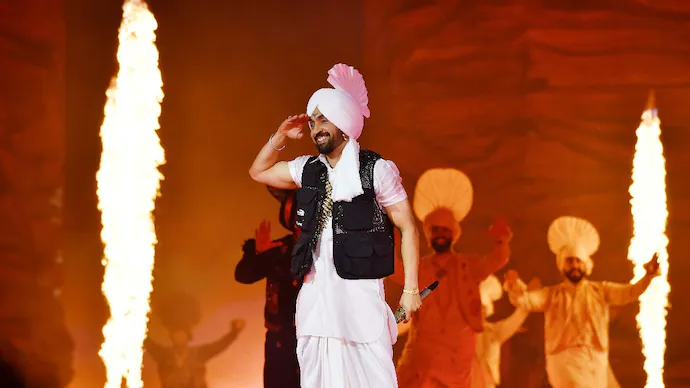
Diljit Dosanjh Bihar concert: Singer Diljit Dosanjh has revealed why his planned concert in Bihar could not take place last year. The singer said the proposal ran into difficulties over crowd management, with organisers unwilling to take responsibility for handling the large audience expected at the show. Diljit maintained that his team could not take on the responsibility alone, as managing a concert of that scale requires proper security and logistical arrangements.
Speaking during an Instagram Live session after beginning his AURA India Tour 2026 in Delhi on October 30, Diljit recalled the attempt to bring his live performance to Bihar. His comments have renewed interest among fans in the possibility of a concert in the state, although no new date or venue has been announced.
The singer’s explanation also highlights a major challenge associated with large-scale live events: organising a concert involves much more than arranging a stage and inviting an artist. Crowd control, security, entry and exit routes, parking and emergency planning all need to be coordinated before thousands of fans gather at a venue.
Why did Diljit Dosanjh’s Bihar concert plan fall through?
According to Diljit, the Bihar concert proposal could not move forward because the organisers were concerned about managing the crowd. The singer said that when the issue of responsibility came up, they asked whether he and his team would take charge of crowd management themselves.
He explained that his team could not accept that responsibility, as the organisers would need to manage the arrangements at the venue.
Speaking in Punjabi during the Instagram Live session, Diljit said, loosely translated: “We tried to go to Bihar. We had attempted to go to Bihar last time as well, but they said it was difficult to manage the crowd. They asked if we would take responsibility for it ourselves. I replied that we couldn’t – they would have to take that responsibility. Since they didn’t take the responsibility, we couldn’t go.”
His remarks suggest that the disagreement was not about his willingness to perform in Bihar. Instead, the plan reached a standstill over who would be accountable for managing the audience and ensuring that the event could be conducted safely.
For a popular performer who attracts large audiences, crowd management is a significant part of concert planning. Without clearly assigned responsibilities and adequate arrangements, even a confirmed performance can become difficult to organise.
Diljit Dosanjh explains why crowd management is a major challenge
Diljit also explained why handling the audience at one of his concerts cannot be treated as a small operational task. His shows attract large numbers of fans, making the planning process more complicated than organising a regular public gathering.
“Managing the crowd is difficult, you see. It’s not just a small gathering; it’s a massive crowd. I had to consider the logistics. It’s like organising an event in Delhi,” he said.
The singer’s comments underline the scale of planning required for a major live music event. A large concert can bring together thousands of people, and organisers need to account for how they will arrive, enter the venue, move around during the performance and leave safely after the show.
Even when an artist and production team are ready, the event depends on the venue and local organisers having the necessary infrastructure and operational support. Crowd management cannot be treated as a responsibility that can simply be transferred to the performers.
What goes into organising a large-scale concert?
A major concert involves several interconnected arrangements. While audiences primarily see the artist, stage, lights and sound, a substantial amount of planning takes place behind the scenes to ensure that the event runs smoothly.
Some of the key arrangements required for a large concert include:
- Crowd control: Organisers need to plan how audiences will be guided into designated areas, prevent overcrowding and maintain clear movement routes around the venue.
- Security arrangements: Security personnel and appropriate access controls are needed to manage entry points, monitor the venue and respond to potential incidents.
- Entry and exit management: Separate and clearly marked routes can help reduce congestion when large numbers of people arrive or leave at the same time.
- Parking and traffic planning: Concerts can attract visitors from different parts of a city or neighbouring areas, making parking and traffic coordination important.
- Emergency preparedness: Organisers need suitable plans for medical assistance, emergency access and responding to unexpected situations.
- Venue capacity: The number of tickets sold and people allowed inside must be consistent with the venue’s capacity and safety arrangements.
These responsibilities require coordination between event organisers, venue management, security teams and relevant local authorities. The precise arrangements depend on the venue, expected attendance and applicable permissions.
For a concert featuring an artist with a large fan following, planning becomes even more important. A high turnout can create pressure on roads, entry gates, parking areas and other facilities surrounding the venue.
Why organisers must take responsibility for crowd safety
Diljit’s comments bring attention to an important aspect of live entertainment: responsibility for public safety must be clearly established before an event takes place.
An artist and their team are generally responsible for the performance and related production requirements. However, managing the audience at a venue involves a broader set of operational responsibilities. These include access control, security deployment, movement management and coordination with local authorities.
If the responsibilities are unclear, important arrangements may be overlooked. This can create difficulties for everyone involved, including the audience, event staff, performers and venue operators.
Large gatherings also require attention to how people move through confined spaces. Congestion near entrances, narrow passageways or exit points can become a safety concern if the audience is not managed properly. Adequate planning helps reduce such risks and allows emergency services to respond if required.
In this context, Diljit’s decision not to accept responsibility for crowd management on his own reflects the practical challenges of staging a large public event. The singer indicated that the organisers needed to take ownership of these arrangements before the concert could proceed.
Could Diljit Dosanjh perform in Bihar in the future?
Although the earlier concert plan did not materialise, Diljit has not announced that he will never perform in Bihar. His comments explain why the previous attempt failed, but they do not rule out a future concert in the state.
For a show to become possible, the organisers would need to address the concerns that affected the earlier proposal. This would include identifying a suitable venue, assessing its capacity, establishing clear responsibility for crowd management and arranging the necessary security and logistical support.
However, there is currently no confirmed date, venue or announcement for a Diljit Dosanjh concert in Bihar. Fans hoping to see him perform in the state will have to wait for an official update from the singer or the event organisers.
The absence of Bihar from his current tour schedule means that fans in the state do not have a confirmed opportunity to attend one of the AURA India Tour 2026 performances locally.
Diljit Dosanjh begins AURA India Tour 2026 in Delhi
Meanwhile, Diljit kicked off his AURA India Tour 2026 with a concert in Delhi on October 30. The opening performance marked the beginning of his latest series of shows across several Indian cities.
Following Delhi, the singer is scheduled to perform in Chandigarh, Kolkata, Ahmedabad, Lucknow, Mumbai, Bengaluru and Indore. The tour will take his music to audiences in different parts of the country, with fans expected to attend the scheduled performances.
Bihar, however, is not included in the announced itinerary. The singer’s recent comments offer an explanation for why the earlier proposal could not be completed, but there is no indication that a new Bihar date has been added to the tour.
For fans, the announcement is likely to be disappointing, particularly for those who were hoping to watch the singer perform closer to home. At the same time, his remarks make clear that the scale of a concert and the safety of the audience must be considered before a performance is finalised.
Diljit Dosanjh’s growing live concert appeal
Diljit Dosanjh has established himself as a prominent name in Indian music and entertainment, with a career spanning Punjabi music, Hindi films and live performances. His concerts attract audiences who connect with his popular songs, energetic stage presence and ability to engage with fans.
As performers increasingly take large-scale tours to multiple cities, the demand for suitable venues and professional event management becomes an important part of the live entertainment ecosystem.
For cities and states hoping to host major concerts, securing an artist is only one part of the process. Organisers also need to demonstrate that they can manage the expected audience and provide the infrastructure required for a safe event.
Diljit’s Bihar experience highlights this reality. A concert can fall through even when there is interest in bringing an artist to a particular location, if the people responsible for organising the event cannot agree on essential safety arrangements.
What Diljit’s Bihar concert experience says about live event planning
The singer’s comments are a reminder that crowd safety should be considered at the earliest stage of concert planning, not treated as a last-minute arrangement. Organisers need to assess the expected turnout, venue capacity, access routes, security requirements and emergency response systems before confirming a large public event.
Clear accountability is equally important. When different teams are involved in producing a concert, each should understand its responsibilities. The artist’s team, event organisers, venue operators and local authorities may have different roles, but their coordination is essential.
For Bihar, the possibility of hosting a Diljit Dosanjh concert in the future remains open, but it will depend on whether these practical requirements can be addressed. Until an official announcement is made, fans will have to look to the singer’s confirmed tour destinations for opportunities to attend his shows.
Frequently asked questions about Diljit Dosanjh’s Bihar concert
1. Why did Diljit Dosanjh’s Bihar concert get cancelled?
According to Diljit, the concert plan could not proceed because organisers were unwilling to take responsibility for managing the large crowd expected at the event. His team said it could not handle crowd management alone.
2. Did Diljit Dosanjh refuse to perform in Bihar?
Diljit’s comments suggest that the issue was not his willingness to perform in Bihar. The earlier plan fell through because of disagreements over crowd management and responsibility for the arrangements.
3. When did Diljit Dosanjh speak about the Bihar concert?
He discussed the earlier concert plan during an Instagram Live session after beginning his AURA India Tour 2026 in Delhi on October 30.
4. What did Diljit say about crowd management?
Diljit said that managing the audience at his concerts is difficult because they attract massive crowds. He explained that organisers would need to take responsibility for the necessary arrangements.
5. Has Diljit Dosanjh announced a new concert date in Bihar?
No. Diljit has not announced a new date or venue for a Bihar concert. Any future performance will depend on suitable crowd management, security and logistical arrangements.
6. Which cities will Diljit Dosanjh visit during his AURA India Tour 2026?
After opening the tour in Delhi on October 30, Diljit is scheduled to perform in Chandigarh, Kolkata, Ahmedabad, Lucknow, Mumbai, Bengaluru and Indore.
7. Why is crowd management important at Diljit Dosanjh’s concerts?
Large concerts can attract thousands of fans. Proper crowd management helps coordinate entry and exit, prevent overcrowding, manage security, organise parking and ensure emergency access.
8. Could Diljit Dosanjh perform in Bihar in the future?
A future Bihar concert has not been ruled out, but no new performance has been confirmed. Organisers would need to establish clear responsibility for crowd safety and arrange suitable venue and security facilities.
For breaking news and live news updates, like us on Facebook or follow us on Twitter and Instagram. Read more on Latest Entertainment on thefoxdaily.com.






COMMENTS 0