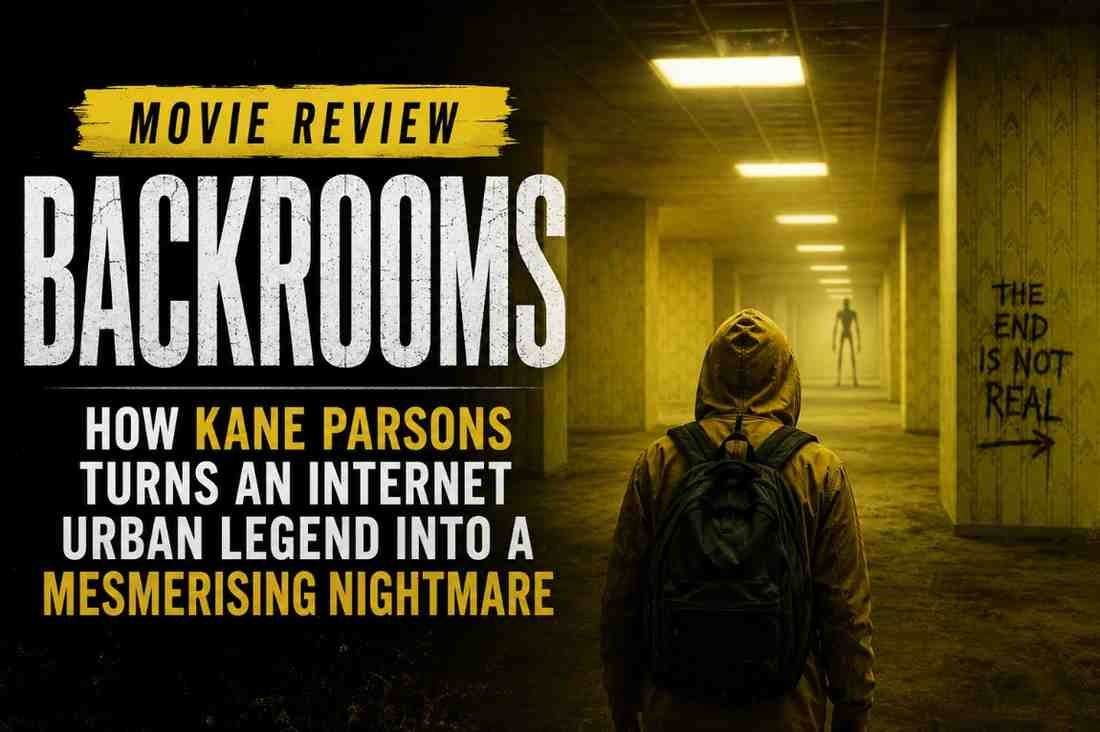
Horror has always evolved alongside society’s fears. In the twentieth century, monsters represented the unknown. In the post-war era, nuclear anxiety inspired science-fiction nightmares. The rise of surveillance technology gave birth to paranoia-driven thrillers. In the digital age, however, fear has become stranger, more abstract, and often impossible to explain.
Kane Parsons’ ‘Backrooms’ embraces that ambiguity. Adapted from one of the internet’s most enduring urban legends, the film feels less like traditional horror and more like a haunting sensory experience. It blurs memory, nostalgia, dream logic, and existential dread into a hypnotic cinematic labyrinth that perfectly captures the atmosphere of a generation raised online.
Rather than relying on conventional jump scares or elaborate mythology, Parsons creates something far more unusual: a mood-driven descent into liminal terror, where empty spaces become as frightening as monsters themselves.
What Is the ‘Backrooms’ Phenomenon?
Long before Hollywood took notice, the Backrooms existed as a piece of internet folklore. Originating from a single image posted online, the concept imagined endless empty rooms covered in yellow wallpaper, buzzing fluorescent lights, and worn carpeting a space that somehow feels both familiar and deeply unsettling.
The idea resonated because it tapped into a universal emotion that psychologists often associate with liminal spaces: places that are transitional, abandoned, or disconnected from normal reality.
Airports at midnight. Empty shopping malls. School hallways during summer vacation. These spaces evoke strange feelings of nostalgia and unease.
Kane Parsons understood something many filmmakers overlook: the fear wasn’t the monster. The fear was the atmosphere itself.
A New Kind of Horror Language
Traditional horror often depends on clearly defined threats. The audience understands what to fear and why. ‘Backrooms’ rejects that formula entirely.
The film thrives on uncertainty.
Questions linger unanswered:
- Where are these endless rooms?
- Who built them?
- What rules govern this reality?
- Can anyone escape?
- Are memories themselves becoming unreliable?
Rather than offering easy explanations, Parsons leans into ambiguity. The result is deeply postmodern a horror experience that values sensation over exposition and mood over narrative certainty.
Why ‘Backrooms’ Feels Like a Dream You Can’t Explain
One of the film’s greatest achievements lies in its ability to recreate the strange texture of dreams.
Scenes unfold with a logic that feels emotionally coherent but intellectually elusive. Familiar objects appear in unfamiliar contexts. Hallways stretch endlessly. Time feels unstable.
The experience resembles memory itself fragmented, distorted, and deeply subjective.
This dreamlike quality explains why viewers often struggle to summarize the film in traditional terms. It isn’t simply watched; it’s absorbed.
Kane Parsons Understands Internet-Era Anxiety
What makes ‘Backrooms’ especially fascinating is how accurately it reflects the psychological landscape of the internet generation.
Modern anxieties are rarely straightforward. People navigate information overload, digital identities, algorithmic realities, and endless streams of nostalgia.
Today’s fears are abstract:
- Feeling disconnected despite constant connectivity.
- Experiencing loneliness in crowded digital spaces.
- Questioning what is real.
- Longing for memories that never truly existed.
- Living inside endless feeds with no exit.
‘Backrooms’ translates those emotions into visual form.
Its endless corridors become metaphors for modern life itself—a maze of information and memories with no obvious destination.
The Rise of Dreamcore and Liminal Horror
Parsons belongs to a new generation of creators redefining horror aesthetics.
Unlike traditional slashers or supernatural films, dreamcore horror emphasizes atmosphere, nostalgia, and uncanny familiarity.
Characteristics include:
- Empty spaces.
- Analog aesthetics.
- Vintage textures.
- Distorted memories.
- Ambiguous threats.
- Psychological unease.
The genre reflects internet culture itself, where forgotten photographs, VHS recordings, and nostalgic imagery carry emotional power far beyond their original context.
Comparison: Traditional Horror vs ‘Backrooms’ Horror
| Traditional Horror | Backrooms Horror |
|---|---|
| Clear villains | Ambiguous threats |
| Linear storytelling | Dreamlike structure |
| Jump scares | Atmospheric dread |
| Physical danger | Existential anxiety |
| Resolution-driven plots | Mystery and ambiguity |
This shift illustrates how horror itself is evolving alongside audiences.
Nostalgia as Terror
One of the film’s most intriguing qualities is its use of nostalgia.
Normally associated with comfort, nostalgia becomes unsettling in ‘Backrooms’. Familiar textures, outdated architecture, fluorescent lighting, and empty interiors create feelings that are strangely comforting and disturbing at the same time.
Psychologists call this emotional contradiction the uncanny a sensation where something feels recognizable yet fundamentally wrong.
Parsons weaponizes that feeling masterfully.
The Visual Language of Isolation
The cinematography deserves special attention.
Wide empty spaces dominate the frame. Long corridors stretch into infinity. Sound design amplifies every hum and echo.
Instead of overwhelming viewers with spectacle, the film embraces minimalism.
The silence becomes oppressive. The emptiness becomes threatening.
Few filmmakers understand that sometimes absence is more terrifying than presence.
How YouTube Changed Modern Horror
Parsons’ journey reflects a larger transformation within the film industry.
YouTube has become one of the most important incubators for emerging horror talent.
Unlike traditional studios, online platforms reward experimentation. Creators can develop unconventional ideas without commercial pressure.
This freedom allows projects like ‘Backrooms’ to exist films that prioritize atmosphere and artistic identity over familiar formulas.
Hollywood increasingly recognizes that internet creators understand younger audiences in ways traditional systems often struggle to replicate.
An Insight Many Reviews Miss: ‘Backrooms’ Is About Memory
Most discussions focus on monsters and mystery, but the film’s deepest theme may be memory itself.
The spaces in ‘Backrooms’ feel like fragments of forgotten childhood experiences—places half remembered and emotionally distorted.
In many ways, the film suggests that memories are their own labyrinth.
We wander through them endlessly, revisiting moments that no longer exist while struggling to distinguish reality from nostalgia.
That emotional truth gives the film unexpected depth.
The Future of Horror Is Becoming More Abstract
‘Backrooms’ may represent a glimpse into horror’s future.
Audiences increasingly embrace stories that prioritize emotion and atmosphere over traditional narratives.
As digital culture continues evolving, horror will likely become even more psychological, symbolic, and immersive.
The monsters of tomorrow may not have names or faces. They may be memories, empty spaces, and feelings that cannot be fully explained.
Parsons understands this shift instinctively.
Verdict: A Mesmerising Moodboard of Internet-Age Fear
‘Backrooms’ isn’t a conventional horror film, nor does it try to be. Kane Parsons transforms one of the internet’s strangest urban legends into a hypnotic exploration of nostalgia, memory, and existential unease.
Its greatest strength lies not in answering questions but in creating emotions that linger long after the credits roll.
For viewers expecting straightforward scares, the experience may feel disorienting. But for those willing to surrender to its dreamlike rhythms, ‘Backrooms’ offers something increasingly rare: a horror film that feels genuinely new.
By embracing ambiguity, liminal aesthetics, and the anxieties of digital life, Kane Parsons has crafted a postmodern fever dream that captures what fear looks like in the internet age.
Rating: 4.5/5
Not merely a movie, but a strange memory you aren’t entirely sure you experienced.
For breaking news and live news updates, like us on Facebook or follow us on Twitter and Instagram. Read more on Latest Entertainment on thefoxdaily.com.

COMMENTS 0