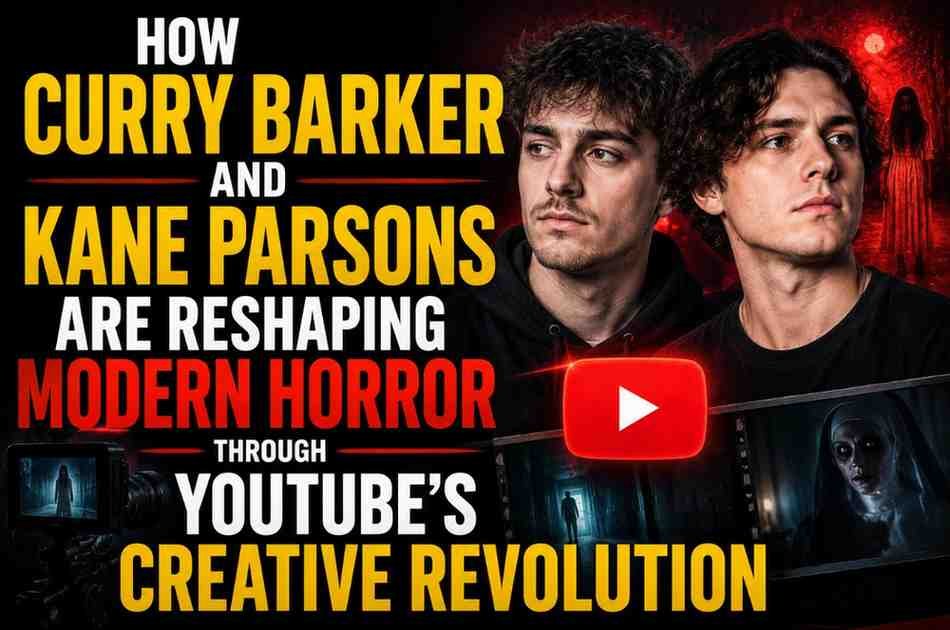
For decades, aspiring horror directors followed a familiar path: film school, independent festivals, industry networking, and the hope of catching the attention of a studio executive. Today, that roadmap is rapidly changing. Increasingly, some of the most exciting voices in horror are emerging not from traditional filmmaking institutions but from YouTube.
The extraordinary success of creators such as Curry Barker and Kane Parsons has highlighted a transformation that has been quietly unfolding for years. Armed with affordable cameras, editing software, visual effects tools, and a direct connection to global audiences, young filmmakers are creating horror stories that rival the creativity and occasionally the impact of studio productions.
What was once dismissed as a platform for amateur videos has evolved into one of the entertainment industry’s most important scouting grounds. In many ways, YouTube is becoming the modern equivalent of the independent horror festival circuit, only faster, larger, and more accessible.
The Success of Kane Parsons and the ‘Backrooms’ Phenomenon
Few creators better illustrate this shift than Kane Parsons. Still in his teens when he gained international recognition, Parsons transformed an obscure internet creepypasta concept known as “The Backrooms” into a cinematic horror experience that captivated millions.
Rather than relying on traditional jump scares, the series tapped into psychological horror, liminal spaces, and existential dread. The unsettling visuals of endless yellow hallways, combined with realistic camera work and sophisticated visual effects, created a uniquely modern form of fear.
The project demonstrated something Hollywood could not ignore: audiences were willing to embrace entirely new horror worlds created outside traditional studio systems.
Industry interest quickly followed, cementing Parsons as one of the most significant examples of YouTube’s ability to discover emerging filmmaking talent.
Curry Barker and the Viral Power of ‘Obsession’
Curry Barker represents another side of YouTube’s horror revolution. His projects, including the widely discussed “Obsession”, showcased a filmmaker capable of combining suspense, storytelling, and technical precision within a format designed for online audiences.
What separates creators like Barker from many traditional filmmakers is their understanding of internet-native storytelling. They know how viewers consume content, how tension can be built within shorter runtimes, and how audience engagement can amplify a story’s reach far beyond conventional marketing campaigns.
The success of “Obsession” demonstrated that compelling horror does not necessarily require massive budgets. Strong concepts, effective execution, and audience connection can be equally powerful.
Why Horror Thrives on YouTube
Among all film genres, horror has proven uniquely suited to digital platforms.
Several factors explain why:
- Horror relies heavily on creativity rather than expensive spectacle.
- Psychological tension can be created with limited resources.
- Online audiences actively share frightening content.
- Short-form storytelling works particularly well for horror concepts.
- Internet culture naturally generates myths, mysteries, and urban legends.
A terrifying idea can often be more effective than an expensive production. This allows independent creators to compete with significantly larger studios.
In many cases, limitations become strengths. Restricted budgets often encourage innovative storytelling techniques that make horror feel more intimate and authentic.
A Brief History of YouTube Horror Evolution
The rise of creators like Curry Barker and Kane Parsons did not happen overnight. YouTube horror has evolved through several distinct phases.
| Era | Characteristics | Impact |
|---|---|---|
| Early YouTube (2005–2012) | Homemade horror shorts and creepypasta videos | Built online horror communities |
| Found-Footage Boom (2012–2017) | Slender Man, ARGs, and viral horror storytelling | Expanded immersive audience participation |
| Cinematic Creator Era (2017–2022) | Higher production quality and advanced VFX | Blurred lines between amateur and professional filmmaking |
| Modern Studio Interest (2022–Present) | Creators attracting Hollywood partnerships | YouTube becomes a major talent pipeline |
This evolution reflects broader changes in technology, audience expectations, and content creation tools.
The Democratization of Horror Filmmaking
One of the most important developments in modern cinema is the democratization of filmmaking.
Years ago, producing visually impressive horror films required access to expensive equipment, professional editing suites, and industry connections. Today, powerful cameras are built into smartphones, editing software is widely available, and visual-effects tools have become significantly more accessible.
This technological shift has lowered barriers to entry and allowed talented storytellers to compete on a global stage.
For young creators, success depends less on industry access and more on creativity, technical skill, and audience engagement.
Why Hollywood Is Paying Attention
Studios are increasingly interested in YouTube Creators for several reasons.
Unlike traditional filmmakers, successful creators arrive with proven audiences and measurable engagement data. Executives can see exactly how viewers respond to a creator’s work.
This reduces uncertainty and provides valuable insights into audience preferences.
Creators also bring:
- Built-in fan communities.
- Demonstrated storytelling abilities.
- Strong understanding of younger audiences.
- Experience working efficiently with limited budgets.
- Innovative approaches to visual storytelling.
In an industry constantly searching for fresh voices, these qualities are highly attractive.
The Influence of Internet Culture on Modern Horror
Modern horror increasingly draws inspiration from internet culture itself.
Concepts such as the Backrooms, analog horror, alternate reality games (ARGs), and digital folklore represent entirely new forms of storytelling that emerged online.
Unlike traditional monsters or haunted houses, these narratives reflect contemporary anxieties:
- Isolation.
- Digital surveillance.
- Artificial intelligence.
- Loss of identity.
- Information overload.
- The uncertainty of virtual spaces.
This connection to modern fears helps explain why internet-born horror resonates strongly with younger audiences.
How YouTube Horror Differs From Traditional Horror Films
| Traditional Horror | YouTube Horror |
|---|---|
| Long-form storytelling | Flexible episode lengths |
| Studio financing | Independent creation |
| Formal distribution | Direct audience access |
| Scheduled releases | Rapid publishing cycles |
| Audience as viewers | Audience as active participants |
Perhaps the biggest difference is audience interaction. Viewers frequently contribute theories, interpretations, and discussions that become part of the storytelling experience itself.
The Rise of Analog Horror and Experimental Storytelling
The success of creators like Kane Parsons has also accelerated interest in analog horror a subgenre that mimics old television broadcasts, surveillance footage, educational tapes, and emergency alerts.
This format exploits uncertainty and ambiguity, allowing viewers’ imaginations to fill in the gaps.
Many creators have discovered that what remains unseen can be far more frightening than explicit visual horror.
As a result, internet horror increasingly emphasizes atmosphere, mystery, and psychological discomfort rather than conventional scares.
The Future of Horror May Begin Online
The unprecedented success of creators such as Curry Barker and Kane Parsons suggests that the next generation of influential horror filmmakers may emerge from digital platforms rather than traditional film schools.
Studios are likely to continue monitoring YouTube, TikTok, and other platforms for creators capable of building original worlds and attracting dedicated audiences.
The distinction between independent online content and professional filmmaking is becoming increasingly blurred.
What matters now is not where a filmmaker starts, but whether they can tell compelling stories that capture attention in a crowded media landscape.
A New Era for Horror Storytelling
The rise of Curry Barker, Kane Parsons, and other online creators represents more than a temporary trend. It reflects a structural shift in how talent is discovered, developed, and distributed.
YouTube has evolved from a video-sharing platform into a creative laboratory where filmmakers can experiment, refine their craft, and build global audiences without waiting for industry approval.
For horror fans, this transformation is particularly exciting. The genre has always thrived on innovation, and digital creators are introducing fresh ideas, new fears, and unconventional storytelling techniques at an unprecedented pace.
If the success of “Obsession” and “Backrooms” is any indication, the future of horror may not begin in Hollywood—it may begin with a creator uploading a video from their bedroom and terrifying millions around the world.
For breaking news and live news updates, like us on Facebook or follow us on Twitter and Instagram. Read more on Latest Entertainment on thefoxdaily.com.




COMMENTS 0