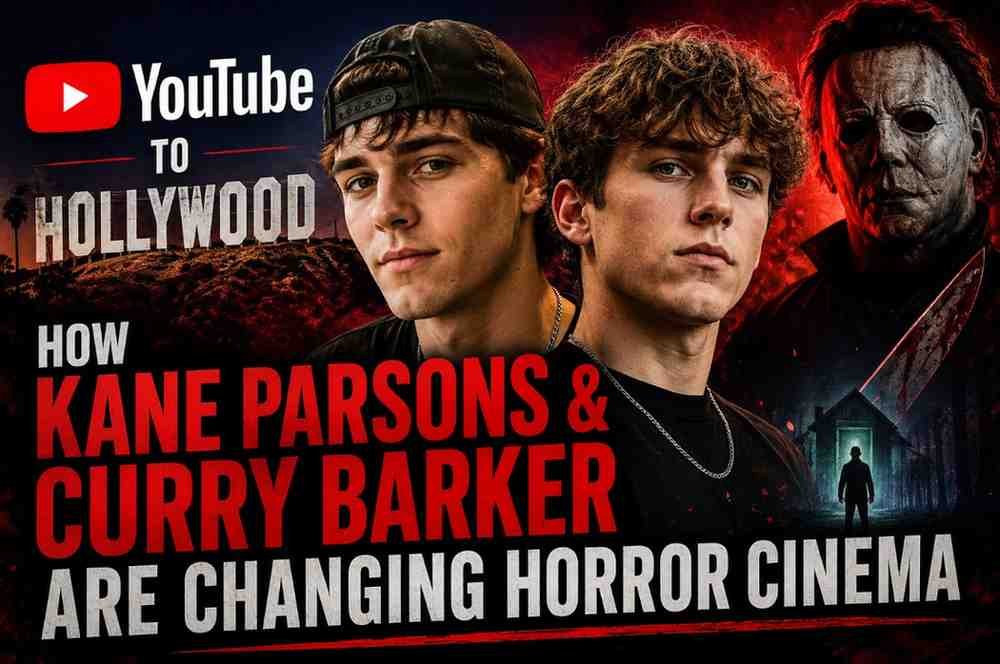
Not long ago, the idea that a teenager filming horror shorts on a consumer camera and uploading them to YouTube would end up with a major studio deal would have sounded like a particularly optimistic fairy tale. Today, it is simply Tuesday. The horror genre always the film industry’s most democratic, most scrappy, most willing to bet on an unknown has found its newest talent pipeline not in film schools or festival circuits, but in the comment sections and subscriber counts of YouTube channels built by creators who learned their craft entirely in public.
Two names sit at the centre of this conversation right now: Curry Barker and Kane Parsons. Their respective projects Obsession and Backrooms have generated the kind of cultural momentum and industry attention that most debut filmmakers spend entire careers chasing. But to understand why their success feels like a genuine inflection point rather than a one-off anomaly, you have to trace the longer arc of how YouTube quietly became the most fertile scouting ground in modern horror.
The YouTube Horror Ecosystem: A Brief but Consequential History
YouTube launched in 2005. Within a few years, a small but dedicated community of horror creators had discovered that the platform offered something film school never could: a direct, unmediated relationship with an audience. No gatekeepers. No development executives. No notes from someone who had never watched a horror film in their life. Just a creator, a camera, and a growing number of viewers who would tell you with complete honesty and occasionally brutal directness exactly whether what you made was scary or not.
The early YouTube horror ecosystem was rough. Production values were low, budgets were nonexistent, and most of what existed fell into the category of amateur experimentation. But experimentation, it turns out, is exactly how new formal languages get invented. Creators who couldn’t afford sets learned to use darkness. Those who couldn’t hire actors learned to use suggestion and sound. Those who couldn’t afford visual effects learned that what the audience’s imagination fills in is almost always scarier than what any effects budget could put on screen.
This constraint-driven creativity produced something genuinely new: a horror sensibility native to the digital age, built on found footage aesthetics, first-person perspective, ambient dread, and the particular uncanniness of footage that feels like it was never meant to be seen. These were not cinematic conventions borrowed from the tradition of Hitchcock or Carpenter. They were new tools, forged in the specific conditions of online video.
The Marble Hornets Moment: When YouTube Horror Proved It Could Actually Scare People
If there is a single project that demonstrated YouTube horror’s potential to transcend its platform and genuinely terrify mainstream audiences, it is Marble Hornets. Launched in 2009 by Troy Wagner and Joseph DeLage, Marble Hornets was a serialised found-footage horror series built around the Slender Man mythology a fictional entity that had itself originated on the internet, on the Something Awful forums in 2009.
Marble Hornets was not a film. It was not a television series. It was something entirely new: a horror narrative told in fragments across dozens of YouTube uploads, with an ARG (alternate reality game) layer that blurred the line between fiction and reality in ways that genuinely unsettled its audience. It accumulated millions of views, generated genuine cultural fear, and proved that you did not need a distribution deal, a theatrical release, or a marketing budget to make people scared.
The significance of Marble Hornets in retrospect is not just that it was effective horror it is that it demonstrated a complete alternative model for horror storytelling. The serialised format, the community engagement, the deliberate ambiguity about what was real these were not compromises forced by lack of resources. They were features. They were what made the project work.
Kane Parsons and the Backrooms: Internet Mythology Meets Cinematic Ambition
The Backrooms as a concept originated as a single creepypasta post in 2019 a brief, eerily written description of an infinite fluorescent-lit office space that you could “noclip” into if you fell through the wrong part of reality. It was accompanied by a single blurry photograph of yellow-carpeted rooms stretching into undefined distance. That image, and the paragraph accompanying it, became one of the most resonant pieces of internet horror mythology of the decade.
In 2022, Kane Parsons who was just sixteen years old at the time uploaded a short film based on the Backrooms concept to YouTube. What he produced was not a fan video in any dismissive sense of that term. It was a formally accomplished piece of atmospheric horror filmmaking that understood, intuitively, exactly what made the Backrooms concept frightening: not monsters, not gore, not jump scares, but the particular existential dread of infinite, featureless space and the absence of any path home.
The video went viral with a velocity that surprised even seasoned observers of internet culture. And then something happened that truly marked a new era: J.J. Abrams’ production company Bad Robot came calling. Parsons, a teenager with no industry connections and no formal training, signed a deal to develop a feature film based on the Backrooms concept. The project remains in development, but its significance as a signal moment is already written into the industry’s history.
Curry Barker and ‘Obsession’: A Different Kind of YouTube-to-Hollywood Story
While Kane Parsons’ story has the quality of a prodigy discovered, Curry Barker’s trajectory is in some ways the more instructive case study because it demonstrates what sustained creative development on YouTube actually looks like when it reaches its logical conclusion.
Barker built a presence on YouTube through horror content that distinguished itself through its commitment to atmosphere, psychological tension, and a visual language that felt genuinely cinematic rather than content-native. Obsession represents the project that translated that accumulated craft into the kind of mainstream attention and industry traction that changes careers. The film’s success both in terms of audience response and the broader conversation it generated about where horror talent now comes from has positioned Barker as one of the most watched emerging names in the genre.
What both Barker and Parsons share, beyond their digital origins, is an understanding of horror that is fundamentally different from the understanding held by filmmakers who came up through traditional routes. They are, in a meaningful sense, products of the internet’s horror culture they absorbed creepypasta, ARGs, analog horror, found footage, and the entire tradition of online collaborative fear-making before they ever thought about making anything themselves. That absorption shows in their work in ways that are difficult to manufacture or teach.
| Creator | Platform Origin | Key Project | Industry Breakthrough | Horror Style |
|---|---|---|---|---|
| Troy Wagner & Joseph DeLage | YouTube | Marble Hornets (2009–2014) | Cult following; ARG pioneer; Slender Man film inspiration | Serialised found footage, ARG |
| Kane Parsons | YouTube | The Backrooms (2022) | Bad Robot / J.J. Abrams feature deal | Atmospheric, liminal space dread |
| Curry Barker | YouTube | Obsession | Major studio/industry attention | Psychological, cinematic tension |
| Zach Correctly (Analog Horror) | YouTube | Various analog horror projects | Genre-defining influence on a new horror subgenre | Retrofitted broadcast horror, VHS aesthetic |
The Analog Horror Wave: YouTube’s Most Distinctive Contribution to the Genre
No survey of YouTube’s impact on modern horror is complete without acknowledging analog horror a subgenre that is almost entirely a YouTube invention and that has produced some of the most genuinely innovative horror content of the past decade.
Analog horror repurposes the visual language of old broadcast television public access channels, emergency broadcast systems, educational films, VHS home recordings and uses it to construct horror narratives that feel like corrupted transmissions from a reality slightly adjacent to our own. The retrofitted aesthetic is not nostalgia. It is weaponised familiarity: the horror works precisely because these formats feel like they belong in safe, domestic contexts, and the intrusion of something genuinely threatening into that context produces an uncanny dissonance that is difficult to shake.
Series like Local 58, created by Kris Straub, and The Mandela Catalogue have accumulated enormous followings and influenced a generation of horror creators. They have also demonstrated that YouTube is not just a platform for short-form content that eventually graduates to longer formats it is capable of sustaining genuinely complex, serialised horror narratives that work specifically because of, not despite, their digital-native delivery.
Why Horror? The Genre’s Unique Relationship With New Talent
It is not accidental that horror is the genre leading this YouTube-to-Hollywood pipeline. Horror has always been the film industry’s most accessible genre for new talent because its fundamental requirements are inverted relative to almost every other kind of filmmaking.
Big-budget action needs spectacle. Drama needs performance depth and nuance. Comedy needs timing refined over years of live audience feedback. Horror needs none of these things as its primary requirement. Horror needs the ability to create and sustain dread — and dread, it turns out, can be created with almost nothing. Darkness is free. Silence is free. The suggestion of something just outside the frame costs nothing.
This is why the genre has historically been the entry point for filmmakers who went on to define cinema more broadly. Sam Raimi made The Evil Dead for $375,000. James Wan made Saw for $1.2 million. Jordan Peele came from sketch comedy and made Get Out for $4.5 million, which earned $255 million worldwide and won him an Academy Award for Best Original Screenplay. The pattern is consistent: horror rewards vision and craft over resources, which means it rewards exactly the kind of talent that YouTube horror has been developing for fifteen years.
What Hollywood Is Actually Buying When It Signs a YouTube Horror Creator
When Bad Robot signed Kane Parsons or when studios take meetings with creators like Curry Barker, they are not simply buying a talented filmmaker. They are buying something more specific and more valuable: proof of audience.
YouTube horror creators arrive with built-in evidence that their sensibility connects with real people. Their subscriber counts are not vanity metrics they are documented proof that this person’s vision of fear resonates with an audience that is, crucially, exactly the demographic that buys horror movie tickets. The risk calculus for a studio signing a YouTube creator is fundamentally different from the risk of betting on an unknown from a film festival: the unknown from the festival has critical validation but no proven audience relationship; the YouTube creator has both.
There is also a content intelligence dimension. Creators who have built audiences on YouTube understand, at a granular level, what works and what does not because they received feedback on every single thing they ever made, in real time, from the exact audience they were trying to reach. That market intelligence is built into their creative instincts in ways that cannot be taught in a classroom and cannot be replicated by a test screening process.
The Risks and the Road Ahead: Not Every Transition Succeeds
It would be dishonest to present this pipeline as without friction or failure. The translation from YouTube to feature filmmaking is not automatic, and several creators who have made the attempt have found that the skills that make a great YouTube horror channel do not automatically transfer to the very different demands of a feature-length narrative.
YouTube horror thrives on brevity, atmosphere, and the particular intensity of short-form dread. Feature films require sustained narrative architecture, character development across longer arcs, and the ability to modulate tension over ninety minutes in ways that keep an audience engaged without exhausting them. These are different crafts, and the transition requires genuine adaptation rather than simple scaling up.
The creators who will succeed in this transition are those who understand that YouTube was their training ground, not their destination those who approach the feature format on its own terms rather than attempting to simply make a very long YouTube video. The early signs from both Parsons and Barker suggest this kind of self-aware adaptability, which is perhaps the most important predictor of long-term success.
Conclusion: YouTube Did Not Discover Horror It Rebuilt It From the Inside
The story of YouTube and modern horror is not a story about a platform disrupting an industry. It is a story about a generation of filmmakers who used the tools available to them consumer cameras, free distribution, direct audience relationships to build a new horror tradition from the ground up, outside the industry’s walls, and then watched as the industry eventually had no choice but to come to them.
Curry Barker, Kane Parsons, and the creators who came before them did not wait for permission. They made things. They uploaded them. They listened to their audiences. They got better. And then they made things again. The result is a pipeline of horror talent that is, in several meaningful ways, better prepared for the realities of modern film than anything a traditional development system could have produced.
Hollywood horror is now, irrevocably, a YouTube story. The only question is which creator uploads something next week that will become the next Backrooms the next piece of digital fear-making that a major studio watches and immediately picks up the phone.
For breaking news and live news updates, like us on Facebook or follow us on Twitter and Instagram. Read more on Latest Entertainment on thefoxdaily.com.




COMMENTS 0