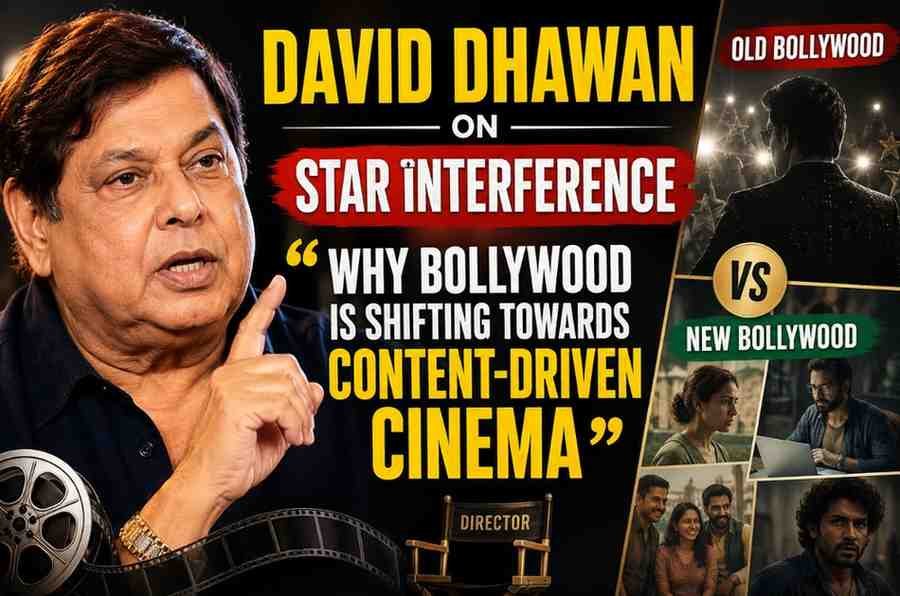
Who: Veteran filmmaker David Dhawan. What: His statement about stars interfering in the filmmaking process. When: During recent reflections on his career and industry trends. Where: Bollywood Film Industry. Why: To regain creative freedom and break repetitive patterns. How: By consciously moving away from working exclusively with big stars.
Introduction: When Stardom Meets Creative Conflict
For decades, Bollywood has thrived on the magnetism of its stars. Big names have driven box office success, dictated trends, and shaped audience expectations. But behind the glamour lies a less-discussed reality creative tension between filmmakers and actors.
Veteran director David Dhawan, known for delivering some of the most iconic commercial entertainers, has now openly addressed this issue. His remark about stars “interfering with the filmmaking process” is not just a personal observation it reflects a structural challenge within the industry.
More importantly, his decision to “get out of the rut of working with stars” signals a potential shift in how mainstream cinema might evolve in the coming years.
Background: David Dhawan’s Legacy in Star Driven Cinema
David Dhawan’s career has been closely tied to some of Bollywood’s biggest stars. His films, particularly in the 90s and early 2000s, were built on high energy performances, comedic timing, and strong star appeal.
He has worked extensively with leading actors, creating commercially successful films that relied heavily on star charisma. This long-standing collaboration makes his recent statement even more significant it comes from someone who has seen both the advantages and limitations of star-driven filmmaking.
What Does “Interference” Really Mean in Filmmaking?
The term “interference” can sound controversial, but in industry terms, it often refers to creative input that goes beyond collaboration.
In practical terms, this can include:
- Changes to script or dialogues based on actor preferences
- Influence over casting decisions
- Adjustments to screen time or character arcs
- Control over editing or final cut
While collaboration is essential in filmmaking, excessive influence can dilute a director’s vision.
Insight: The challenge is not star involvement but imbalance in creative authority.
The “Rut” of Star Centric Filmmaking
David Dhawan’s use of the word “rut” is particularly telling. It suggests repetition, predictability, and creative stagnation.
Star-driven films often follow familiar formulas:
- Hero-centric narratives
- Predictable character arcs
- Fan-service moments over storytelling depth
While these elements can ensure commercial success, they can also limit innovation.
Breaking out of this cycle requires risk and that is exactly what Dhawan seems to be advocating.
Comparison: Star Driven vs Content-Driven Cinema
| Aspect | Star Driven Cinema | Content Driven Cinema |
|---|---|---|
| Creative Control | Shared or star influenced | Director focused |
| Storytelling | Formula based | Experimental and diverse |
| Risk Level | Lower (due to star pull) | Higher but rewarding |
| Audience Expectation | Mass appeal | Quality and originality |
| Longevity | Short term success | Long term impact |
This comparison highlights why many filmmakers today are gravitating toward content first storytelling.
Why This Shift Matters Now More Than Ever
The timing of Dhawan’s statement is crucial. The Bollywood landscape is undergoing rapid transformation:
- Streaming platforms are changing viewing habits
- Audiences are more content aware than ever
- Box office failures of big-budget star films are increasing
In this environment, relying solely on star power is no longer a guaranteed success strategy.
Key Insight: The power equation is shifting from stars to stories.
The Director’s Perspective: Reclaiming Creative Ownership
For filmmakers, creative control is not just a preference it is essential for storytelling integrity.
When directors lose control, films risk becoming fragmented visions rather than cohesive narratives.
Dhawan’s decision to step away from the “star system” can be seen as an attempt to:
- Reclaim narrative authority
- Experiment with fresh storytelling styles
- Work with actors who prioritize the script over stardom
This approach aligns with global filmmaking trends, where directors often lead the creative process.
Real-World Impact: What This Means for Actors and Producers
This shift has implications across the industry:
- Actors: May need to adapt to more collaborative, less controlling roles
- Producers: Might prioritize strong scripts over star casting
- New talent: Gets more opportunities as dependence on big stars reduces
In essence, it democratizes filmmaking.
Unique Angle: The Rise of “Director Brands” in Bollywood
Traditionally, Bollywood has been star centric. However, there is a growing trend where directors themselves are becoming brands.
Audiences are beginning to trust filmmakers known for consistent quality and storytelling.
This shift creates a new dynamic:
- Earlier: Audience watched films for stars
- Now: Audience increasingly watches films for creators
Dhawan’s perspective fits into this larger transformation.
Prediction: The Future of Bollywood Filmmaking
If this trend continues, the industry could see:
- More mid-budget, content-driven films
- Reduced dependence on superstar led projects
- Greater experimentation in genres and narratives
However, star power will not disappear it will evolve.
Stars who adapt to collaborative storytelling will continue to thrive, while those relying solely on influence may face challenges.
Conclusion: A Turning Point in Creative Dynamics
David Dhawan’s statement is more than just a critique it is a reflection of a changing industry.
His desire to move away from star driven filmmaking highlights a growing need for balance between commercial appeal and creative integrity.
Final Insight: The future of cinema may not belong to stars or directors alone but to those who can align both in service of a compelling story.
As Bollywood evolves, one thing is clear: storytelling is reclaiming its rightful place at the center of filmmaking.
For breaking news and live news updates, like us on Facebook or follow us on Twitter and Instagram. Read more on Latest Entertainment on thefoxdaily.com.






COMMENTS 0