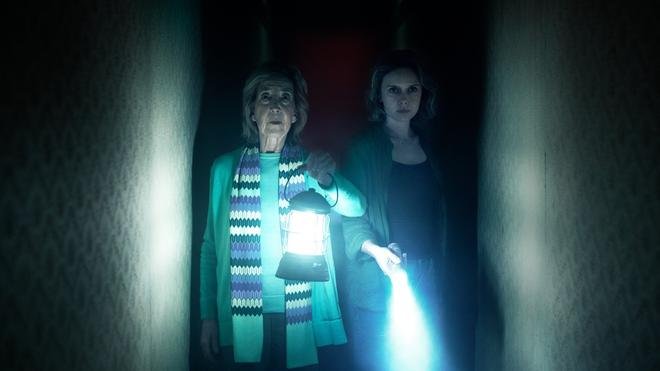
‘Insidious: Out of the Further’ arrives with an unenviable task: make one of modern horror cinema’s most recognisable supernatural worlds feel dangerous again. Sixteen years after the original Insidious introduced audiences to the eerie dimension known as the Further, the franchise has already explored haunted houses, astral projection, demons, possession and the Lambert family’s increasingly complicated relationship with the dead.
The new film tries to refresh the formula by stepping away from the Lambert family and introducing a new mother-daughter story. Jacob Chase, who previously directed Come Play, writes and directs the sixth instalment, placing Amelia Eve’s Gemma and Island Austin’s Maya at the centre of the nightmare.
It is a sensible decision. After five films, continuing to squeeze new trauma from the Lambert family risks making the series feel trapped by its own mythology. A new household gives the franchise an opportunity to rebuild its atmosphere from scratch.
Unfortunately, Out of the Further only partially takes advantage of that opportunity. There are several sequences that demonstrate genuine horror craftsmanship, and the Further still contains visual possibilities that other franchises would envy. But too much of the film feels like an attempt to revive an engine that has already been running for too long.
The imagination is not completely dead. It is simply struggling to stay awake.
A New Family, the Same Nightmare
At the centre of the film is Gemma, a single mother raising her daughter Maya in the house where Gemma’s own mother died.
The choice of location immediately establishes the film’s central idea: trauma can become part of a place.
Gemma is not simply moving into a haunted house. She is returning to the physical setting of her childhood trauma and raising her own child there. The house therefore carries two generations of fear before the supernatural elements even begin.
The film opens in the past, showing a young Gemma witnessing her mother’s suicide. That disturbing memory becomes the psychological foundation for what follows.
Years later, Gemma is living in the same house with Maya.
And, because this is Insidious, whatever happened there has clearly not stayed in the past.
Why Moving Away From the Lamberts Is a Good Idea
The decision to introduce a new protagonist is arguably the film’s strongest structural choice.
The Lambert family gave the original films their emotional centre, but their story has increasingly become tangled in the franchise’s mythology. Josh and Dalton Lambert’s connection to the Further provided a useful engine for several films, but repeatedly returning to the same supernatural family history can make horror feel like homework.
Gemma gives the series a clean starting point.
She has her own history, her own relationship with her mother and her own responsibilities as a parent. Most importantly, she has a daughter to protect.
That creates a potentially powerful emotional parallel: Gemma grew up in a home defined by her mother’s instability and death, and now she must prevent that legacy from consuming Maya.
The film understands the idea.
The problem is that it does not always explore it deeply enough.
The Further Is Still the Franchise’s Best Idea
The central invention of Insidious remains remarkably effective.
The Further is not simply another haunted dimension. It is a supernatural space that turns the ordinary rules of reality upside down. The dead remain present, demons lurk within its darkness and living people can become vulnerable when their consciousness crosses into it.
That concept gives the franchise something many haunted-house movies lack: an entire supernatural geography.
The Further can look familiar and alien at the same time. It can transform a corridor, bedroom or doorway into something threatening without requiring the filmmakers to abandon the recognisable spaces of the real world.
But that flexibility creates a challenge.
The more frequently a horror universe is visited, the less mysterious it becomes.
What was once an unknowable place gradually becomes franchise territory.
When Horror Mythology Becomes Too Familiar
The first Insidious benefited enormously from mystery.
Audiences did not know exactly what the Further was, what lived there or what rules governed it. That uncertainty created dread.
By the sixth film, much of that mystery has inevitably disappeared.
Viewers familiar with the franchise already understand the basic mechanics. They know that the Further exists. They know that spirits can cross between worlds. They know demons can become central threats. They know that seemingly ordinary domestic spaces can become gateways to supernatural danger.
That means the filmmakers have to create fear in new ways.
Out of the Further occasionally succeeds, particularly when it stops explaining and starts showing. But whenever the movie leans too heavily on familiar mythology, the sense of discovery weakens.
The Film’s Best Horror Comes From Simplicity
Some of the strongest moments work because they return to a basic principle of horror: show the audience something that should not be there, then make them wait.
A strange movement in the background can be more disturbing than a loud jump scare. A door that opens by itself can create more tension than a creature suddenly appearing on screen.
The Insidious franchise has always understood the power of visual unease, and Out of the Further occasionally rediscovers it.
Several set pieces demonstrate that the series’ filmmakers still know how to construct a creepy image or stretch a moment of anticipation.
These sequences are reminders of what the franchise could still accomplish if it trusted atmosphere more consistently.
The Problem With Too Many Scares
Horror depends on rhythm.
Fear requires anticipation, release and silence. If every quiet moment is immediately followed by a scare, the audience learns the pattern.
Eventually, the viewer is no longer frightened by the darkness. They are simply waiting for the soundtrack to become loud.
Out of the Further sometimes falls into that trap.
The film has enough effective scares to demonstrate technical competence, but not all of them carry the same weight. When supernatural interruptions become too predictable, they stop feeling like violations of reality and start feeling like scheduled attractions.
That distinction is crucial for a franchise like Insidious.
Gemma Has the Potential to Be a Strong Franchise Lead
Amelia Eve gives Gemma a grounded quality that suits the character.
She is not introduced as a professional paranormal investigator or someone who understands the supernatural rules of the world. She is a mother confronted with something she does not fully understand.
That makes her vulnerability useful.
Her greatest weapon is not supernatural knowledge but her determination to protect Maya.
The character could have provided the franchise with a fresh emotional centre, particularly because her relationship with her own mother gives the story an opportunity to explore inherited trauma.
However, the screenplay sometimes prioritises supernatural mechanics over that emotional material.
As a result, Gemma can feel more like a participant in the franchise’s horror machinery than a character whose psychological journey drives it.
The Mother-Daughter Dynamic Is the Film’s Real Opportunity
The most promising element of Out of the Further is not necessarily the new demon.
It is the relationship between Gemma and Maya.
Gemma has experienced the destruction of a family from inside the same house in which she is now raising her daughter. That gives the film a naturally unsettling question: Can someone escape the trauma inherited from a previous generation, or does it inevitably follow them?
Horror has long been effective at turning family anxieties into supernatural metaphors. A haunted house can represent memory. A monster can represent inherited fear. A possession story can transform the fear of losing a child into literal physical danger.
Out of the Further has all the ingredients for that kind of layered horror.
It simply does not always push them far enough.
A Franchise Caught Between Reinvention and Nostalgia
There is a familiar problem facing long-running horror franchises: audiences want something new, but they also want the elements they recognise.
Remove too much of the original formula and the movie risks becoming an unrelated horror film with a familiar title.
Keep too much of it and the movie feels repetitive.
Out of the Further attempts to occupy the middle ground.
It introduces new characters and a new family while retaining the Further, supernatural mythology and general visual vocabulary of the earlier films.
The result is recognisable without being particularly revolutionary.
What ‘Out of the Further’ Gets Right
- A fresh protagonist: Moving away from the Lambert family gives the franchise room to explore a different emotional story.
- The Further: The supernatural world remains the series’ most distinctive concept.
- Several effective set pieces: The film occasionally produces genuinely eerie sequences that show the franchise still has visual imagination.
- A strong horror premise: Gemma’s traumatic childhood and her daughter’s vulnerability provide the foundations for meaningful psychological horror.
- Atmospheric potential: The house and its history offer an effective setting for a story about inherited fear.
Where the Movie Falls Short
- Familiar mythology: After five previous films, the Further no longer carries the same mystery.
- Uneven scares: Some sequences are effective, while others rely too heavily on predictable horror rhythms.
- Underused emotional material: The mother-daughter relationship could have been developed with greater depth.
- Franchise fatigue: The film occasionally feels more like another instalment than a reinvention.
- Overreliance on mechanics: Explaining supernatural rules can reduce the mystery that makes horror work.
How It Compares With the Original ‘Insidious’
| Element | Original ‘Insidious’ | ‘Out of the Further’ |
|---|---|---|
| Central appeal | Mystery surrounding the Further and the Lambert family | A new family confronting an established supernatural world |
| Horror atmosphere | Built heavily around uncertainty and anticipation | More reliant on familiar franchise conventions |
| Mythology | Fresh and unfamiliar | More developed but consequently less mysterious |
| Emotional stakes | Strongly connected to family and parenthood | Potentially powerful through Gemma and Maya, but unevenly explored |
| Originality | Distinctive supernatural concept | Attempts to refresh the formula without completely abandoning it |
The Bigger Problem: Can the Further Still Scare Us?
This is ultimately the question hanging over the entire franchise.
The Further was frightening partly because it represented the unknown. But franchises inevitably turn the unknown into lore.
The more films explain a supernatural world, the more familiar its rules become. And familiarity is the enemy of dread.
The solution is not necessarily to abandon the Further.
Instead, future films need to discover new ways of using it. The dimension should feel unpredictable again. Its rules should perhaps become less important than its atmosphere. New characters should encounter it without the story immediately turning their experiences into another chapter in a supernatural instruction manual.
In other words, the franchise needs to make the Further mysterious again.
Final Verdict
‘Insidious: Out of the Further’ is a serviceable supernatural horror film that occasionally reminds us why this franchise became popular, but it rarely reaches the unsettling heights of its best instalments.
Jacob Chase’s decision to move away from the Lambert family is smart, and Gemma and Maya provide a promising new emotional foundation. The haunted house, generational trauma and supernatural dimension offer plenty of material for a genuinely disturbing story.
And yet, the film too often settles for familiar franchise mechanics when it could have pursued something stranger and more psychologically resonant.
The good news is that the horror imagination has not completely flatlined. A handful of terrific set pieces prove that the series can still create unsettling images and effective tension.
The bad news is that Out of the Further keeps reaching for the defibrillator.
The Further is still there. The question is whether the franchise can find a genuinely frightening reason to go back.
For breaking news and live news updates, like us on Facebook or follow us on Twitter and Instagram. Read more on Latest Entertainment on thefoxdaily.com.




COMMENTS 0