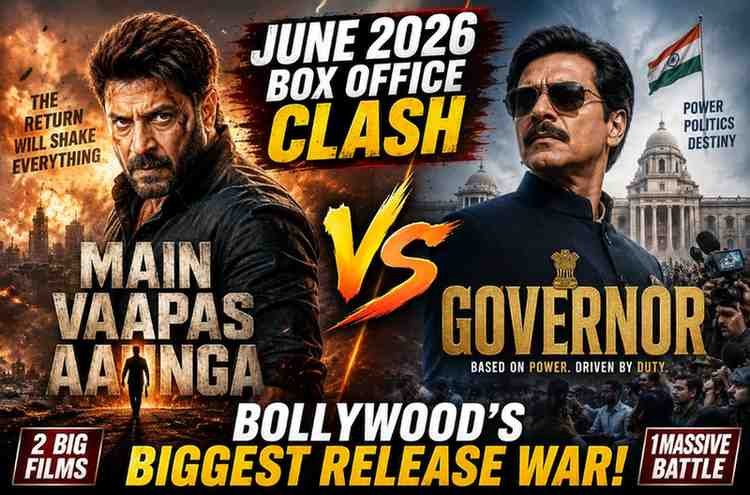
Indian cinema has seen its share of release date pile-ups, but June 13, 2026 is something else entirely. Imtiaz Ali’s emotionally charged period romance Main Vaapas Aaunga, Manoj Bajpayee’s high-stakes biographical thriller Governor: The Silent Saviour, Kangana Ranaut’s 26/11 drama Bharat Bhhagya Vidhaata, and Vikram Bhatt’s 3D horror Haunted Echoes Of The Past are all storming theatres on the same day. This is not a soft clash. This is a full-scale box office war and it arrives in the middle of what is already bollywood‘s most brutally competitive month in recent memory.
With nine major Indian releases spread across four Fridays in June, over Rs. 1,400 crore in combined production and marketing investment is riding on a single summer month. Industry veterans are not just worried some are describing the situation as a systemic failure of release calendar management. So what exactly is happening, why did it happen, and who is most likely to survive the carnage?
The Full Picture: June 2026’s Overcrowded Release Calendar
To understand the scale of this collision, it helps to zoom out. June 2026 opened with its own three-way clash on June 6 Varun Dhawan’s romantic comedy Hai Jawani Toh Ishq Hona Hai, Bobby Deol’s festival-circuit drama Bandar, and Ram Charan’s Telugu blockbuster Peddi. That opening weekend was already a pressure cooker. The second Friday, June 13, somehow manages to be worse.
The month doesn’t stop there. Cocktail 2, featuring Shahid Kapoor, Kriti Sanon, and Rashmika Mandanna, arrives on June 19. The multi-starrer comedy Welcome To The Jungle one of the most anticipated commercial entertainers of the year closes out the month on June 26. And threaded through all of this are major Hollywood releases: He-Man And The Masters Of The Universe, Toy Story 5, Supergirl, and Disclosure Day, all chasing premium multiplex screens in the same window.
Nine major domestic releases. Four Hollywood films. Four Fridays. The math simply does not work in everyone’s favour.
Main Vaapas Aaunga: The Frontrunner With the Most to Lose
Of all the films clashing this Friday, Main Vaapas Aaunga carries the most creative pedigree and arguably, the most pressure. Directed by Imtiaz Ali following his critically acclaimed Chamkila, the film stars Diljit Dosanjh and Naseeruddin Shah in a dual-timeline narrative that stretches from pre-Partition India to the present day. Vedang Raina plays a grandson trying to anchor his aging grandfather (Shah), who is consumed by the memory of a lost love from his youth. Sharvari plays the romantic lead. The music is by A.R. Rahman, with lyrics by Irshad Kamil the same trio that delivered some of the most emotionally resonant soundtracks in Hindi cinema’s recent history.
On paper, this is Bollywood’s most promising release of the month. The trailer received strong audience response. The cast is a credible mix of veterans and rising stars. The Imtiaz Ali-Diljit Dosanjh reunion carries natural goodwill from their previous collaboration. And the partition-era backdrop gives the film a rare emotional and historical sweep that separates it from the typical summer entertainer.
But there is a complication. Reports from trade observers have flagged that pre-release buzz for Main Vaapas Aaunga, while positive in quality, has been relatively limited in reach. Diljit’s Punjabi fanbase is deeply loyal but does not always translate to all-India theatrical numbers. Vedang Raina, despite the goodwill from his OTT work, has yet to prove his theatrical pull at the box office. And Imtiaz Ali’s films, beloved critically, have a track record of underperforming commercially relative to their prestige.
The film announced its June 13 release date first. Then the others came. Imtiaz Ali, speaking recently, acknowledged the situation with characteristic restraint: “We announced first. Usually there’s a kind of bhaichara in the industry if my film is coming, others step back, and vice versa. This is the first time I’m hearing other films are also coming on that day.”
Governor: The Silent Saviour A Different Beast Entirely
If Main Vaapas Aaunga is chasing the heart, Governor: The Silent Saviour is chasing the mind. Directed by Chinmay Mandlekar and produced by Vipul Amrutlal Shah, the film stars Manoj Bajpayee as the Governor of the Reserve Bank of India a role set against the backdrop of the 1990 Gulf War and the economic crisis it triggered for India. The film draws from lesser-known historical events: the government’s decision to airlift Indian citizens from Kuwait, and the behind-the-scenes financial manoeuvrings that prevented national economic collapse.
This is a niche but potentially powerful subject. The 1990 Gulf crisis led to India’s most severe balance of payments crisis, ultimately forcing the country to pledge gold reserves to the IMF a national humiliation that also catalysed the liberalisation reforms of 1991. Bajpayee in a quietly commanding role, backed by the kind of subject matter that feels relevant in an era of economic nationalism, is a credible combination.
Adah Sharma co-stars. The film’s marketing has leaned into its political and historical intrigue rather than conventional masala hooks. That positioning is both its strength and its limitation: it will attract a serious, older, urban audience but that audience overlaps far less with the Diljit Dosanjh crowd than the release calendar overlap might suggest.
Critically, Governor and Main Vaapas Aaunga do not actually compete for the same viewer. The danger is not direct audience cannibalisation. The danger is screen allocation. Multiplexes will distribute shows based on advance bookings, and whichever film builds stronger early momentum will get more shows starving the others by Sunday morning regardless of their individual merit.
The Other Two Contenders: Bharat Bhhagya Vidhaata and Haunted 3D
Kangana Ranaut’s Bharat Bhhagya Vidhaata, directed by Manoj Tapadia, follows hospital workers protecting hundreds of patients trapped inside Mumbai’s Cama Hospital during a terror attack a dramatisation adjacent to the real events of 26/11. It is a film with genuine emotional potential and a subject that carries national resonance. However, Kangana’s recent box office record has been difficult, and the pre-release climate for this film has been complicated by controversy and mixed audience sentiment.
Vikram Bhatt’s Haunted Echoes Of The Past, starring Mimoh Chakraborty, is a 3D horror film a genre that has its own loyal but limited audience. The 3D hook might drive curious footfalls in the opening weekend, but horror in Hindi cinema has rarely scaled into blockbuster territory. In a four-way clash, this film is statistically the most vulnerable to getting squeezed out of screens by Saturday evening.
Why Does This Keep Happening? The Release Calendar Problem in Bollywood
The crowding of June 2026 is not accidental it is structural. And understanding why reveals a deeper dysfunction in how Bollywood manages its release pipeline.
Summer months particularly May and June are considered high-footfall windows because schools and colleges are closed, families go to theatres, and the holiday mood drives discretionary spending. Every producer wants a summer release. Every studio pushes for it. The result is a zero-sum competition for the same peak windows, while other months September, November, early January are left relatively thin.
The informal system of bhaichara where filmmakers voluntarily step back to avoid clashing with each other has never been formalised. There is no industry body with enforcement authority over release dates. So when one film locks a date, others can crowd in, and there is nothing contractually preventing it. The result is the chaos of June 2026.
Compare this with Hollywood, where major studios actively coordinate release calendars to protect their own films’ margins. Disney does not release two tentpole films on the same weekend if it can help it. The Indian film industry, fragmented across languages, studios, and independent producers, lacks that coordination infrastructure entirely.
| Film | Director | Lead Cast | Genre | Primary Audience |
|---|---|---|---|---|
| Main Vaapas Aaunga | Imtiaz Ali | Diljit Dosanjh, Naseeruddin Shah, Sharvari, Vedang Raina | Period Romance | Young adults, music fans, Diljit fanbase |
| Governor: The Silent Saviour | Chinmay Mandlekar | Manoj Bajpayee, Adah Sharma | Biographical Thriller | Urban, older, politically aware viewers |
| Bharat Bhhagya Vidhaata | Manoj Tapadia | Kangana Ranaut | Patriotic Drama / Thriller | Nationalistic sentiment-driven audience |
| Haunted – Echoes Of The Past | Vikram Bhatt | Mimoh Chakraborty | 3D Horror | Horror genre loyalists, tier-2 markets |
The Screen Allocation Battle: Where the Real War Is Fought
Here is what most casual observers miss about multi-film clashes: the real competition is not between audiences, it is between booking systems. India has roughly 9,500 to 10,000 active screens and of those, premium multiplexes in top metros number in the hundreds. These are the screens that drive opening weekend revenue and determine whether a film enters the box office conversation as a success or a write-off.
When four films release simultaneously, multiplexes do not divide screens equally. They allocate based on pre-release demand, star power, and advance bookings. A film that opens with strong advance numbers on Monday and Tuesday of release week walks into a 40–50% screen share. The others split what remains. By Saturday, multiplexes pivot ruthlessly: underperforming films lose shows to whichever film is filling seats.
For Main Vaapas Aaunga, this dynamic is the central risk. It is the best-positioned film of the four but if advance bookings open slowly, the multiplex machinery will not wait for word-of-mouth to build. The audience that would have found the film by Wednesday of its first week may never get the chance if shows are cancelled by Sunday.
What This Means for the Industry — and for Audiences
The irony of June 2026 is that several of these films are genuinely good. Under different circumstances spread across separate weekends Main Vaapas Aaunga and Governor both have the pedigree to generate meaningful theatrical conversation. As it stands, they will be defined by opening weekend numbers that reflect scheduling chaos as much as actual audience appetite.
For audiences, the overcrowding is also a practical problem. Choosing between four films on the same weekend requires active decision-making. Research consistently shows that when consumers face too many choices in a single category, decision paralysis sets in they choose none, or they default to the most familiar option. In box office terms, that defaults to whichever film has the biggest star or the loudest pre-release noise.
The longer-term industry implication is more serious. If multiple prestige films underperform due to scheduling congestion rather than content failure, it risks chilling investment in mid-budget, non-franchise cinema. Studios learn the wrong lesson that serious films do not work commercially when the real lesson is that serious films cannot survive being buried under four simultaneous competitors.
Predictions: Who Survives the June 13 Battlefield?
Main Vaapas Aaunga is the most likely to emerge with the largest screen share and the strongest opening weekend number. The Imtiaz Ali brand, the A.R. Rahman music, and the emotional weight of the story give it the broadest appeal of the four. If it opens to Rs. 8–12 crore on Day 1, it will be considered a decent start given the competition. Anything above Rs. 15 crore would be a genuine success story.
Governor has the potential for a slow-burn performance the kind of film that benefits from strong reviews and word-of-mouth more than opening day fireworks. If multiplexes give it breathing room through the first week, Bajpayee’s performance could carry it to a respectable total. The risk is that it never gets that breathing room.
Bharat Bhhagya Vidhaata and Haunted 3D face the steepest climb. Without dominant advance booking or standout reviews, both films risk being rationalised out of multiplex schedules by the second day.
The Larger June 2026 Story Is Still Being Written
The real verdict on this chaotic month will come not just from opening weekend numbers, but from how the films hold through the week. A period romance with A.R. Rahman’s music is exactly the kind of film that builds on repeat viewings and emotional word-of-mouth. A biographical thriller with Manoj Bajpayee can find its audience if critics champion it loudly enough.
June 2026 will likely be remembered as the month Bollywood tested the absolute limits of its own release calendar logic. The industry needs a structural solution whether that is a voluntary coordination body, studio-level calendar discipline, or a formal staggering mechanism for peak windows. Without it, the same collision will happen again next summer, and the summer after that.
For now, the films are made, the dates are locked, and the screens are waiting. On June 13, audiences will vote with their tickets and the box office will deliver its unambiguous, unsentimental verdict.
For breaking news and live news updates, like us on Facebook or follow us on Twitter and Instagram. Read more on Latest Entertainment on thefoxdaily.com.






COMMENTS 0