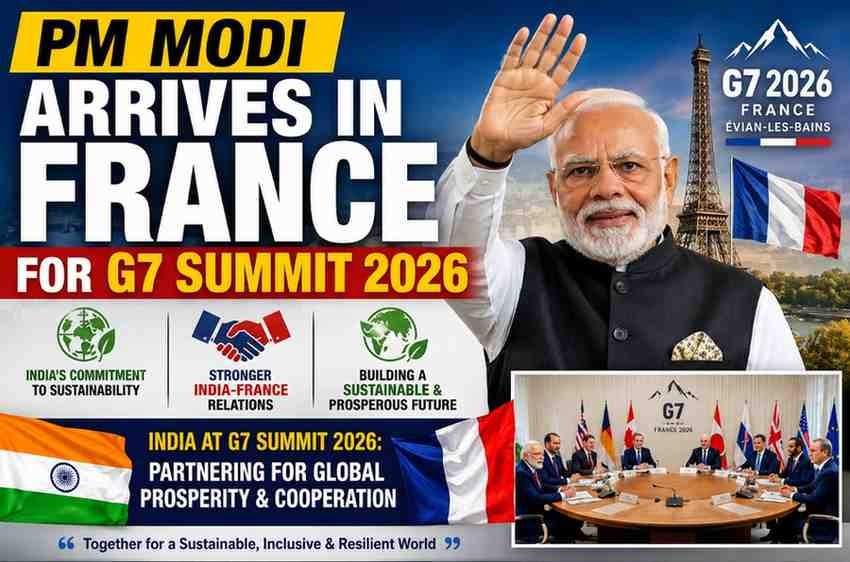
Prime Minister Narendra Modi arrived in France to participate in the G7 Summit, where leaders from some of the world’s largest economies are expected to discuss pressing global challenges ranging from sustainable development and climate change to energy security and economic growth.
Before the summit, Mr. Modi emphasized India’s commitment to international cooperation, stating that the country “remains committed to advancing collective efforts for a more sustainable and prosperous planet.” His remarks reflect India’s increasingly prominent position in global policymaking and its efforts to balance economic growth with environmental responsibility.
Why the G7 Summit Matters
The Group of Seven, or G7, comprises Canada, France, Germany, Italy, Japan, the United Kingdom, and the United States. Although India is not a member, it has frequently been invited as a guest nation in recognition of its growing economic and geopolitical significance.
The summit serves as a platform where leaders discuss:
- Climate change and energy transition.
- Global economic stability.
- Artificial intelligence and emerging technologies.
- Food and energy security.
- Geopolitical tensions and international cooperation.
- Sustainable development goals.
India’s participation highlights its role as one of the fastest-growing major economies and a key voice representing the Global South.
India’s Expanding Global Role
Over the past decade, India has increasingly positioned itself as a bridge between developed and developing economies. Its diplomatic approach seeks to combine strategic autonomy with active engagement in multilateral institutions.
India’s growing influence stems from several factors:
- Its position as one of the world’s largest economies.
- Leadership in renewable energy initiatives.
- Strong digital and technological capabilities.
- A large and youthful population.
- Strategic importance in the Indo-Pacific region.
Participation in forums like the G7 allows India to contribute to discussions that affect both advanced and emerging economies.
Sustainability at the Center of India’s Agenda
Prime Minister Modi’s remarks regarding a “more sustainable and prosperous planet” reflect India’s efforts to integrate environmental priorities with economic development.
India has championed several international initiatives, including:
- Expansion of renewable energy capacity.
- Promotion of solar energy partnerships.
- Green hydrogen development.
- Sustainable infrastructure programs.
- Climate adaptation measures for vulnerable communities.
The country has also emphasized that climate action should account for developmental needs and equity among nations.
Comparison: G7 Economies and India’s Role
| G7 Nations | India |
|---|---|
| Advanced industrial economies | Fast-growing emerging economy |
| Established technological leadership | Rapid digital transformation |
| High per capita income | Large demographic advantage |
| Climate transition challenges | Balancing growth and sustainability |
| Traditional global powers | Voice of the Global South |
An Often Overlooked Dimension: India as a Consensus Builder
Much of the attention surrounding international summits focuses on geopolitical competition, but India has increasingly attempted to position itself as a consensus builder.
Rather than aligning exclusively with one bloc, India has sought to maintain relationships across diverse regions and institutions. This approach allows it to advocate for issues affecting developing countries while participating actively in global decision-making.
Its role during international forums has often centered on balancing economic growth, energy security, and climate commitments.
Economic Cooperation and Trade Opportunities
Global summits are not merely diplomatic gatherings; they also create opportunities for strengthening economic ties. Discussions often extend to:
- Trade partnerships.
- Investment opportunities.
- Technology collaboration.
- Supply chain resilience.
- Infrastructure development.
France and India, in particular, have deepened cooperation in areas such as defense, space, clean energy, and innovation.
Why France Is an Important Partner for India
India and France share a strategic partnership that spans multiple sectors. Their cooperation includes:
- Defense and security collaboration.
- Maritime cooperation in the Indo-Pacific.
- Space exploration initiatives.
- Renewable energy partnerships.
- Artificial intelligence and digital technologies.
The bilateral relationship has steadily expanded, making France one of India’s key partners in Europe.
Looking Ahead: India’s Global Influence Is Likely to Grow
As the global economic landscape evolves, India is expected to play an increasingly important role in shaping discussions on sustainability, technology, trade, and geopolitical stability.
Its participation in forums like the G7 demonstrates that emerging economies are becoming central to addressing challenges that transcend borders.
The coming years are likely to see India deepen its engagement with advanced economies while continuing to advocate for the priorities of developing nations.
Conclusion
Prime Minister Narendra Modi’s arrival in France for the G7 Summit reflects India’s growing stature on the world stage and its ambition to contribute to solutions for shared global challenges.
By emphasizing sustainability and collective prosperity, India is seeking to position itself not merely as a participant in international forums but as a country capable of shaping the future agenda.
In an increasingly interconnected world, India’s voice at gatherings like the G7 is becoming harder to ignore—and more important to the global conversation.
For breaking news and live news updates, like us on Facebook or follow us on Twitter and Instagram. Read more on Latest Entertainment on thefoxdaily.com.






COMMENTS 0