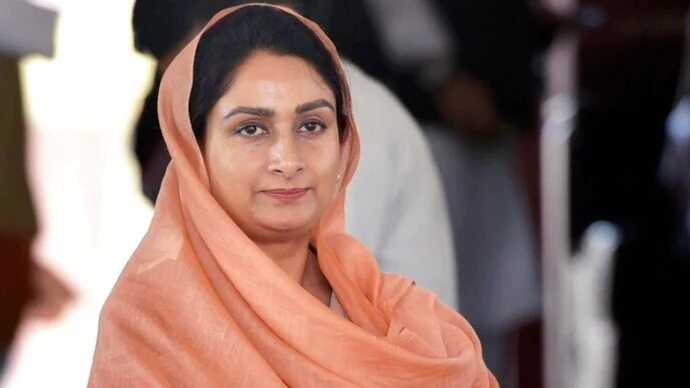
Shiromani Akali Dal (SAD) leader and Bathinda MP Harsimrat Kaur Badal has promised a comprehensive campaign against Drug Trafficking and addiction in Punjab if her party returns to power after the 2027 Assembly elections. Her proposed plan includes a special anti-drug task force led by a woman police chief, village-level monitoring by women’s groups, rehabilitation programmes, skill development and stricter legal measures against drug traffickers.
Addressing gatherings of women in Tarn Taran and Khadoor Sahib, Badal said the drug crisis had become one of the biggest concerns for families across the state. She accused the previous Congress government and the incumbent Aam Aadmi Party (AAP) government of failing to fulfil their promises to control drug trafficking.
Badal said women who previously approached political representatives over schools, drinking water and healthcare were increasingly raising concerns about drug abuse and the safety of their children. She alleged that families were afraid to report traffickers because they feared intimidation and a lack of protection from authorities.
Her remarks place the drug issue at the centre of the SAD’s preparations for the 2027 Punjab Assembly elections. The party is proposing a combination of enforcement and community participation, although the measures remain political promises that would require implementation if it forms the next government.
Harsimrat Badal Accuses Congress and AAP of Failing to Control Drugs
During her address, Harsimrat Kaur Badal criticised both the previous Congress administration and the current AAP government over their handling of drug trafficking and addiction in Punjab.
She alleged that both parties had promised to eliminate the drug menace but had failed to deliver on those commitments. Badal also claimed that drug availability had spread to the extent that substances were being delivered directly to homes in parts of the state.
These statements reflect the SAD leader’s political criticism of successive state governments. The allegations about government protection of traffickers and the scale of drug distribution were made by Badal and should not be treated as independently established findings.
Badal said the concerns raised by women during her village visits had changed over time. According to her, demands that once focused on basic public services were now increasingly centred on preventing young people from becoming addicted to drugs.
She argued that addiction affects entire households, not only the individuals consuming drugs. Families can face financial pressure, emotional distress and concerns about personal safety when a member struggles with substance dependence. Her proposed campaign seeks to involve women who experience these consequences directly.
Mai Bhago Di Fauj to Lead Village-Level Action Against Drug Trafficking
A central part of the SAD’s proposed strategy is the role of Mai Bhago di Fauj, a women-led initiative created to mobilise women against drug trafficking in Punjab.
Badal appealed to members of the organisation to form village-level groups, known as jathas, to collect information about people allegedly involved in selling drugs and those suspected of providing them shelter. She said the information would help identify local trafficking networks and support action against offenders if the SAD formed the government.
She also urged members to maintain records of suspected drug sellers and individuals allegedly helping them operate. The proposed approach is intended to create a network of local information that could be examined by a dedicated police task force.
In an earlier appeal, Badal had called for a sustained public movement against drugs, drawing a comparison with the farmers’ agitation. She also encouraged women to organise community groups and consider traditional village night-watch arrangements, known as thikri pehra, to discourage the entry of drug traffickers.
However, community members collecting information about suspected offenders would need clear safeguards. Allegations should be verified by law enforcement agencies, and any action must follow due process. Unverified accusations or confrontations with suspected traffickers could put residents at risk and undermine investigations.
SAD Promises Special Task Force Headed by a Woman DGP
If the Shiromani Akali Dal returns to power in 2027, Badal has promised to establish a special task force headed by a woman Director General of Police (DGP) to take action against drug trafficking networks.
The proposed force would examine information gathered by members of Mai Bhago di Fauj and investigate allegations involving drug sellers, traffickers and people accused of protecting them. Badal said the task force would pursue offenders and ensure strict action against those found guilty.
Placing a woman DGP at the head of the proposed force is a prominent feature of the announcement. It also connects the party’s enforcement plan with its effort to involve women in identifying local drug-related activity.
The proposal would require more than the appointment of a senior police officer. Its effectiveness would depend on the task force’s investigative authority, staffing, coordination with existing police units, access to intelligence and ability to secure convictions through evidence-based investigations.
Drug trafficking networks can involve multiple levels, from local distribution to larger supply chains. Tackling them would therefore require coordination between police stations, specialised investigation teams and other relevant agencies. The SAD has not provided a detailed operational framework for the proposed task force in the announcement.
New Law to Deny Bail to Drug Offenders for 10 Years
Badal has also promised to introduce a new law under which drug offenders would be denied bail for 10 years. She said the proposed legislation would allow authorities to seize offenders’ properties and use the proceeds to compensate victims.
The announcement signals the party’s intention to pursue tougher legal action against people involved in drug trafficking. Property confiscation, in particular, is intended to target the financial resources that support illegal drug networks.
However, the proposed bail provision raises important legal questions. Bail decisions and criminal penalties must operate within India’s constitutional and statutory framework. Any new restriction would need to be drafted carefully, with clear definitions of the offences covered and safeguards against arbitrary detention.
There is also a distinction between drug traffickers and people who use drugs. A policy aimed at organised trafficking should not automatically treat individuals struggling with addiction as members of criminal networks. The effectiveness of the proposed law would depend on how clearly it separates these categories and protects the rights of accused persons.
Badal has not provided the full text of the proposed legislation. Its legal scope, enforcement procedures and relationship with existing narcotics laws will become clearer only if the party develops a formal legislative proposal.
Rehabilitation and Skill Training for People Battling Addiction
Alongside tougher enforcement, the SAD leader has promised a rehabilitation programme for people struggling with drug addiction. Under the proposed plan, individuals would receive support to overcome dependence and develop skills that could help them rebuild their lives.
The inclusion of rehabilitation is significant because drug addiction is not addressed through policing alone. People with substance dependence may need medical treatment, counselling, psychological support and assistance in returning to education or employment.
Skill development could form part of the recovery process by helping people gain the qualifications needed to enter the workforce. Access to employment can support financial independence and social reintegration, although training programmes need to be linked to actual job opportunities to deliver lasting benefits.
Badal has also discussed providing loans to people undergoing rehabilitation as part of the wider proposal. Financial assistance could help eligible individuals establish small businesses or pursue self-employment after treatment. The announcement, however, does not specify the proposed loan amounts, eligibility conditions, funding arrangements or monitoring system.
A comprehensive rehabilitation policy would also need to address treatment capacity, trained professionals, affordable services and follow-up support. Recovery can involve setbacks, making continued care and family support important parts of the process.
What NCRB Data Says About Punjab’s Drug Problem
Badal referred to National Crime Records Bureau (NCRB) figures while criticising the AAP government’s record on drug trafficking. She claimed Punjab ranked first nationally in drug trafficking and second in drug overdose deaths.
The latest available NCRB figures provide important context, although the two rankings relate to different measures and should not be confused. According to reporting on the NCRB’s 2024 data, Punjab recorded 6,060 cases of drug trafficking, the highest number among states. The state also reported 106 drug overdose deaths in 2024, the second-highest total nationally after Tamil Nadu, which recorded 313 deaths.
Punjab’s overdose deaths increased from 89 in 2023 to 106 in 2024. The figures underline the continuing public health challenge, but they do not by themselves establish the total number of people affected by addiction or measure the full scale of drug use across the state.
Crime statistics also require careful interpretation. The number of registered cases can be influenced by enforcement activity, reporting practices and the detection of offences. A high number of cases may reflect the scale of the problem, increased policing or both. Similarly, overdose figures capture recorded fatalities rather than every health consequence associated with substance use.
The distinction matters when political parties use official statistics to assess the performance of governments. Drug trafficking, drug possession, addiction treatment and overdose deaths are related issues, but each requires separate indicators and policy responses.
Why the Drug Issue Is Becoming Central to Punjab’s 2027 Elections
Drug trafficking and addiction have remained major public concerns in Punjab for years. The issue affects families across rural and urban communities and has implications for public health, policing, employment and social stability.
With the 2027 Assembly elections approaching, political parties are placing greater emphasis on their proposed responses. For the SAD, Harsimrat Badal’s announcement combines a law-enforcement promise with a women-led public campaign and support for people undergoing rehabilitation.
The party’s outreach places particular emphasis on mothers, wives and other family members who may experience the effects of addiction within their households. By encouraging women to report suspected trafficking activity and organise village groups, the SAD is seeking to make community participation a central part of its proposed strategy.
The AAP government has faced criticism from opposition parties over the persistence of drug trafficking and overdose deaths. Badal has also directly challenged Chief Minister Bhagwant Mann to identify prominent drug lords arrested during the government’s tenure and explain the lack of action against alleged synthetic drug manufacturing facilities.
These are political allegations and challenges rather than independent findings about the government’s conduct. Assessing the state’s performance requires examining arrests, investigations, convictions, drug seizures, treatment access and changes in overdose deaths over comparable periods.
Key Questions Facing the SAD’s Anti-Drug Proposal
The announcement outlines several commitments, but important implementation questions remain. The proposed task force would need to explain how it would verify information collected by village groups, protect whistleblowers and prevent false accusations. It would also need to demonstrate how investigations would reach larger trafficking networks rather than focusing only on local sellers.
The proposed 10-year restriction on bail would require detailed legal scrutiny. Any new law would have to comply with constitutional protections and established principles of criminal procedure. Property confiscation would similarly need transparent procedures and safeguards against wrongful seizure.
On the rehabilitation side, the party would need to specify how treatment facilities would be expanded, how patients would be supported after treatment and how skill training would translate into sustainable employment. Funding and coordination with healthcare and social welfare institutions would also be important.
These details will determine how the proposals could work in practice if the SAD forms the next government. For now, they remain commitments announced by a political leader ahead of the state election.
What Harsimrat Badal Has Promised if SAD Wins Punjab in 2027
- Women-led anti-drug movement: Expand the role of Mai Bhago di Fauj and encourage village-level groups to identify suspected drug trafficking activity.
- Special task force: Establish an anti-drug force headed by a woman DGP to investigate information and pursue traffickers.
- Stricter legal action: Introduce a proposed law to deny bail to drug offenders for 10 years and seize their properties, subject to legal safeguards.
- Victim compensation: Use confiscated property to compensate victims, as outlined in the party’s proposal.
- Rehabilitation: Provide treatment and support for people struggling with drug addiction.
- Skill development and loans: Help people in recovery develop employment skills and access financial assistance to make a fresh start.
Conclusion
Harsimrat Kaur Badal’s latest announcement makes the drug crisis a central part of the Shiromani Akali Dal’s political pitch ahead of the 2027 Punjab Assembly elections. The proposed strategy combines a woman-led police task force, community-level monitoring, tougher action against traffickers and rehabilitation support for people affected by addiction.
The promises outline the party’s intended approach if it returns to power, but their impact will depend on the legal framework, resources, institutional safeguards and treatment facilities put in place. With NCRB figures continuing to show a serious drug-related challenge in Punjab, the proposals are likely to remain an important subject of political debate as the election approaches.
For breaking news and live news updates, like us on Facebook or follow us on Twitter and Instagram. Read more on Latest India on thefoxdaily.com.






COMMENTS 0