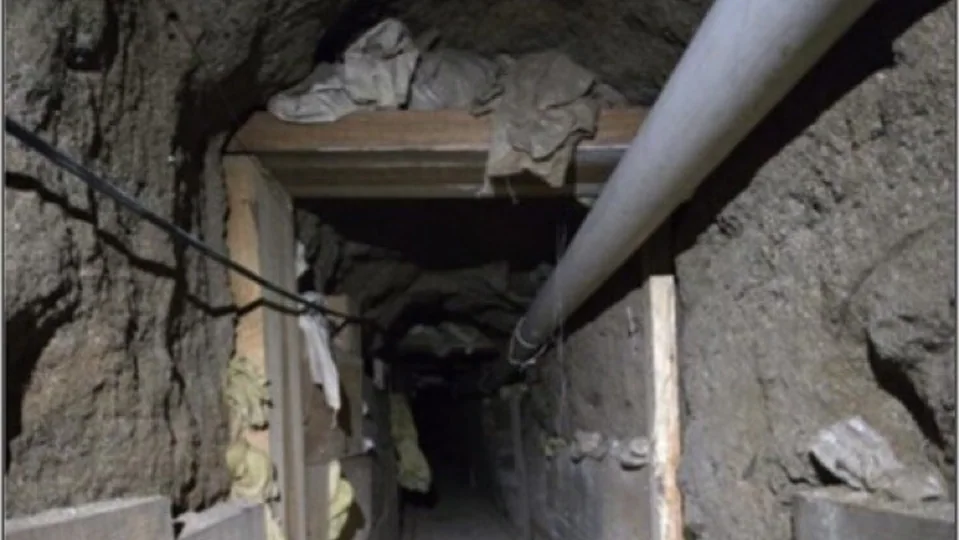
A Mexican engineer accused of designing and constructing a sophisticated underground drug-smuggling tunnel for the Jalisco New Generation Cartel (CJNG) has been indicted by a federal grand jury in California. The US Department of Justice announced on October 29, 2026, that Luis Manuel Hernandez Victoria, also known as “El Ingeniero”, faces four federal charges linked to an alleged cross-border narcotics operation connecting Tijuana, Mexico, with San Diego, California.
Prosecutors allege that Hernandez Victoria helped design and build the tunnel to enable the cartel to transport controlled substances into the United States. The passageway, discovered beneath a retail property near the Otay Mesa Port of Entry in May 2026, was equipped with reinforced walls, rail systems, ventilation and electricity.
Authorities said more than one ton of cocaine, estimated to be worth over $45 million, was seized when the tunnel was discovered. Hernandez Victoria is the seventh person charged in connection with the investigation, which involves several US law enforcement agencies and forms part of the federal government’s broader effort to target transnational criminal organisations. :chatgpt-content-reference{index=”0″}
Who Is Luis Manuel Hernandez Victoria, Also Known as El Ingeniero?
Luis Manuel Hernandez Victoria is a Mexican national accused by US prosecutors of playing a technical role in the CJNG’s cross-border drug-smuggling activities. Known by the nickname “El Ingeniero”, meaning “the Engineer”, he is alleged to have been responsible for designing and constructing an underground passageway used by the cartel to move narcotics from Mexico into the United States.
The US Department of Justice identified Hernandez Victoria as a 60-year-old man from Guadalajara, Mexico. The indictment also lists the aliases “El Inge” and “Nalgon” alongside “El Ingeniero”. Prosecutors allege that his engineering expertise helped create a tunnel with infrastructure intended to support the movement of drugs beneath the international border. :chatgpt-content-reference{index=”1″}
Mexican authorities had announced his arrest on October 16, saying he was detained a day earlier in Zapopan, in the state of Jalisco. According to Mexico’s Defence Ministry, the operation involved the National Guard, the Mexican Army and the Attorney General’s Criminal Investigation Agency. Authorities said weapons, drugs and a vehicle were seized during the operation.
Mexico’s Defence Ministry described him as a key member of the CJNG who was allegedly involved in designing and constructing cross-border tunnels, particularly in the Tijuana area. The US indictment subsequently connected him to the specific tunnel discovered in San Diego in May. :chatgpt-content-reference{index=”2″}
How the CJNG Cross-Border Drug Tunnel Was Discovered
The investigation centres on a tunnel discovered on May 29, 2026, beneath a retail property at 2498 Roll Drive, Suite E, in San Diego. The location was near the Otay Mesa Port of Entry and was identified as the former “Buy 4 Less” store.
According to the indictment, the underground passageway extended from Tijuana, in the Mexican state of Baja California, to the retail property in San Diego. Its location near a major border crossing placed it within an area where cross-border movement and commercial activity are significant parts of the local landscape.
Federal prosecutors allege that the tunnel was constructed for the benefit of the Cártel de Jalisco Nueva Generación. The passageway was not described as a simple underground opening. Investigators reported a system with reinforced structural walls, a rail installation, ventilation equipment and electrical infrastructure.
These features are central to the prosecution’s allegation that the passageway was a deliberately engineered smuggling route. Its construction would have required more than digging a narrow passage beneath the border, according to the details released by federal authorities. The indictment identifies Hernandez Victoria as the alleged engineer behind its design and construction. :chatgpt-content-reference{index=”3″}
Inside the 1,933-Foot Underground Passageway
Federal authorities estimated that the tunnel measured approximately 1,933 feet in length, reached a depth of around 55 feet and had a height of about 4.5 feet. Its dimensions and reported infrastructure indicate the scale of the underground construction involved in the alleged smuggling operation.
The passageway’s reinforced walls were intended to provide structural support, while its ventilation system and electrical equipment formed part of the tunnel’s internal infrastructure. Prosecutors also identified rail systems inside the passageway, another feature that distinguished it from a basic underground excavation.
The tunnel’s reported length of nearly 2,000 feet illustrates the logistical challenge involved in constructing a route beneath an international border. Its depth and internal installations also form part of the evidence described by authorities as they pursue allegations against those connected to the operation.
However, the details released by prosecutors do not establish that Hernandez Victoria personally carried out every stage of the construction. The indictment alleges that he designed and constructed the tunnel for the cartel’s benefit. Those allegations will need to be tested through the federal court process. :chatgpt-content-reference{index=”4″}
More Than One Ton of Cocaine Seized During Tunnel Investigation
When authorities discovered the tunnel on May 29, they also seized more than one ton of cocaine. The US Department of Justice estimated the drugs’ street value at more than $45 million.
The seizure is a central part of the case because prosecutors allege that the underground passageway was used as a route for importing controlled substances into the United States. The cocaine seizure provides important context for the scale of the suspected trafficking operation, although the indictment against Hernandez Victoria concerns his alleged role in designing and constructing the tunnel and participating in related conspiracies.
The Justice Department has not described the tunnel investigation as closed. Hernandez Victoria is the seventh person charged in connection with the case, and authorities have said the investigation remains ongoing.
The discovery has also drawn attention to the use of underground infrastructure by organised criminal groups seeking to move drugs across the US-Mexico border. The allegations in this case highlight how technical expertise, construction capabilities and cross-border networks can become part of a wider narcotics operation. :chatgpt-content-reference{index=”5″}
Why the CJNG Designation Matters in the Federal Case
The indictment includes a charge of providing material support to a foreign terrorist organisation. This charge is connected to the US government’s designation of the Cártel de Jalisco Nueva Generación as a foreign terrorist organisation on February 20, 2025.
The designation provides the legal basis for prosecutors to pursue the material-support allegation under federal law. According to the Justice Department, Hernandez Victoria is accused of providing support to the organisation through his alleged work on the cross-border tunnel.
The designation does not mean that every person accused of having a connection to the cartel is automatically guilty of a terrorism-related offence. Prosecutors must establish the elements of the specific charge against the defendant in court.
In this case, the material-support allegation is one of four charges listed in the indictment. The remaining charges relate to the alleged construction or financing of a cross-border tunnel and conspiracies involving the use of the passageway and the importation of controlled substances. :chatgpt-content-reference{index=”6″}
Four Federal Charges Against Hernandez Victoria
A federal grand jury in San Diego returned an indictment charging Hernandez Victoria with four offences. The allegations cover both the construction of the tunnel and its alleged role in facilitating drug imports, as well as the accusation that he provided material support to a designated foreign terrorist organisation.
- Providing material support to a foreign terrorist organisation: Prosecutors allege that Hernandez Victoria provided support to the CJNG, which the US government designated as a foreign terrorist organisation in February 2025. The charge carries a maximum possible sentence of 20 years in prison and a fine of up to $500,000.
- Conspiracy to construct or finance a cross-border tunnel: This charge concerns the alleged agreement to construct or finance an underground passageway beneath the US-Mexico border. It carries a maximum possible sentence of 20 years in prison and a fine of up to $500,000.
- Conspiracy to use a cross-border tunnel to import controlled substances: Prosecutors allege that the tunnel was intended to facilitate the importation of controlled substances into the United States. This charge carries a maximum possible sentence of life imprisonment and a fine of up to $10 million.
- Conspiracy to import controlled substances: The final charge concerns an alleged agreement to bring controlled substances into the United States. It carries a maximum possible sentence of life imprisonment and a fine of up to $10 million.
The penalties listed by the Justice Department are maximum possible punishments, not sentences imposed on Hernandez Victoria. Any sentence would depend on the outcome of the court proceedings and applicable sentencing rules. :chatgpt-content-reference{index=”7″}
Multiple US Agencies Involved in the Investigation
The investigation has brought together federal, state and border enforcement agencies. The US Department of Justice identified Homeland Security Investigations, US Border Patrol, US Customs and Border Protection, the Drug Enforcement Administration, the Federal Bureau of Investigation, the San Diego County Sheriff’s Office and the California Department of Justice among the participating agencies.
Homeland Security Investigations is part of the US Department of Homeland Security and investigates cross-border criminal activity, including Drug Trafficking and smuggling networks. Its involvement in the case reflects the international dimension of the alleged operation and the need for cooperation between agencies working on both sides of the border.
Border Patrol and Customs and Border Protection are responsible for border enforcement and inspection functions, while the DEA investigates drug trafficking networks. The FBI also participates in federal investigations involving organised criminal activity and national security concerns.
The San Diego County Sheriff’s Office and the California Department of Justice are among the other agencies named by prosecutors. Their involvement reflects the multi-agency nature of the investigation into the tunnel and the alleged drug-smuggling activity associated with it. :chatgpt-content-reference{index=”8″}
Homeland Security Task Force Initiative Targets Cartel Networks
The Justice Department said the case is part of the Homeland Security Task Force initiative, a multi-agency effort established under Executive Order 14159. The initiative is intended to target criminal cartels, transnational organisations and smuggling networks.
Federal authorities have presented the indictment as part of a wider effort to pursue not only individuals accused of trafficking drugs but also people alleged to provide the technical and logistical support that makes such operations possible.
In a statement released alongside the indictment, US Attorney Adam Gordon said, “Hernandez engineered his own downfall.” Kevin Murphy, special agent in charge of Homeland Security Investigations in San Diego, said the indictment reflected the commitment of HSI and its task force partners to targeting transnational criminal organisations and those accused of building cross-border smuggling tunnels.
The case is being prosecuted by Assistant US Attorneys Michael Deshong and Jordan Arakawa in the Southern District of California. The investigation remains ongoing, according to the Justice Department. :chatgpt-content-reference{index=”9″}
What Happens Next in the Case?
Hernandez Victoria was arrested in Jalisco, Mexico, on October 15, 2026, according to the Justice Department’s account of publicly reported information. Mexican authorities said the arrest took place in Zapopan and that weapons and narcotics were seized during the operation.
The federal indictment announced on October 29 formally sets out the charges prosecutors intend to pursue in the United States. The case will proceed through the federal judicial system, where the prosecution must present evidence supporting the allegations.
The fact that a grand jury has returned an indictment does not establish guilt. An indictment is a formal accusation, and the defendant is presumed innocent unless and until proven guilty beyond a reasonable doubt in court.
The investigation’s wider implications may also depend on whether authorities identify additional people involved in the alleged tunnel operation. With Hernandez Victoria becoming the seventh person charged in connection with the discovery, the case remains part of an ongoing effort to investigate the network behind the passageway and the cocaine seizure.
Cross-Border Drug Tunnels Remain a Law Enforcement Challenge
The San Diego-Tijuana tunnel case highlights the challenges faced by authorities investigating organised drug-smuggling networks along the US-Mexico border. Underground passageways can create routes that are difficult to detect through ordinary border inspections, particularly when they are concealed beneath commercial or residential properties.
The tunnel described in the indictment had several features associated with substantial construction work, including reinforced walls, ventilation, electricity and rail infrastructure. Prosecutors allege that the engineering behind the passageway was part of a wider effort to support the CJNG’s drug-trafficking activities.
For investigators, identifying the people responsible for designing, financing and operating such infrastructure is an important part of understanding how smuggling networks function. The charges against Hernandez Victoria focus on that alleged technical role rather than treating the tunnel simply as an isolated discovery.
The seizure of more than one ton of cocaine, the indictment of a suspected engineer and the involvement of multiple law enforcement agencies make the investigation a significant cross-border drug-trafficking case. Its outcome will depend on the evidence presented in court and the progress of the continuing investigation.
For now, Hernandez Victoria faces four federal charges in California over his alleged role in the construction and use of a tunnel linked to the CJNG. Prosecutors have outlined the potential penalties, but the allegations remain unproven as the case moves through the US legal system.
For breaking news and live news updates, like us on Facebook or follow us on Twitter and Instagram. Read more on Latest World on thefoxdaily.com.






COMMENTS 0