Introduction: When a Crematorium Becomes a ContentFarm
On June 27, 2026, Tamil cinema lost one of its mostbeloved architects. K. Bhagyaraj filmmaker, actor, screenwriter, and the manwho made middle-class Tamil families the heroes of their own love stories passed away in Chennai following a cardiac arrest. He was 73. Within hours,dignitaries, colleagues, and fans gathered to pay their respects. ChiefMinister Vijay, opposition leader Stalin, and superstars Rajinikanth and KamalHaasan all attended the state funeral held on June 28 at Besant Nagar crematoriumin Chennai.
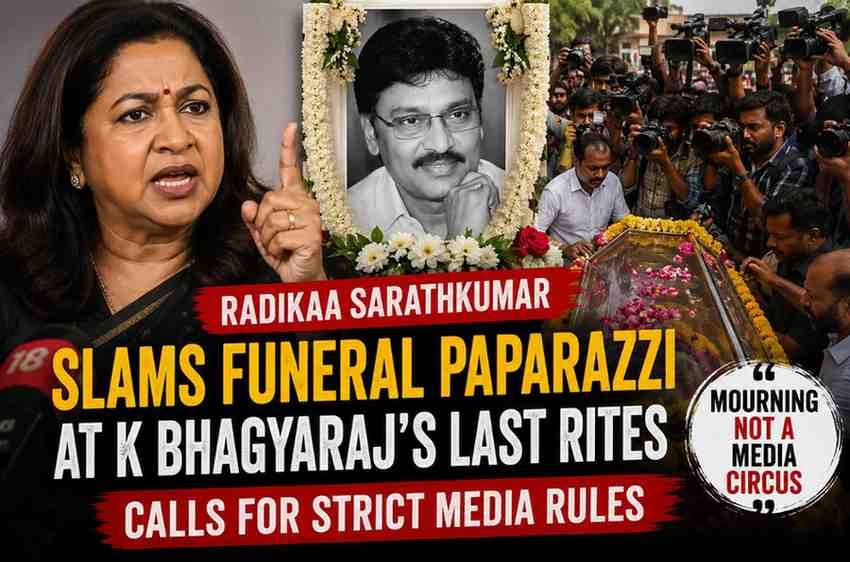
But alongside the mourners came something elseentirely: cameras. Jostling, zooming, clicking not to document history, butto harvest grief for views and engagement. And when veteran actress RadikaaSarathkumar, a 50-year friend of the late filmmaker, witnessed photographerszooming in on the tear-streaked faces of Bhagyaraj’s family members, she didnot stay silent.
Her response a video posted to Instagram and ablistering statement on X has sparked the most concrete conversation Tamilcinema has had about media ethics, grief, and the right to mourn in peace. Thisis not just a story about one funeral. It is about a broken system, a patternof exploitation, and the moment one woman decided to demandaccountability.
Who Was K. Bhagyaraj? Understanding the Weight ofThis Loss
To understand why the violation at his funeral feltso acute, you first have to understand who K. Bhagyaraj was and what he meantto Tamil cinema and its audiences.
Born Krishnaswamy Bhagyaraj on January 7, 1953, inVellankoil near Gobichettipalayam, he came from modest origins. He began hisjourney in cinema as an assistant to the legendary director Bharathiraja,learning the grammar of storytelling from one of the best. He made hisdirectorial debut with Suvarilladha Chiththirangal in1979, and over the next decade, he constructed a body of work that was unlikeanything Tamil cinema had seen before.
Bhagyaraj wrote, directed, and often acted in filmsthat placed ordinary people bus conductors, tenants, tutors, middle-classfathers at the centre of meaningful narratives. His most iconic works includeMundhanai Mudichu (1983), Andha 7Naatkal (1981), Alaigal Oivathillai (1981),Chinna Veedu (1985), and Oru KaidhiyinDiary. He directed over 25 films and appeared in more than 75 avolume of output matched by very few creator-performers in Indian cinemahistory.
What made him singular was not just quantity butquality of intention. His scripts were witty, layered with double meanings, anddeeply empathetic to women. He introduced actress Urvashi to Tamil audiencesthrough Mundhanai Mudichu, creating one of the earliestpsychologically complete, agency-driven female characters in commercial Tamilcinema. His dialogue entered everyday Tamil speech. His song placementscrafted in close collaboration with composer Ilaiyaraaja were architecturalrather than decorative; each lyric a plot device, each tune acallback.
He received the Filmfare Award for Best Actor(Tamil) for Mundhanai Mudichu and the Tamil Nadu StateFilm Award for Best Dialogue Writer for Puthiya Vaarpugal.His screenplay for Mundhanai Mudichu was remade in Hindias Masterji starring Rajesh Khanna — a massive box-officesuccess that introduced his sensibility to national audiences. He even directedAakhree Raasta starring Amitabh Bachchan, cementing hisreputation beyond the Tamil-speaking world.
In short: this was not a routine farewell. This wasTamil cinema saying goodbye to one of the people who shaped what Tamil cinemacould be.
What Happened at the Funeral: The PaparazziProblem
The cremation on June 28, 2026, was attended by thewho’s who of Tamil Nadu political leaders, film industry veterans, andthousands of fans who had grown up with Bhagyaraj’s films. Radikaa Sarathkumar,who had shared a five-decade friendship with him, was among the very first toreach his home after the news broke. She helped the family coordinate thetransfer of his mortal remains from the hospital.
What she encountered, both at the hospital and thecrematorium, left her shaken. Photographers and video crews jostled forposition, zooming their lenses directly onto the faces of grieving familymembers capturing private tears, private collapses, private moments of lossfor public consumption. It was not documentation. It was extraction.
Radikaa filmed part of the confrontation and postedit to Instagram. Then she posted a statement on X that was as clear as it wasdamning.
“Funeral paparazzi and grief onlookers shouldbe booked. This is so sad. A place where all needed to digress and mourn insilence turned into a circus.”
Radikaa Sarathkumar, June 29, 2026
She went further, identifying the structuralproblem beneath the individual behavior: “With the influence ofsocial media and the race to deliver news instantly… competing over whoreports first, who zooms in more on people’s grief, and who can attract moreviewers with dramatic captions, one cannot help but wonder whether society ismoving towards a state where it is unable to respect genuine human emotions andlacks empathy and understanding.”
Her demands were specific and serious. She calledon both the Tamil Nadu government and the Tamil film industry to jointly draftbinding protocols for media conduct at public funerals. She called for a formalrestraining order system — a legal mechanism to keep cameras at a respectfuldistance during final rites.
This Is Not the First Time: A Pattern Tamil CinemaCannot Keep Ignoring
The fury surrounding K. Bhagyaraj’s funeral did notemerge from nowhere. It is the latest and most loudly protested episode ina disturbing pattern of Tamil media converting grief into clickablecontent.
| Incident | Year | Nature of Violation | Industry Response |
|---|---|---|---|
| Vijay Antony’s daughter’s death by suicide (age16) | September 2023 | Channels livestreamed the grave being dug; outletspublished the child’s photograph; media speculated live about reasons forsuicide | Nadigar Sangam issued statement; Behindwoodspublicly apologised and announced a blanket policy against covering celebrityfunerals |
| Manoj Bharathi’s funeral (son of directorBharathiraja) | March 2025 | Intrusive media coverage of a private familyfuneral; cameras in grieving faces | Tamil Film Active Producers Association issued astrong condemnation |
| K. Bhagyaraj’s state funeral | June 2026 | Paparazzi zoomed in on family members’ tears;jostling and disruption during cremation | Radikaa Sarathkumar’s public call for a legalrestraining order mechanism and binding government-industryprotocols |
The cycle has been the same each time: publicoutrage, industry condemnation, promises of restraint, and then silence untilthe next funeral. What makes the Bhagyaraj case different is the specificity ofRadikaa’s demand. She is not asking the media to “be more sensitive.”She is asking for law.
Why Does This Keep Happening? The Economics ofGrief Content
Understanding why funeral paparazzi exist requiresunderstanding what drives them. The answer, unsatisfyingly, isclicks.
In the current social media landscape, footage ofpublic grief particularly of famous faces showing raw, unguarded emotion performs exceptionally well across platforms. A close-up of a superstar weepingat a colleague’s funeral generates engagement that no scripted promotionalcontent can match. The algorithmic incentives reward emotional extremity, andgrief is among the most extreme emotions visible to a camera.
This has created a perverse economy where mediaoutlets and individual content creators compete not just to cover funerals, butto extract the most emotionally intense footage from them. The first outlet topost a close-up of a crying celebrity wins the morning’s click race. The factthat this footage is obtained by invading the private grief of real humanbeings including children, elderly parents, and spouses is, in the coldcalculus of engagement metrics, an irrelevant consideration.
Radikaa named this dynamic with precision. When sheasked whether society is “moving towards a state where it is unable torespect genuine human emotions,” she was identifying something deeper thanbad behavior by individual photographers. She was describing a structuraldehumanization a media ecosystem that has monetized the worst moments ofother people’s lives.
The Legal and Ethical Gap: What India’s Laws Doand Don’t Cover
India currently has no specific legislationgoverning media conduct at funerals. The Press Council of India and the NewsBroadcasters and Digital Standards Authority have issued general guidelinesabout privacy and dignity in coverage, but these are advisory in nature andcarry no enforcement teeth. Violations result, at most, in public criticism which, as the pattern above demonstrates, has not been an effectivedeterrent.
Radikaa’s call for a “restraining order”mechanism is legally interesting. In practice, this would likely require eitheran amendment to existing privacy laws or a new category of regulation something akin to the “exclusion zones” that exist in somejurisdictions around courthouses or protest areas, applied to funeral venues.It would require coordination between the Tamil Nadu state government, theUnion government’s information and broadcasting ministry, and the film industry’sown regulatory bodies.
This is ambitious. But it is not impossible. And itmay be the only thing that actually breaks the cycle.
Radikaa Sarathkumar’s Moral Authority on ThisIssue
It matters that this particular demand is comingfrom this particular person. Radikaa Sarathkumar is not an outsider to theTamil film industry making an uninformed critique. She is a veteran actress anda respected voice within the industry, someone who knew K. Bhagyaraj personallyfor five decades long before either of them was famous. She was present atthe hospital. She helped move his remains. She stood with the family throughthe most private hours of their loss.
Her critique, therefore, is not abstract. Shewitnessed the violation. She was part of the family circle that was violated.And she chose to use her platform not to simply express anguish, but to convertthat anguish into a concrete policy demand.
This is what sets her response apart from the manycelebrity statements that follow such incidents. Most condemnations in thesesituations are emotional and ephemeral expressions of disgust that fadewithin the news cycle. Radikaa’s statement contains a demand with legalspecificity: binding protocols, a restraining order mechanism, coordinatedgovernment-industry action. It is advocacy, not just expression.
The Larger Question: What Do We Owe theGrieving?
At the core of this controversy is a question aboutthe limits of public life. K. Bhagyaraj chose, through decades of creativework, to be a public figure. He directed, acted, and wrote stories for publicconsumption. His life was, in meaningful ways, a public life.
But death is not a continuation of that publiclife. It is the end of it. And the grief of the people who loved him hisfamily, his close friends, his colleagues of five decades was never, in anysense, a public act. They did not choose public grief. They had no choice ingrief at all.
The paparazzi who zoomed their lenses into thefaces of Bhagyaraj’s weeping family made a choice that the family could not.They chose to convert private loss into public spectacle. And the platforms andoutlets that published and amplified that footage made the same choice,downstream.
This is not a matter of taste or journalisticphilosophy. It is a matter of basic human dignity. The right to grieveprivately even for people who have lived publicly should be the default.The onus should be on those who wish to intrude to justify their intrusion, noton the grieving to defend their privacy.
A Tribute Within the Controversy: RememberingBhagyaraj Through Radikaa’s Eyes
Amid her sharp critique of media behavior, Radikaadid not lose sight of why she was there. Her statement included a tribute tothe man she had just lost one that reveals as much about Bhagyaraj as it doesabout their friendship.
She described him as “a great creator, anevolved writer, and someone who drew wonderful boundaries in cinema.” Sheremembered him as someone who “stood by her family in a quiet and loyalway” a phrase that speaks to a friendship built not on industrynetworking but on genuine human connection.
The irony, of course, is profound. A man whosedefining quality was the creation of dignified, humane boundaries — in hisfilmmaking, in his relationships was given a farewell in which every boundarywas violated. Radikaa made sure that the record reflects both the violation andthe man it violated.
What Needs to Happen Next: Concrete StepsForward
The conversation Radikaa has forced open deservesto result in something more durable than this news cycle. Based on the patternof incidents and the nature of the demands being made, several concrete actionsare both feasible and overdue.
The Tamil Nadu government should convene a formalworking group including representatives from the film industry, journalismbodies, legal experts, and civil society to draft enforceable guidelines formedia conduct at public funerals. These guidelines should include definedexclusion zones, mandatory accreditation requirements, and penalties forviolations that go beyond public censure.
The Tamil film industry’s own bodies the NadigarSangam, the Tamil Film Active Producers Association, and similar organizations should collectively refuse to provide access to industry events for outletsand individuals who have violated funeral privacy standards. This is a form ofsocial enforcement that does not require legislation and can be implementedimmediately.
Media outlets themselves particularly those whohave already acknowledged past failures, like Behindwoods should formalizetheir existing commitments into published editorial policies. A stated policyof non-coverage of private grief moments, consistently applied, would both seta standard and hold the outlet accountable.
And finally, individual media consumers theaudience whose engagement ultimately funds the click economy bear someresponsibility too. Choosing not to watch, share, or engage withgrief-exploitation content is a small act with collective consequence.
Conclusion: Grief Is Not Content And TamilCinema Must Make That Binding
K. Bhagyaraj spent four decades creating art thathonored ordinary human experience the dignity of the mundane, the beauty ofeveryday emotion, the worth of people who would never make headlines. His filmsinsisted that middle-class Tamil lives deserved the full depth of cinematictreatment. He believed, in his bones, that people’s inner livesmattered.
The paparazzi at his funeral believed the opposite.They believed that the inner lives of grieving people are raw material footage to be harvested, packaged, and sold.
Radikaa Sarathkumar has made the conflict explicit.She has named it, documented it, and issued a demand that it be resolvedthrough law and policy rather than left to individual decency. Given thethree-year pattern of violations, individual decency has been demonstrated tobe insufficient.
The question now is whether the Tamil film industryand the Tamil Nadu government have the will to act or whether they will wait,as they have before, for the next funeral and the next wave ofoutrage.
Bhagyaraj’s legacy is a cinema of human dignity.The least his industry can do is extend that dignity to the people who mournhim and to every family that comes after.
Tamil cinema has celebrated him. Nowit must honor him. The camera should have no business in a grieving family’stears. It is time to make that law.
For breaking news and live news updates, like us on Facebook or follow us on Twitter and Instagram. Read more on Latest Entertainment on thefoxdaily.com.



COMMENTS 0